
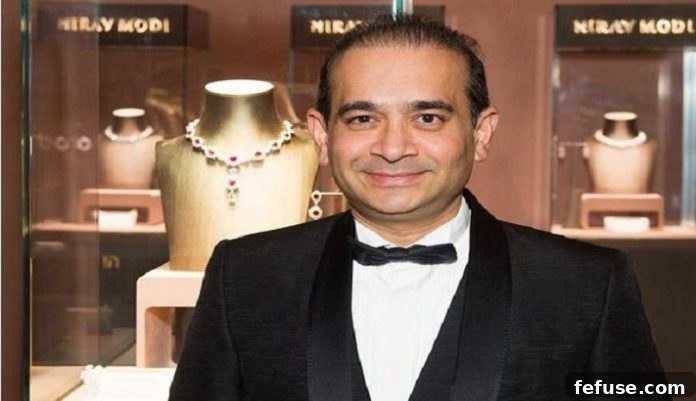
India’s Relentless Pursuit: Landmark Asset Seizure in Nirav Modi and Mehul Choksi PNB Fraud Case Signals New Era of Accountability
In a significant and highly anticipated development, Indian officials have successfully seized a vast collection of diamonds, pearls, and other valuable jewelry, estimated to be worth an astounding $177 million. These assets are directly linked to fugitive billionaire Nirav Modi and his uncle, Mehul Choksi, the primary accused in the infamous Punjab National Bank (PNB) fraud. This landmark confiscation underscores India’s fortified resolve to tackle high-profile economic crimes and bring absconding offenders to justice, demonstrating a pivotal moment in the nation’s financial law enforcement.
The recent court-approved confiscation represents a monumental first under the stringent provisions of the Fugitive Economic Offenders Act (FEOA). This critical legislation, which came into force just two years ago, empowers Indian authorities to attach and confiscate properties of individuals who have fled the country after committing significant financial offenses. The successful application of FEOA in this high-profile case sets a powerful precedent, indicating a more aggressive and effective strategy against those who attempt to evade the legal system.
The seized assets include a staggering 108 packages, which are alleged to have been illicitly dispatched to Dubai by firms operated by both Modi and Choksi. These packages alone carried an immense weight exceeding 2,300 kg, highlighting the sheer scale and audacity of the alleged fraudulent operations. Beyond the precious stones and metals, authorities have also successfully confiscated several other substantial properties belonging to Nirav Modi, notably including a sprawling farmhouse and a functional windmill. These comprehensive seizures reflect the breadth of the investigative efforts and the far-reaching powers granted by the FEOA.
Unpacking the Fugitive Economic Offenders Act (FEOA): A Game Changer
The enactment of the Fugitive Economic Offenders Act (FEOA) in India was a direct and necessary response to a growing national concern: high-net-worth individuals committing large-scale financial frauds and then absconding from the country, often relocating their illicit wealth abroad. Prior to FEOA, the legal framework for recovering such assets and compelling offenders to face trial was often protracted and less effective, allowing many to enjoy their ill-gotten gains with relative impunity. The FEOA was designed to close these loopholes, offering a more robust and proactive legal mechanism.
Under the FEOA, an individual can be declared a ‘fugitive economic offender’ if two key conditions are met: firstly, an arrest warrant must have been issued against them for specific economic offences involving a threshold amount of 100 crore rupees (approximately $13 million USD or more); and secondly, they must have either left India to avoid criminal prosecution or, being abroad, have refused to return to face prosecution. Once an individual is officially declared a fugitive economic offender, the Act grants the government extensive powers to attach and confiscate all their properties, irrespective of whether these properties are directly derived from the proceeds of crime or are legitimate assets. A crucial aspect of the FEOA also prevents such individuals from filing or defending any civil claims in Indian courts, thereby isolating them legally within the country.
The recent court approval for asset confiscation in the Nirav Modi case is not just a procedural step but a landmark validation of the FEOA’s practical utility. It sends an unequivocal message to other potential economic offenders: fleeing the country will neither shield them from criminal prosecution nor protect their assets. This particular action serves as a powerful deterrent, demonstrating the Indian government’s unwavering resolve to fully operationalize this significant piece of legislation, ensuring accountability and justice, even for those who attempt to place themselves beyond the immediate reach of Indian law.
The PNB Fraud: A Deeper Dive into the $1.85 Billion Deception
At the core of this expansive saga lies the monumental $1.85 billion fraud that rocked the state-owned Punjab National Bank (PNB), one of India’s most venerable and largest public sector banks. This intricately planned scheme, allegedly masterminded and executed by Nirav Modi and his uncle Mehul Choksi, came to public light in early 2018, triggering widespread alarm across India’s financial sector and prompting urgent calls for enhanced regulatory oversight and internal control mechanisms within banks.
Who are Nirav Modi and Mehul Choksi?
Nirav Modi, aged 49, was once celebrated as an internationally acclaimed luxury diamantaire. His eponymous brand garnered significant global recognition, attracting celebrity endorsements and establishing high-end boutique stores in some of the world’s most prestigious fashion capitals. His uncle, Mehul Choksi, 60, was the driving force behind Gitanjali Gems, another formidable jewelry retail chain with a substantial presence across India. Both individuals meticulously leveraged their considerable influence and prominent positions within the diamond and jewelry trade to allegedly orchestrate the fraudulent activities, weaving an intricate web of shell companies, fictitious transactions, and complex financial maneuverings.
The Elaborate Modus Operandi of the Fraud
The alleged fraud primarily revolved around the insidious misuse of Letters of Undertaking (LoUs) and Foreign Letters of Credit (FLCs). An LoU functions as a bank guarantee issued by one bank to another on behalf of its client, promising payment for a specified transaction. In this meticulously planned scheme, corrupt officials at PNB’s Brady House branch in Mumbai are accused of fraudulently issuing numerous LoUs and FLCs to overseas branches of other Indian banks. These instruments were ostensibly for facilitating the import of foreign goods, primarily diamonds and pearls, for Modi’s and Choksi’s associated companies. However, these transactions were reportedly conducted without the necessary collateral, deliberately bypassing PNB’s core banking system, and critically, without the knowledge or approval of senior bank management.
The fraudulently obtained LoUs and FLCs were then allegedly utilized to secure short-term credit from the overseas branches of other Indian banks. These banks, operating under the mistaken belief that the instruments were fully backed by PNB’s robust guarantee, extended credit. Crucially, the substantial funds acquired through this illicit method were purportedly not used for genuine trade or legitimate business expansion. Instead, they were allegedly diverted to settle pre-existing debts of Modi’s and Choksi’s companies, thereby perpetuating a continuous and expanding cycle of debt and systematic deception. This elaborate and long-running scheme managed to evade detection for several years, ultimately accumulating an astronomical liability for Punjab National Bank.
The Flight, Capture, and Protracted Legal Battles
As the colossal scale of the PNB scandal began to surface and unravel in early 2018, both Nirav Modi and Mehul Choksi swiftly fled India, effectively transforming into two of the nation’s most sought-after economic fugitives. Their sudden escape triggered an intensive international manhunt and prompted significant diplomatic efforts by the Indian government to secure their much-needed extradition.
Nirav Modi’s Complex Extradition Saga
Nirav Modi was eventually located in London and subsequently arrested in March 2019, following a formal arrest warrant issued by the UK authorities at the direct request of India. Since his initial arrest, Modi has remained incarcerated in a London prison, vigorously contesting his extradition to India. There, he faces an extensive array of severe charges, including large-scale fraud, money laundering, and criminal conspiracy. His legal defense team has consistently argued against his extradition, frequently citing concerns regarding the conditions of Indian prisons and potential impacts on his mental health. The extradition hearing, a complex legal battle that has experienced multiple delays and appeals, is slated to resume next month, maintaining global attention on whether he will ultimately be brought back to India to face the full force of the law.
Mehul Choksi’s Antiguan Asylum
Mehul Choksi, taking a different route, fled to the Caribbean nation of Antigua and Barbuda, where he had acquired citizenship in 2017 through the country’s Citizenship by Investment Program. This strategic move has significantly complicated India’s efforts to extradite him, as Antigua and Barbuda operates under its own sovereign legal processes and international obligations. India has submitted numerous formal requests for his extradition, but Choksi has consistently invoked health issues and cited various legal protections afforded under Antiguan law to vehemently resist these attempts. This has resulted in a protracted and intricate legal battle within the Caribbean nation, positioning his case as a complex and ongoing diplomatic and legal challenge for Indian authorities.
India’s Broader Campaign Against Financial Impunity
The concerted efforts to seize assets and pursue the extradition of high-profile fugitives like Nirav Modi and Mehul Choksi are integral components of a much larger, invigorated campaign by the Indian government to systematically crack down on financial impunity. The PNB fraud, alongside a series of other high-profile cases involving economic offenders, critically exposed significant vulnerabilities within the banking system and prompted an urgent and robust legislative and enforcement response from the government.
Beyond the transformative Fugitive Economic Offenders Act (FEOA), India has also been actively engaged in strengthening its international cooperation frameworks. This includes diligently signing new extradition treaties and mutual legal assistance treaties with various countries worldwide. These agreements are meticulously designed to facilitate not only the swift return of economic offenders but also the crucial recovery of stolen assets that have been siphoned abroad. The message being conveyed by the Indian state is unequivocally clear: it will relentlessly pursue those who defraud its financial institutions and attempt to evade justice, regardless of their chosen refuge across international borders.
The successful confiscation of assets in the Modi-Choksi case serves as a profoundly powerful deterrent. It unequivocally demonstrates that the long arm of the law can indeed extend beyond national borders to reclaim illicit wealth, even when the primary culprits themselves remain outside India’s direct jurisdiction. This proactive and assertive approach is absolutely vital for rebuilding public trust in the integrity of the financial system, effectively deterring future instances of large-scale fraud, and unequivocally reinforcing the fundamental principle that no individual, regardless of their wealth or influence, is above the law. As the intricate legal battles continue to unfold, these significant asset seizures stand as a tangible and symbolic victory in India’s enduring struggle for comprehensive financial accountability and justice.