
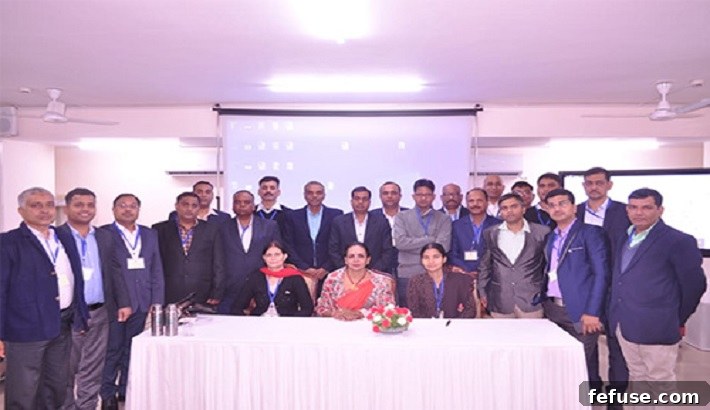
Empowering Border Security: GJEPC’s Gemstone Training Elevates Customs & Excise Expertise in Jaipur
In a significant move to bolster national economic security and refine expertise within critical government departments, the Jaipur Regional Office of The Gem & Jewellery Export Promotion Council (GJEPC), in strategic collaboration with the esteemed Gem Testing Laboratory (GTL) Jaipur, successfully organized a comprehensive and complimentary training session titled “Introduction to Gemstones.” This vital three-day program, specifically tailored for officers of the Customs and Excise department, took place at the prestigious National Academy of Customs, Indirect Taxes & Narcotics (NACIN), Jaipur, commencing on January 22, 2020. The initiative underscores GJEPC’s unwavering commitment to fostering skill development and maintaining the integrity of India’s vibrant gem and jewellery sector.
Coordinated with the invaluable leadership and insight of Addl. Director General, Ms. Simmi Jain, the session was meticulously designed to equip participants with an in-depth understanding of the fundamental features, intrinsic characteristics, and crucial valuation parameters inherent to coloured gemstones. A primary objective was to significantly enhance their practical identification skills, empowering them to accurately assess and differentiate various types of gemstones encountered in their line of duty. This proactive training is pivotal for safeguarding against illicit trade practices, ensuring accurate duty assessments, and upholding the ethical standards that define the global gem industry.
Safeguarding Borders and Revenue: Why Gemological Acumen is Indispensable for Customs Officers
The intricate world of gemstones, characterized by high value, diverse origins, and often subtle differences, presents unique challenges for Customs and Excise officers. The potential for misdeclaration, undervaluation, and the illicit smuggling of high-value gems poses a substantial threat to national revenue and economic stability. Without specialized knowledge, differentiating between natural and synthetic stones, identifying various treatments, or accurately assessing the value of a gemstone can be exceedingly difficult. This specialized training bridges that critical knowledge gap, transforming theoretical understanding into practical, actionable expertise.
- Accurate Valuation for Duty Assessment: Proper identification and valuation are paramount for correct duty and tax collection, directly impacting national exchequer.
- Detection of Illicit Trade: High-value, compact nature of gemstones makes them susceptible to smuggling. Enhanced knowledge enables officers to identify and intercept such activities more effectively.
- Identification of Undeclared Materials: Distinguishing between natural, synthetic, treated, or imitation gemstones is crucial to prevent fraudulent declarations and ensure fair trade.
- Combating Fraud and Misdeclaration: Equipping officers with gemological insights empowers them to detect and prevent sophisticated schemes involving false declarations.
- Ensuring Compliance with International Trade Regulations: Adherence to global standards for disclosure and classification is vital for India’s reputation in international trade.
- Protecting the Integrity of India’s Gem & Jewellery Brand: By maintaining strict vigilance, officers contribute to upholding the quality and authenticity associated with Indian-sourced or processed gems.
Pioneering Excellence: The Collaborative Force of GJEPC and Gem Testing Laboratory Jaipur
The Gem & Jewellery Export Promotion Council (GJEPC) stands as the apex body of India’s gem and jewellery export industry, established by the Ministry of Commerce & Industry, Government of India. Its extensive mandate includes promoting exports, facilitating industry growth, advocating for policy reforms, and, critically, fostering education and skill development across the sector. GJEPC’s role in organizing such training sessions reflects its commitment to not just economic prosperity but also ethical practices and regulatory compliance within the trade.
Complementing GJEPC’s leadership is the Gem Testing Laboratory (GTL) Jaipur, renowned for its scientific expertise, advanced testing methodologies, and unwavering commitment to accuracy and impartiality in gem certification. GTL Jaipur provides crucial analytical services, ensuring the authenticity and correct classification of gemstones. The laboratory’s practical, hands-on knowledge in gem identification and appraisal is an invaluable asset, making them the ideal partner to deliver the technical aspects of this specialized training. This synergy between GJEPC’s industry oversight and GTL’s scientific proficiency creates a robust framework for knowledge dissemination.
A Deep Dive into the World of Gems: The Comprehensive Training Module
The three-day “Introduction to Gemstones” session was meticulously structured to provide a blend of theoretical knowledge and practical application. Under the expert coordination of Ms. Simmi Jain, the curriculum moved beyond basic definitions to immerse participants in the multifaceted aspects of gemology, essential for precise identification and valuation in their daily operations.
Core Gemological Concepts: Understanding the Building Blocks
The initial phase of the training focused on familiarizing officers with the fundamental physical and optical properties that define and distinguish gemstones. This foundational knowledge is critical for understanding why and how different gems behave under various tests.
- Physical Properties: Detailed explanations of Mohs hardness scale, specific gravity, refractive index, luster, cleavage, and fracture characteristics unique to various gemstones.
- Optical Properties: An exploration of how light interacts with gems, covering color (hue, tone, saturation), pleochroism (color variation with viewing angle), dispersion (fire), and luminescence (fluorescence under UV light).
- Crystal Systems and Formation: A basic overview of the geological processes and crystalline structures that lead to the formation of different gem materials.
- Common Gemstone Families: Introduction to key coloured gemstones such as Ruby, Sapphire, Emerald, Topaz, Garnet, Amethyst, Tourmaline, and Aquamarine, highlighting their distinct features and common sources.
Mastering Identification Techniques and Tools
Beyond theoretical understanding, the training emphasized hands-on experience with standard gemological instruments, enabling officers to perform preliminary identifications effectively.
- Visual Inspection: Practical guidance on using the naked eye and a 10x jeweler’s loupe to observe internal characteristics (inclusions) and external blemishes.
- Refractometer: Training on how to accurately measure the refractive index, a crucial optical property for differentiating gems.
- Specific Gravity Hydrostatic Balance: Demonstrations on determining the density of a gemstone through hydrostatic weighing.
- Spectroscope: Introduction to analyzing absorption spectra, which can reveal the elemental composition and identity of a stone.
- Polariscope & Dichroscope: Usage for identifying optic character (singly or doubly refractive) and pleochroism.
- Microscope: Techniques for examining internal growth patterns and specific inclusions that can indicate a gem’s origin or treatment.
- UV Lamp: Practical application for observing fluorescence, another key diagnostic feature.
The Nuances of Gemstone Valuation
Accurate valuation is critical for revenue collection and preventing illicit trade. The session delved into the complex factors that influence a gemstone’s market value.
- The 4 Cs (and beyond):
- Color: The most significant factor for coloured gemstones, including hue, tone, and saturation.
- Clarity: The presence or absence of internal inclusions and external blemishes, and their impact on value.
- Cut: The shape, proportions, and finish of a gem, influencing its brilliance and overall appeal.
- Carat Weight: The standard unit of weight for gemstones, with larger stones often commanding a premium due to rarity.
- Origin: The geographical source of a gem can significantly influence its value due to historical reputation (e.g., “Burmese Ruby,” “Colombian Emerald”).
- Treatments: Understanding various gem treatments (heating, oiling, dyeing, fracture filling, irradiation, diffusion) and their impact on value and disclosure requirements.
- Market Trends: Awareness of current supply, demand, and consumer preferences influencing gemstone prices.
Navigating the Complexities: Synthetics, Simulants, and Treatments
One of the most challenging aspects for Customs officers is distinguishing between natural gems and their often-convincing imitations or altered versions. This module provided vital insights into these distinctions.
- Synthetics: Lab-grown gemstones possessing the same chemical and physical properties as their natural counterparts (e.g., synthetic ruby, sapphire, emerald). The training focused on identifying subtle diagnostic features unique to synthetic growth.
- Simulants: Materials that visually resemble natural gems but are chemically and structurally different (e.g., glass, cubic zirconia, YAG, strontium titanate). Officers learned to differentiate these using basic tests.
- Advanced Treatments: In-depth discussion on sophisticated treatments like lead-glass filling in rubies, clarity enhancement in emeralds, and various heating processes, along with methods to detect them.
- Disclosure Standards: Emphasizing the international and national standards for declaring treatments and synthetic origins to ensure transparency and prevent misrepresentation.
NACIN Jaipur: Fostering Expertise for National Economic Security
The National Academy of Customs, Indirect Taxes & Narcotics (NACIN) serves as the apex training institution for officers of the Indian Revenue Service (Customs & Indirect Taxes). Its mission is to develop highly skilled, ethical, and efficient public servants capable of enforcing complex economic laws. As such, NACIN Jaipur provided an ideal and strategically important venue for this specialized gemological training. The academy’s facilities and its focus on continuous professional development align perfectly with the objectives of the “Introduction to Gemstones” program, ensuring that officers receive instruction in a conducive and authoritative environment.
Strengthening India’s Global Position: The Far-Reaching Benefits of Specialized Gemological Training
India holds a pre-eminent position as a global leader in the gem and jewellery sector, being the second-largest exporter in the world. The integrity and efficiency of its import and export processes are crucial for maintaining this standing. By enhancing the gemological expertise of Customs and Excise officers, this training directly contributes to several vital aspects of national economic well-being and international trade reputation.
- Promoting Fair Trade: By rigorously enforcing regulations and accurately assessing goods, officers prevent illicit trade from undermining legitimate businesses and market stability.
- Boosting Consumer Confidence: Robust checks at borders assure international buyers and domestic consumers of the authenticity and fair value of Indian-traded gems, strengthening trust in the “Brand India” label.
- Optimizing Revenue Generation: Accurate valuation and classification directly lead to appropriate duty collection, contributing significantly to government revenues.
- Enhancing Economic Stability: A secure and well-regulated gem and jewellery sector supports countless livelihoods, from miners and cutters to designers and exporters, bolstering overall economic stability.
- Adapting to Industry Dynamics: The gem industry is constantly evolving with new treatments and synthetics. Continuous training ensures officers remain current with the latest developments and challenges.
Charting the Course Ahead: A Model for Sustained Collaboration and Skill Development
The successful execution of this “Introduction to Gemstones” training serves as a powerful testament to the effectiveness of collaborative initiatives between industry bodies and government agencies. It establishes a valuable precedent for ongoing skill development programs, highlighting the collective commitment to nurturing a transparent, compliant, and globally competitive gem and jewellery ecosystem. This model of cooperation can be replicated and expanded, potentially leading to advanced modules, refresher courses, and outreach to other key regions, ensuring that India’s customs framework remains robust and responsive to the evolving complexities of the global gem trade.
Conclusion: A Foundation for Future Vigilance and Growth
The complimentary training session on “Introduction to Gemstones,” spearheaded by GJEPC Jaipur and GTL Jaipur for Customs and Excise officers at NACIN, Jaipur, represents a critical investment in India’s economic integrity and the future of its gem and jewellery sector. By empowering these frontline officers with specialized gemological knowledge and practical identification skills, the initiative not only fortifies national borders against illicit trade and revenue leakage but also significantly enhances confidence in India’s commitment to fair and ethical global commerce. This collaborative effort lays a solid foundation for continuous vigilance, fostering a more secure, transparent, and prosperous environment for all stakeholders within the dynamic world of gemstones.
News Source: gjepc