
Unlocking Earth’s Ancient Secrets: GIA Scientist Dr. Karen Smit Leads Groundbreaking Research on Diamond Inclusions
Diamonds, often revered for their unparalleled beauty and rarity, are far more than exquisite gemstones. For scientists, these magnificent crystals serve as invaluable time capsules, preserving clues about the earliest chapters of our planet’s formation. A recent groundbreaking study, led by GIA (Gemological Institute of America) research scientist Dr. Karen Smit, has harnessed the unique properties of diamonds to shed new light on how the most ancient continents were constructed deep within the Earth. The findings, which represent a significant leap in our understanding of planetary evolution, were prominently featured in the esteemed Science magazine, in an article titled “Sulfur Isotopes in Diamonds Reveal Differences in Continent Construction.”
This pivotal research was the result of a powerful collaboration between leading institutions. Dr. Karen Smit spearheaded the effort, working alongside Steven B. Shirey and the late Erik H. Hauri from the Department of Terrestrial Magnetism at the Carnegie Institution for Science, and Richard A. Stern, a distinguished research scientist at the University of Alberta. Their collective expertise converged to meticulously analyze tiny mineral remnants, specifically sulfide inclusions, trapped within diamonds during the tumultuous processes of Earth’s early development. These microscopic samples, preserved flawlessly within the diamond matrix, offer an unprecedented glimpse into conditions that existed billions of years ago, providing tangible evidence of geological processes otherwise inaccessible to modern scientific inquiry.
“Diamonds are incredibly valuable, not just as symbols of luxury or cherished jewelry, but perhaps even more profoundly in the realm of geoscience,” explained Dr. Karen Smit, the lead author whose vision and dedication guided this ambitious project. “The mineral inclusions encased within diamonds act as direct messengers from Earth’s inaccessible depths – regions of our planet that current technology cannot penetrate. They allow us to ‘see’ into the mantle, providing direct evidence of its composition and the processes occurring there over vast geological timescales.” This statement underscores the profound scientific utility of diamonds, positioning them as essential tools for understanding the very foundations of our world.
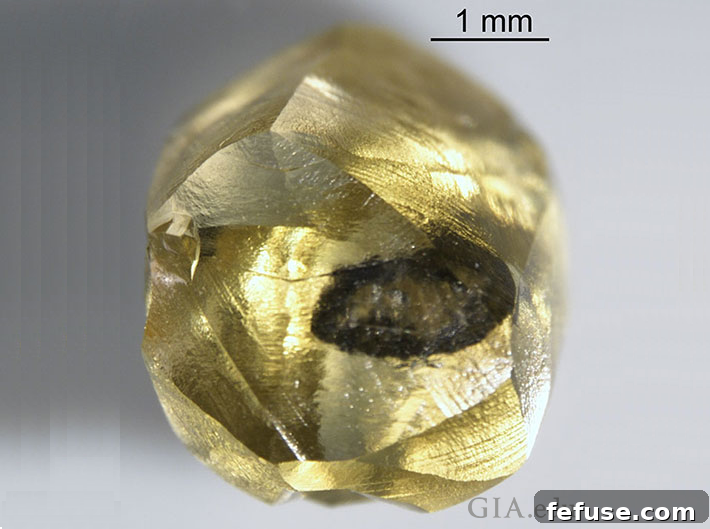
The focus of this illuminating study centered on diamonds sourced from the Zimmi mining area, located near the Liberia-Sierra Leone border. This region is particularly renowned for producing distinctive yellow diamonds, which hold special significance for researchers. The diamonds selected for analysis were classified as Type Ib diamonds, a designation that signifies the presence of rare nitrogen impurities within their atomic structure. Type Ib diamonds are extraordinarily uncommon in nature, representing a minute fraction – less than 0.1% – of all natural diamonds ever mined globally. Their extreme rarity makes them especially precious for scientific investigation, as their unique characteristics can harbor unusual chemical signatures pertinent to deep Earth processes.
To unlock the secrets held within these rare specimens, the research team employed advanced techniques. They meticulously laser-cut and polished exceedingly thin plates from the Zimmi diamonds. This delicate process allowed them to precisely isolate and study the minute sulfide inclusions embedded within the diamond matrix. Once isolated, these inclusions underwent sophisticated chemical analysis, specifically focusing on the extraction of sulfur isotopes. Sulfur isotopes, variations of the sulfur element with different neutron counts, serve as powerful geochemical tracers. By analyzing their ratios, scientists can deduce critical information about the environmental conditions, temperatures, and source materials present at the time of the diamond’s formation, offering vital clues not only about when the diamonds themselves crystallized but also about the timing and mechanisms of formation of the deepest and oldest segments of Earth’s continents.
“This remarkable level of insight into Earth’s primordial past is uniquely achievable thanks to the extraordinary characteristics of diamonds,” commented Dr. Wuyi Wang, GIA Vice President of Research and Development. He emphasized the multifaceted effort required to bring such a discovery to fruition. “GIA’s substantial and sustained investment in cutting-edge research, coupled with our unique access to these incredibly rare diamonds and the outstanding collaborative spirit demonstrated by our partners at the Carnegie Institution and the University of Alberta, were all indispensable elements that converged to make this significant scientific breakthrough possible.” This highlights GIA’s commitment to advancing not just gemology, but fundamental earth sciences.
The Gemological Institute of America boasts a formidable legacy spanning more than 60 years of continuous, pioneering research into diamonds, colored gems, and pearls. This unwavering dedication forms a cornerstone of its overarching mission: to safeguard consumers and uphold their confidence and trust in the integrity of gems and jewelry worldwide. GIA’s proactive research initiatives directly contribute to this mission by continually enhancing our understanding of gem identification, origin, treatments, and quality, thereby providing the vital knowledge necessary for accurate grading and disclosure. This commitment extends beyond the immediate concerns of the gem trade, contributing broadly to scientific understanding.
The sustained research effort at GIA is a testament to its institutional strength, supported by a world-class team comprising more than 60 full-time researchers, 22 of whom hold Ph.D.s in relevant scientific disciplines. This diverse team operates at the forefront of gemological science, utilizing state-of-the-art laboratories and cutting-edge analytical instrumentation. The findings generated by GIA’s extensive research initiatives reach a global audience through various highly respected channels. The Institute’s flagship publication, “Gems & Gemology” (G&G), a quarterly professional journal, serves as a vital platform for disseminating peer-reviewed articles on new discoveries, scientific advancements, and industry trends. Furthermore, all G&G articles are made freely accessible to the public on the Institute’s comprehensive website, GIA.edu, ensuring that vital information is widely available to academics, industry professionals, and enthusiasts alike.
Beyond its own publications, GIA researchers regularly present their findings and engage in collaborative discussions at numerous scientific journals and international conferences, fostering a global exchange of knowledge and pushing the boundaries of gemological and geological science. This robust research framework directly underpins and elevates the Institute’s industry-leading gemology education offerings, ensuring that future generations of gemologists are trained with the most current and accurate scientific knowledge. Moreover, this deep scientific understanding is intrinsically linked to the unparalleled accuracy and reliability of the identification and grading services provided by GIA’s world-renowned gemological laboratories. In essence, every aspect of GIA’s operations, from consumer protection to professional education, is strengthened by its foundational commitment to rigorous scientific inquiry and discovery, continuously enriching our understanding of the Earth’s most captivating treasures.
In conclusion, the collaborative research spearheaded by Dr. Karen Smit and featured in Science magazine exemplifies the profound insights that can be gleaned from Earth’s most precious materials. By delving into the microscopic world within diamonds, scientists are steadily piecing together the complex puzzle of our planet’s earliest history, revealing the processes that shaped the continents we inhabit today. This work not only underscores the scientific marvel of diamonds but also highlights GIA’s enduring role as a global leader in advancing both gemological science and the broader understanding of our dynamic Earth.