
Forging Stronger Ties: India and Russia Deepen Bilateral Trade and Diamond Sector Cooperation
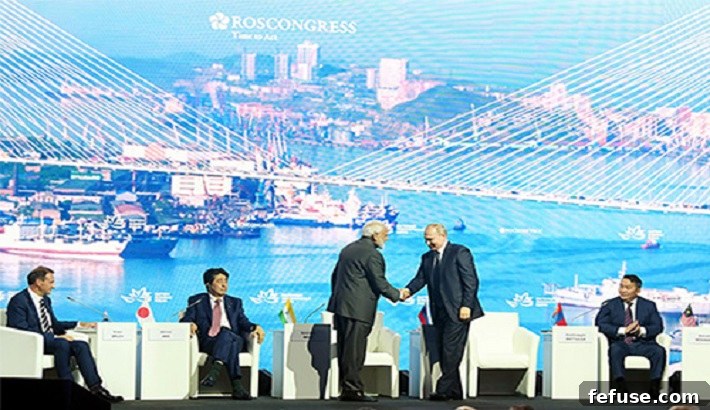
The 20th India-Russia Annual Summit, held on September 4-5, 2019, in Vladivostok, marked a pivotal moment in the strategic partnership between the two nations. Hon’ble Prime Minister of India, Shri Narendra Modi, engaged in extensive and fruitful discussions with his counterpart, H.E. President Vladimir Putin, covering a vast spectrum of bilateral trade and economic issues. This high-level engagement underscored both leaders’ commitment to further fortifying the deep-rooted relationship between India and the Russian Federation, extending beyond traditional areas into new avenues of cooperation.
The Cornerstone of Cooperation: Diamond Industry at the Forefront
Among the wide-ranging discussions, a significant focus was placed on enhancing cooperation within the global diamond industry, a sector where India plays a crucial role as the world’s largest cutting and polishing hub. The leaders specifically addressed the pivotal relationship between the Russian diamond mining behemoth, ALROSA, and India’s vibrant diamond sector. This dialogue highlights the mutual recognition of the immense potential for growth and collaboration within this specialized trade.
ALROSA’s Strategic Presence in India
The successful establishment and operation of PJSC ALROSA’s representative office in Mumbai, located within the prestigious Bharat Diamond Bourse (BDB), was prominently noted during the summit. Launched approximately a year prior to the summit, this office has been instrumental in bridging the gap between one of the world’s largest diamond producers and its primary market. A substantial portion of ALROSA’s global clientele comprises Indian diamond manufacturers, making a direct presence in India a strategic imperative. This direct engagement facilitates smoother transactions, fosters stronger relationships, and ensures a more efficient supply chain for rough diamonds.
Furthermore, ALROSA has emerged as an early and enthusiastic supporter of the India Diamond Trade Centre (IDTC) Special Notified Zone (SNZ). The IDTC SNZ was specifically created to provide a dedicated platform for international mining companies to bring their rough diamonds into India, allowing for direct trade with local manufacturers. This initiative reduces the dependency on intermediary trading centers, thereby enhancing transparency, reducing costs, and boosting India’s position as a global diamond trading hub. ALROSA’s endorsement and active participation in the IDTC SNZ are testament to its commitment to strengthening direct ties with the Indian diamond industry.
Enhancing Rough Diamond Trade and Regulatory Frameworks
The joint statement from the Prime Minister’s Office (PMO), disseminated via the Press Information Bureau (PIB), encapsulated the leaders’ shared vision for the diamond sector. It stated: “They attach high importance to cooperation in the diamond industry. The successful activity of the PJSC ALROSA office in India was noted by the Sides. They declared their interest in enhancing rough diamonds trading system and exploring ways to further improve the regulatory environment in this field with the aim of protecting the equity of natural diamonds.”
This commitment extends to several critical areas:
- Streamlining Trading Systems: Efforts are underway to optimize the mechanisms for rough diamond trade, making it more efficient, transparent, and accessible for all stakeholders.
- Improving Regulatory Environment: Both nations aim to refine policies and regulations governing the diamond trade. This includes measures that prevent illicit trade, ensure ethical sourcing, and promote fair practices across the value chain.
- Protecting Natural Diamonds: In an era where synthetic diamonds are gaining traction, the leaders emphasized the importance of safeguarding the integrity and inherent value of natural diamonds. This involves promoting clear disclosure, robust grading standards, and consumer confidence in natural stones.
The Indian diamond industry, centered in Surat, processes roughly 90% of the world’s rough diamonds, transforming them into polished gems. Direct sourcing from ALROSA not only ensures a stable and high-quality supply but also significantly enhances the competitive edge of Indian manufacturers by reducing logistical complexities and costs associated with indirect procurement. This direct channel fosters a symbiotic relationship crucial for the global diamond market.
Broadening the Horizon: Towards US$30 Billion in Bilateral Trade
While expressing satisfaction with the “stable mutual growth of trade turnover,” both Prime Minister Modi and President Putin set an ambitious target: to elevate bilateral trade to US$30 billion by 2025. This aspirational goal reflects a shared desire to unlock the full potential of economic cooperation between the two nations. Achieving this target necessitates active engagement across various sectors, leveraging the “impressive resource and human resources potential of India and Russia.”
Diversifying Trade and Investment Avenues
The PIB release highlighted several key areas for expanding economic engagement:
“Both Sides expressed their interest in expanding the participation of Russian business in ‘Make in India’ programme and that of Indian companies in investment projects in Russia. In this context, they agreed to speed up preparations for signing of the India-Russia Intergovernmental Agreement on Promotion and Mutual Protection of Investments.”
This signals a strategic shift towards more balanced and reciprocal investment flows. The “Make in India” initiative, a flagship program of the Indian government, invites foreign companies to manufacture their products in India. For Russian businesses, this presents opportunities in sectors like defense manufacturing, heavy machinery, infrastructure, and energy, tapping into India’s vast domestic market and skilled workforce. Conversely, Indian companies are encouraged to explore investment projects in Russia, particularly in areas like pharmaceuticals, IT services, agriculture, and energy exploration, thereby diversifying Russia’s economic landscape and strengthening bilateral economic ties.
The proposed Intergovernmental Agreement on Promotion and Mutual Protection of Investments is a critical step in this direction. Such an agreement provides a robust legal framework that safeguards investments, offers dispute resolution mechanisms, and creates a predictable and secure environment for businesses from both countries. Expediting its signing will build investor confidence and catalyze cross-border capital flows, which are essential for achieving the ambitious trade target.
Eliminating Barriers and Harmonizing Standards
Recognizing that trade potential can only be fully realized by addressing practical impediments, the leaders committed to “intensify joint work towards eliminating barriers in mutual trade” and to “further consider reducing restrictive measures through bilateral dialogue.” This pragmatic approach aims to tackle issues that hinder smooth trade flows and increase transaction costs.
The joint statement further elaborated on the scope of these efforts:
“They agreed to improve the structure of trade in goods and services, environment for entrepreneurial activities and investment, harmonise and refine relevant import and export procedures, streamline and standardise technical, sanitary and phytosanitary requirements.”
These measures are designed to create a more conducive and predictable trade environment:
- Trade Structure Improvement: Moving beyond traditional commodities, both sides aim to diversify the basket of goods and services traded, focusing on high-value products, technology, and intellectual property.
- Enhanced Business Environment: Efforts will be made to simplify bureaucratic processes, reduce red tape, and foster an atmosphere that encourages entrepreneurial ventures and foreign direct investment.
- Streamlined Procedures: Simplifying import and export documentation, customs clearance, and logistical processes will significantly reduce transit times and operational costs for businesses.
- Standardization and Harmonization: The harmonization of technical, sanitary, and phytosanitary (SPS) standards is paramount. Divergent standards often act as non-tariff barriers, impeding market access. By aligning these requirements, both nations can ensure that products meet necessary quality and safety benchmarks, thereby facilitating smoother trade in agricultural products, food items, and manufactured goods.
Promoting National Currencies for Trade Settlements
A significant agreement between the two sides was the commitment to “continue the work on promoting mutual settlements of payments in national currencies.” This initiative aligns with a broader global trend towards de-dollarization and aims to reduce dependency on third-party currencies for international trade. By enabling settlements in Indian Rupees (INR) and Russian Rubles (RUB), both countries can mitigate currency exchange rate risks, reduce transaction costs, and enhance the financial stability of bilateral trade. This move also strengthens the financial autonomy of both nations and deepens their economic integration.
A Foundation for Future Growth: The Strategic Importance
H.E. President Putin and Hon’ble PM Shri Modi both unequivocally prioritized “strong, multifaceted trade and economic cooperation as the foundation for further expanding the range of India-Russia relations.” This emphasizes that economic collaboration is not merely transactional but forms the bedrock of a comprehensive strategic partnership that spans defense, energy, science and technology, and cultural exchanges. The 20th Annual Summit in Vladivostok therefore served as a powerful testament to the enduring bond between India and Russia, charting a clear course for enhanced economic prosperity and deepened strategic alignment in the years to come.
The discussions and agreements reached during the summit demonstrate a forward-looking vision, seeking to leverage the strengths of both economies to achieve mutually beneficial growth. From the specialized nuances of the diamond industry to the broader ambitions of boosting bilateral trade and investment, India and Russia are committed to building a robust and resilient economic partnership that contributes to global stability and prosperity.
New Source: gjepc