
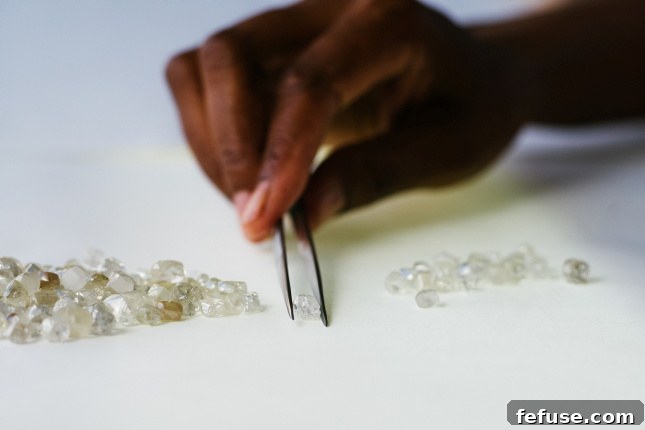
De Beers Navigates Shifting Diamond Market: Q1 2023 Sales Reflect Global Economic Headwinds Amidst Cautious Optimism
De Beers, a global leader in diamond production and distribution, recently announced its rough diamond sales figures for the first sales cycle of 2023, reporting a total of $450 million. This figure represents a notable decrease of over 30 percent when compared to the corresponding period in 2022, signaling a more conservative start to the year for the diamond industry giant. The reported sales provide a crucial early indicator of the current market sentiment and the broader economic pressures influencing the luxury goods sector.
The significant year-on-year decline in sales comes despite a series of strategic adjustments implemented by De Beers to stimulate demand and support its network of sightholders. Among these measures, discounts of up to 10 percent were reportedly applied to larger stones, specifically those exceeding 2.0 carats. This targeted pricing strategy suggests a keen awareness of the sensitivity of the high-value segment of the market to economic fluctuations. Furthermore, De Beers introduced more flexible buyback terms, allowing sightholders the option to reject 20 percent of goods over one carat from a parcel, a considerable increase from the standard 10 percent. These adjustments underscore De Beers’ proactive approach in adapting to evolving market conditions and maintaining strong relationships with its key clients.
Understanding the Market Dynamics: Discounts and Flexible Terms
The decision by De Beers to offer discounts on larger stones is particularly telling. Typically, larger, higher-quality diamonds command premium prices and are often seen as a barometer of the luxury market’s health. A price adjustment in this segment indicates that even the most coveted diamonds are not immune to the broader economic climate. Consumers, especially those in the high-net-worth bracket, tend to become more discerning with discretionary spending during periods of economic uncertainty. By making these stones more accessible, De Beers aimed to encourage purchasing activity and maintain liquidity within the supply chain, ensuring that these valuable assets continue to move through the pipeline from mining to retail.
The relaxation of buyback terms also represents a significant concession designed to alleviate pressure on sightholders. Under the traditional Sightholder system, clients commit to purchasing a fixed allocation of rough diamonds from De Beers. The ability to return a larger proportion of goods, particularly those over one carat, provides sightholders with increased flexibility to manage their inventory levels and respond to real-time market demand. This measure is crucial for businesses operating in a volatile environment, as it helps mitigate the risk of holding excessive stock that may not sell quickly or at desired margins. Such flexibility fosters greater confidence among sightholders, allowing them to plan their purchases more effectively and cautiously.
Sightholder Strategies and the Macroeconomic Outlook
The UK-based miner revealed that sightholders are strategically planning a greater portion of their purchases for later in the year, a direct reflection of current market uncertainties. This cautious approach by De Beers’ direct clients is understandable given the prevailing macroeconomic outlook. Global inflation, rising interest rates, and the specter of a potential recession in several major economies have collectively dampened consumer confidence and purchasing power. Businesses throughout the diamond value chain, from cutters and polishers to manufacturers and retailers, are all keenly aware of these headwinds and are adjusting their inventory and operational strategies accordingly. The deferment of purchases suggests a belief that economic conditions, and consequently consumer demand, may improve in the latter half of 2023.
Despite the immediate challenges, De Beers expressed a sentiment of “cautious optimism” for the remainder of the year. This tempered outlook acknowledges the current difficulties while pointing towards potential catalysts for recovery. The diamond industry, like many luxury sectors, is highly sensitive to global economic trends. Periods of high inflation erode disposable income, making consumers hesitant to invest in non-essential luxury items like diamonds. Similarly, rising interest rates can increase the cost of borrowing for businesses, impacting investment in inventory and expansion. Therefore, any signs of easing inflation or stabilizing economic conditions would be warmly welcomed across the industry.
A Glimmer of Hope: Comparing Cycle Performance
While the year-on-year comparison shows a dip, it is also important to note that sales during the first cycle of 2023 did show an improvement over the preceding cycle. De Beers’ sales in Cycle 1 of 2023, totaling $450 million, were up from the $417 million recorded in Cycle 10 of 2022. This sequential increase, albeit modest, could indicate a bottoming out of demand or a slight reawakening of market activity as the new year began. Such incremental improvements, even in challenging environments, can foster a sense of stability and provide a foundation for future growth. It suggests that while the market is undoubtedly challenging, it is not in freefall, and there are underlying currents of demand that persist.
Bruce Cleaver, who is set to step down as CEO later this month, offered his insights into the current situation. He commented, “As expected, given the macroeconomic outlook at the time, sightholders took a cautious approach in late 2022 in planning their 2023 allocation schedule, with a greater weighting of goods to be purchased as the year progresses.” Cleaver’s statement underscores the foresight and strategic planning employed by sightholders, who, being at the forefront of the rough diamond market, often have an early pulse on prevailing economic winds. Their decision to front-load fewer purchases and spread them out over the year is a rational response to the uncertainties that characterized the end of 2022, preparing for a potentially more robust market later in 2023.
The Impact of China’s Reopening and Decreasing Inflation
Cleaver further elaborated on the sources of optimism, stating, “While there is still some uncertainty over the macroeconomic environment, we see cautious optimism for demand to increase as China continues to reopen and inflation rates start to decrease in many major economies.” The reopening of China’s economy following prolonged lockdowns is a monumental development for the global luxury market, including diamonds. China is a powerhouse for luxury consumption, and the unleashing of pent-up demand from its vast consumer base is anticipated to provide a significant boost to sales of high-end goods. As travel restrictions ease and consumer confidence slowly rebuilds, Chinese consumers are expected to once again become a dominant force in the global diamond market, both domestically and through international tourism.
The prospect of decreasing inflation rates in major economies such as the United States and Europe is another critical factor contributing to this cautious optimism. Persistent high inflation has eroded consumer purchasing power, making luxury items less accessible. As inflation moderates, real incomes are expected to stabilize or even increase, leading to a potential rebound in discretionary spending. Lower inflation could also signal more stable economic conditions overall, which tends to improve consumer confidence and willingness to invest in significant purchases like diamond jewelry. This dual positive impact from China and major Western economies forms the cornerstone of De Beers’ hopeful, yet pragmatic, outlook for the coming months.
Looking Ahead: The Resilient Diamond Market
The diamond industry has historically demonstrated remarkable resilience, navigating various economic downturns and geopolitical shifts. While the current environment presents its unique set of challenges, the fundamental drivers of diamond demand—namely, their enduring symbolism in celebrations of love and commitment, along with their intrinsic value—remain strong. De Beers, as a dominant player, is well-positioned to adapt and lead the market through these fluctuations. Their strategic moves to offer discounts and more flexible terms are testaments to their commitment to supporting the entire value chain and ensuring the health and stability of the rough diamond trade.
As 2023 progresses, the industry will closely monitor key economic indicators, particularly those related to consumer spending and macroeconomic stability. The success of China’s economic reopening and the trajectory of inflation rates will be pivotal in determining the overall strength of diamond demand in the latter half of the year. The initial caution displayed by sightholders and the strategic flexibility offered by De Beers collectively paint a picture of an industry preparing itself for recovery, poised to capitalize on any positive shifts in the global economic landscape. The journey ahead for the diamond market promises to be dynamic, but with strategic adjustments and a focus on long-term value, the sector is well-equipped to overcome current headwinds.