
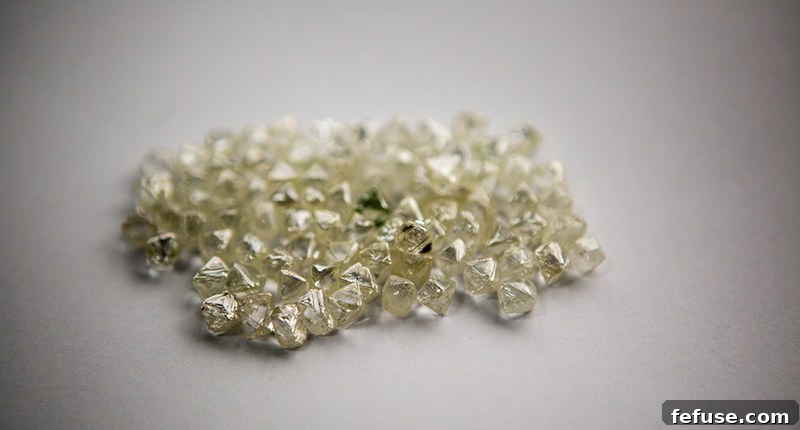
De Beers Kicks Off 2018 with Robust Rough Diamond Sales Amidst Positive Market Trends
The global diamond industry closely monitors the performance of major players, and the De Beers Group’s sales figures often serve as a crucial barometer for market health. De Beers recently announced its sales (Global Sightholder Sales and Auction Sales) for Cycle 1, 2018, reaching a provisional figure of US$ 665 million. While this represents a strong start to the year, it is important to contextualize these numbers against previous periods to gain a comprehensive understanding of the market’s trajectory.
Comparing the Cycle 1, 2018 sales to the corresponding period in 2017, the current figure of US$ 665 million stands below the actual sales of US$ 729 million recorded for Cycle 1, 2017. However, the latest figures mark a significant increase over the US$ 455 million registered for Cycle 10, 2017, which was the final sales cycle of the preceding year. This fluctuation underscores the dynamic nature of the rough diamond market, heavily influenced by seasonal demand and broader economic factors.
De Beers CEO Bruce Cleaver on Market Dynamics and Restocking Efforts
Bruce Cleaver, CEO of De Beers Group, offered valuable insights into the forces shaping the company’s early 2018 performance. Cleaver noted, “Following positive early signs for diamond jewellery sales over the holiday season in the US, the need for the industry to restock led to increasing demand for our rough diamonds in the first sales cycle of 2018.” This statement highlights two critical drivers: robust consumer demand in a key market and the subsequent ripple effect through the supply chain.
The “restocking” phenomenon is a recurring theme in the diamond pipeline. After strong retail periods, such as the crucial year-end holiday season, retailers and polished diamond manufacturers find their inventories depleted. To prepare for future demand, they turn to rough diamond suppliers like De Beers to replenish their stock. This cyclical demand typically results in a larger share of annual purchases being front-loaded into the first sales cycle of the year by De Beers’ Sightholders and auction buyers, creating an encouraging sales performance at the outset.
Cleaver further elaborated on the comparative sales figures, providing essential context for the difference between Cycle 1, 2018 and Cycle 1, 2017. He explained, “In the equivalent sales cycle last year, sales levels benefitted from purchases that had been deferred from late in 2016 as a result of the initial impact at that time of India’s demonetisation programme.” This historical factor is crucial for a fair comparison, as the Indian demonetisation initiative significantly disrupted the world’s largest diamond cutting and polishing hub, causing a temporary slowdown and subsequent rebound.
Unpacking the Comparison: 2018 vs. 2017 Sales Cycles
The Lasting Impact of India’s Demonetisation on 2017 Figures
The Indian government’s demonetisation policy, enacted in November 2016, aimed to curb black money and counterfeit currency by withdrawing high-value banknotes from circulation. This drastic measure had an immediate and profound impact on India’s diamond industry, which is heavily reliant on cash transactions for various stages of its operations. As the world’s primary center for cutting and polishing diamonds, a slowdown in India’s processing sector sent ripples throughout the global supply chain.
Many diamantaires in India faced liquidity challenges, leading to a temporary deferral of rough diamond purchases in late 2016. Consequently, when the market began to stabilize and adjust to the new financial landscape in early 2017, there was a surge in demand to catch up on delayed orders and replenish inventories. This pent-up demand artificially inflated the sales figures for De Beers’ Cycle 1, 2017, making the US$ 729 million an outlier rather than a standard benchmark.
Therefore, while Cycle 1, 2018’s US$ 665 million might appear lower on paper, it represents a more organic and sustainable level of demand driven by genuine market restocking and consumer sentiment, rather than a recovery from an exogenous shock. Understanding this nuance is vital for an accurate interpretation of the figures and the underlying health of the diamond trade.
The Upswing from Cycle 10, 2017: A Sign of Renewed Confidence
In contrast to the inflated 2017 start, the comparison to Cycle 10, 2017, which registered US$ 455 million, paints a picture of positive momentum. The final sales cycle of the year typically experiences a natural slowdown. This is often due to manufacturers and retailers having sufficiently stocked up for the holiday season, or simply reducing purchases as the year draws to a close and they await new market signals for the following year.
The substantial jump from US$ 455 million in Cycle 10, 2017, to US$ 665 million in Cycle 1, 2018, is a clear indicator of renewed activity and confidence within the industry. It reflects the post-holiday restocking imperative and a positive sentiment among Sightholders and buyers, who are positioning themselves for anticipated consumer demand in the upcoming year. This rebound signals a healthy transition from the traditional year-end lull into a proactive buying phase, setting an optimistic tone for the initial months of 2018.
The Global Diamond Pipeline: From Mine to Market
De Beers’ sales performance is intricately linked to the broader mechanics of the global diamond pipeline. As one of the world’s foremost diamond companies, De Beers plays a pivotal role across various stages, from exploration and mining to sorting, grading, and sales. Its unique “Sightholder” system, alongside auction sales, dictates how rough diamonds are distributed to a select group of global manufacturers and traders.
The journey of a diamond typically begins in countries rich in mineral resources, such as Botswana, South Africa, Namibia, and Canada, where De Beers operates significant mines. Once extracted, rough diamonds are meticulously sorted and valued. These raw stones are then sold through the aforementioned channels to buyers, predominantly in major cutting and polishing centers like India (Surat), Belgium (Antwerp), and Israel (Ramat Gan). Here, skilled artisans transform the rough stones into sparkling polished diamonds.
Finally, these polished diamonds are integrated into jewelry by manufacturers, which are then distributed through a global retail network to consumers in key markets such as the United States, China, India, and Japan. Each stage of this pipeline is interdependent, meaning that shifts in consumer demand at the retail end quickly translate into corresponding demand for rough diamonds from miners like De Beers, highlighting the sensitivity and interconnectedness of the industry.
Factors Influencing Rough Diamond Demand
Several critical factors converge to influence the demand for rough diamonds, making it a complex and often unpredictable market. Understanding these elements is essential for forecasting industry trends and evaluating the significance of sales reports.
Consumer Confidence and Economic Health
Diamonds, being luxury goods, are highly sensitive to global economic conditions and consumer confidence. When economies are robust, employment rates are high, and disposable incomes increase, consumers are more inclined to invest in discretionary purchases like diamond jewelry. Conversely, during economic downturns, luxury spending is often among the first categories to be curtailed. The positive early signs for diamond jewelry sales over the US holiday season, as noted by Bruce Cleaver, directly correlate with an optimistic consumer outlook in a crucial market, thereby driving rough diamond demand.
Inventory Levels Across the Pipeline
The level of inventory at various stages of the diamond pipeline – rough, polished, and retail – significantly impacts purchasing decisions. If polished diamond manufacturers and jewelers have high existing stock, their immediate need for new rough diamonds diminishes. Conversely, if inventories are lean due to strong sales, as was the case following the US holiday season, the pressure to restock rough diamonds intensifies. De Beers’ sales cycles effectively manage this supply-demand dynamic, signaling the current appetite for raw materials among its buyers.
Polished Diamond Prices and Profit Margins
The profitability of the cutting and polishing sector is a key determinant of rough diamond demand. Manufacturers assess the prices of rough diamonds against the potential selling prices of the polished diamonds they will produce. If polished diamond prices are stagnant or declining, while rough diamond prices remain high, profit margins shrink, discouraging new rough purchases. A healthy profit margin encourages manufacturers to buy more rough diamonds, contributing to robust sales figures for producers like De Beers.
De Beers’ Strategic Vision and Market Challenges
Beyond sales figures, De Beers continuously adapts its strategic vision to navigate an evolving market landscape. Historically, De Beers shaped global diamond demand through iconic marketing campaigns like “A Diamond Is Forever,” creating an enduring emotional connection with consumers. Today, its focus extends to ensuring the integrity and sustainability of the entire diamond value chain.
The industry faces several modern challenges, including the rise of laboratory-grown diamonds, which offer an alternative to natural stones; increasing consumer scrutiny regarding ethical sourcing and environmental impact; and changing preferences among younger generations. De Beers addresses these through initiatives promoting traceability, investing in sustainable mining practices, and launching new marketing campaigns that highlight the unique natural heritage and positive impact of responsibly sourced natural diamonds, such as the ‘Diamond Is Me’ platform.
Outlook for the Diamond Market in 2018
The Cycle 1, 2018 sales figures from De Beers provide an encouraging, albeit measured, outlook for the diamond market for the year ahead. The strong restocking demand, particularly driven by positive US holiday sales, suggests a healthy baseline of consumer interest. While the comparison to a demonetisation-inflated 2017 figure requires careful consideration, the substantial uplift from late 2017 indicates a confident start to the new trading year.
For the remainder of 2018, market participants will be closely watching several key indicators: sustained consumer demand in major markets like the US, China, and India; global economic stability; the performance of the polished diamond sector; and any geopolitical developments that could influence trade flows or consumer sentiment. De Beers’ performance in subsequent cycles will further clarify whether this initial positive momentum translates into sustained growth throughout the year.
Conclusion: A Measured Optimism for the Diamond Industry
De Beers Group’s Cycle 1, 2018 sales of US$ 665 million represent a solid and encouraging start to the year for the global diamond industry. Driven by a seasonal need for restocking following robust US holiday sales, these figures demonstrate an underlying strength in consumer demand and a proactive stance from manufacturers. While comparisons to the previous year’s demonetisation-influenced sales cycle require careful interpretation, the significant rebound from the end of 2017 signals renewed confidence among buyers.
As a bellwether for the industry, De Beers’ initial performance suggests a cautiously optimistic environment for natural diamonds. The industry continues to evolve, balancing traditional values with modern consumer expectations around transparency and sustainability. With a strategic focus on responsible sourcing and effective market engagement, De Beers, and the wider diamond sector, appear poised to navigate the complexities of the global luxury market with resilience and adaptive growth.
News Source : gjepc.org