
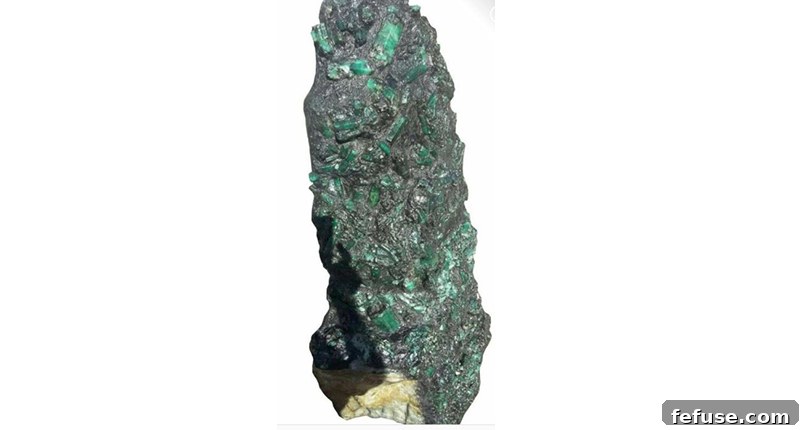
Colossal Emerald Unearthed in Bahia, Brazil: A New Jewel for the World
The lush, mineral-rich landscapes of Bahia, Brazil, have once again yielded an extraordinary treasure from deep within their earth. Just in time to celebrate May as the traditional birthstone month, a staggering 600-pound (approximately 272 kg) emerald was recently uncovered in the northeastern Brazilian state. This magnificent discovery not only captivates the imagination but also reaffirms Brazil’s prominent status as a global epicenter for some of the world’s most spectacular and valuable gemstones.
The colossal gem, reportedly standing an impressive four feet (1.2 meters) tall, emerged from the famed Carnaiba mine in early May. Miners working diligently for the Bahia Mineral Cooperative were credited with this monumental find, bringing to light a raw emerald that promises to be a marvel in the world of precious stones. While the country’s National Department of Mineral Production was unable to officially confirm the specific details of the discovery by the initial press deadline, the news quickly spread, igniting excitement among gem enthusiasts, collectors, and the public alike, eager to learn more about this incredible natural wonder.
The Discovery: Details from the Depths of Carnaiba
The Carnaiba mining region in Bahia is renowned for its geological formations that are exceptionally conducive to the growth of high-quality emeralds. It has been a site of significant finds for decades, making it a crucial area for Brazil’s gem industry and a source of considerable economic activity. The recent 600-pound emerald, while yet to have its exact carat weight officially disclosed (though its sheer size suggests hundreds of thousands of carats), represents an extraordinary specimen of nature’s artistry—a rough gem of unparalleled scale and potential beauty.
Following its extraction, the immediate fate of the gigantic stone was decided swiftly. A local mine owner, whose identity remains undisclosed, acquired the emerald. The plans for this remarkable acquisition are ambitious and public-minded: the owner intends to exhibit the emerald in museums and other public spaces across the globe. This approach suggests a recognition of the stone’s historical, scientific, and aesthetic significance, aiming to share its splendor with a wider audience rather than keeping it solely within private collections. Such a gesture would allow millions to witness firsthand the raw beauty and immense scale of a world-class natural wonder, promoting education and appreciation for mineralogy and geology.
Intriguingly, specific details regarding the emerald’s estimated monetary value and its precise quality characteristics have not yet been made public. The valuation of such a unique and enormous rough gemstone is a complex process, involving intricate assessments of color saturation, clarity, crystalline structure, and the potential yield of cuttable material. The decision to withhold this information might stem from ongoing expert evaluations, security considerations, or a strategic approach to its future display and potential eventual sale. Nevertheless, given its monumental size and origin from a reputable emerald source, its intrinsic value is undoubtedly immense, positioning it as one of the most significant emerald discoveries in recent memory and a testament to the Earth’s enduring capacity to produce treasures.
Bahia’s Legacy: A History of Monumental Emerald Finds
The state of Bahia is no stranger to unearthing colossal emeralds; it has a storied history of revealing some of the largest and most controversial gemstones ever discovered. The recent 600-pound find naturally draws comparisons to its equally famous, and perhaps even more contentious, predecessor: the renowned Bahia Emerald.
The Saga of the Bahia Emerald (2001)
Discovered in 2001, also in Bahia, the original Bahia Emerald was an astonishing 752-pound (approximately 341 kg) gemstone that contained more than 180,000 carats of emeralds embedded within its host rock. This truly gargantuan specimen quickly became a focal point of intense legal battles and international intrigue, overshadowing its natural beauty with a complex web of ownership disputes that continue to this day, making it one of the most litigated gemstones in history.
The journey of the 2001 Bahia Emerald is a testament to the high stakes involved in such valuable finds. Initially extracted from the same Carnaiba mining region, the stone embarked on a convoluted journey that saw it transported to the United States. It spent time in various locations, including New Orleans, where it narrowly escaped destruction during Hurricane Katrina when it was submerged in a flooded warehouse. Its legal battles have spanned multiple states, involving numerous claimants who each asserted ownership, citing various purchase agreements or discovery rights. The stone has been held in secure, undisclosed locations, often under court order, as judges untangled a labyrinth of conflicting testimonies and documentation. This ongoing saga highlights the critical importance of clear legal frameworks and meticulous documentation in the gemstone industry, especially for objects of such immense value. Its story serves as a cautionary tale, underscoring the potential for disputes when priceless natural treasures exchange hands multiple times without unequivocal legal clarity. The turbulent history of the 2001 Bahia Emerald contrasts sharply with the recent acquisition, where the unnamed buyer’s immediate plan for public exhibition suggests a more straightforward path, at least for now.
Understanding the Allure: What Makes Emeralds So Precious?
Emeralds, with their captivating verdant hues, have been cherished for millennia, revered by ancient civilizations from Egypt to the Incas, who associated them with fertility, rebirth, and eternal youth. They belong to the beryl mineral family, deriving their vibrant green color primarily from trace amounts of chromium and sometimes vanadium. The intensity, saturation, and uniformity of this green are the most crucial factors in determining an emerald’s value, distinguishing a common beryl from a true emerald. Their unique beauty has long made them a favorite for royalty and a symbol of luxury.
The Four C’s of Emerald Quality:
- Color: This is paramount for emeralds. The most desirable specimens possess a vivid, intense green with a slight bluish tint, neither too dark nor too light, and evenly distributed throughout the stone. The best colors are often described as “grass green” or “chrome green.”
- Clarity: Unlike diamonds, emeralds are known for their characteristic inclusions, often referred to as “jardin” (French for garden) because they resemble moss or foliage within the gem. While some inclusions are acceptable and even expected, and can serve as fingerprints of authenticity, excessive or distracting inclusions can significantly reduce value and compromise durability.
- Cut: The cut of an emerald is designed to enhance its color and minimize internal stress, as emeralds can be more brittle than other gemstones. The rectangular or square “emerald cut” is classic, specifically designed to protect the gem from chipping while showcasing its color. Other cuts are also used to maximize the stone’s beauty and yield from the rough.
- Carat Weight: While weight is important, for emeralds, quality often trumps sheer size. However, a truly large, high-quality emerald like the recent Bahia find is exceptionally rare. Such colossal rough stones provide a unique opportunity for both study and the potential cutting of multiple valuable finished gems, adding to their allure and investment potential.
The geological conditions required for emerald formation are relatively rare, typically involving the interaction of chromium-rich and beryllium-rich fluids under intense pressure and temperature within specific metamorphic or igneous rock environments. This geological rarity, combined with their striking beauty, durability (when cared for), and historical significance, contributes significantly to their high value and enduring appeal as precious gemstones and investment pieces in the global market.
The Significance of Such Discoveries for Brazil and the World
The unearthing of a 600-pound emerald holds multifaceted significance. For Brazil, and specifically for the state of Bahia, it underscores the region’s immense geological wealth and its potential to continue surprising the world with incredible finds. It brings positive international attention to Brazilian mining, potentially stimulating further investment and exploration in a responsible and sustainable manner, while also highlighting the skill and perseverance of local miners.
Economically, such discoveries can have a profound ripple effect. They can boost local economies through job creation in mining and related industries, and through increased tourism if the stone is exhibited locally. Globally, a find of this magnitude excites the entire gem and jewelry industry, from gemologists and collectors to designers and retailers. It reminds us of the Earth’s enduring capacity to produce natural wonders and reinforces the timeless allure of raw, untamed beauty, inspiring new generations of mineral enthusiasts and jewelers alike.
The decision by the new owner to display the emerald publicly is particularly noteworthy. It transforms a private asset into a shared cultural and educational resource. Future museum exhibitions will not only showcase the gem’s intrinsic beauty but also educate the public about geology, mineralogy, Brazil’s natural heritage, and the intricate process of gemstone discovery and valuation. It allows people from all walks of life to connect with something ancient and awe-inspiring, fostering a greater appreciation for the natural world and the wonders it holds hidden beneath its surface.
Looking Ahead: The Journey of a New Gemstone Icon
As the 600-pound emerald from Bahia embarks on its journey from the Carnaiba mine to potential global exhibition halls, it carries with it the mystique of its origin and the promise of future admiration. While specific details about its quality and precise value await further expert assessment, its sheer scale alone secures its place in the annals of significant gemstone discoveries, guaranteeing it a spot in history alongside other legendary finds.
This magnificent find serves as a powerful reminder of Brazil’s incredible geological bounty and the tireless efforts of miners who bring these treasures to light. It is a testament to the Earth’s enduring capacity to produce wonders, offering a tangible link to deep time and natural processes that have shaped our planet. As the world eagerly anticipates more information and the eventual public debut of this colossal emerald, it stands as a symbol of nature’s grandeur, the timeless allure of precious stones, and the ongoing human fascination with the hidden gems of our world.
News Source: www.nationaljeweler.com