
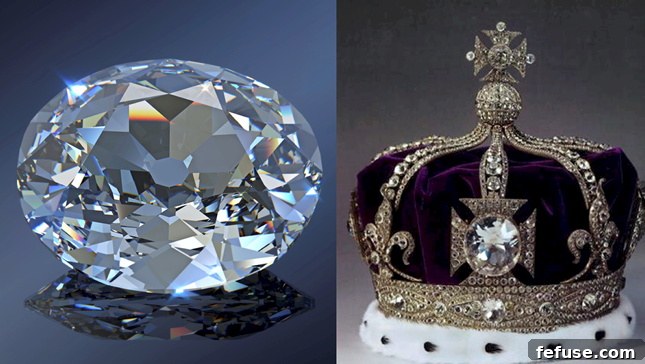
The passing of Queen Elizabeth II in September 2022 not only marked the end of an era but also swiftly rekindled a centuries-old geopolitical and historical debate surrounding one of the world’s most famous and contested gemstones: the 105.6-carat Koh-i-Noor diamond. As the world mourned the long-reigning monarch, attention quickly turned to the future of the British monarchy and, intrinsically, the precious artifacts that symbolize its power and legacy. Central to this discussion is the magnificent Koh-i-Noor, a diamond whose history is as complex and dramatic as its unparalleled brilliance.
This iconic Type IIa D-color gem, renowned for its exceptional purity and colorlessness, currently graces the Queen Mother’s Crown, a magnificent platinum piece crafted for Queen Elizabeth II’s mother for the coronation of King George VI in 1937. Following a directive from the late Queen herself, Queen Camilla, the wife of the new King Charles III, is expected to wear this very crown, featuring the disputed Koh-i-Noor, at her husband’s coronation ceremony. This decision, while in line with royal tradition, has once again propelled the diamond into the global spotlight, intensifying calls for its repatriation from several nations that claim historical ownership.
The Enduring Mystery and Unparalleled Value of the Koh-i-Noor
Often described as the “Mountain of Light” (the literal translation of its Persian name), the Koh-i-Noor diamond is not merely a precious stone; it is a repository of history, power, and contention. While its exact origins are shrouded in antiquity, it is widely believed to have been discovered in the fabled Golconda mines of Andhra Pradesh, India, likely during the Kakatiya dynasty in the 13th or 14th century. For centuries, these mines were the sole source of the world’s most magnificent diamonds, including other legendary gems like the Hope Diamond and the Darya-ye Noor.
Initially weighing a staggering 186 carats in its original cut, the Koh-i-Noor possessed a mystical aura and was believed to bring both immense fortune and ultimate power to its possessor, alongside a dark prophesy of misfortune for male rulers. This belief contributed to its turbulent journey across empires and dynasties, making it one of the most traveled and fought-over diamonds in human history. Its inherent rarity, coupled with its profound historical narrative, solidifies its status as arguably the world’s most valuable diamond, transcending mere monetary worth to embody cultural heritage and contested sovereignty.
A Journey Through Empires: The Diamond’s Tumultuous History
The diamond’s recorded history truly begins in the hands of the Kakatiya rulers. From there, it embarked on a dramatic odyssey through the hands of various Indian potentates, including the Delhi Sultans and the formidable Mughal Emperors, where it adorned the legendary Peacock Throne. In 1739, the Persian conqueror Nader Shah invaded India, sacked Delhi, and appropriated the vast treasures of the Mughals, including the Koh-i-Noor. It was Nader Shah who reportedly gave the diamond its iconic name, exclaiming “Koh-i-Noor!” upon seeing its dazzling brilliance for the first time.
Following Nader Shah’s assassination in 1747, the diamond eventually found its way into the hands of Ahmad Shah Durrani, the founder of the Afghan Empire, and subsequently passed down through his successors. It eventually returned to India in the early 19th century, coming into the possession of Maharaja Ranjit Singh, the founder of the Sikh Empire, based in Lahore (present-day Pakistan). Ranjit Singh, a powerful and astute ruler, valued the diamond immensely, displaying it prominently and famously wearing it on his arm.
The British Acquisition and Its Controversial Legacy
The pivotal moment in the diamond’s history, and the genesis of the current repatriation debate, occurred after the Anglo-Sikh Wars. Following the British annexation of Punjab in 1849, the Treaty of Lahore was signed. Article III of this treaty stipulated that “The gem called the Koh-i-Noor, which was taken by Maharajah Runjeet Singh from Shah Sooja-ool-Moolk, shall be surrendered by the Maharajah of Lahore to the Queen of England.” This clause is the cornerstone of the British claim of legal ownership, asserting that the diamond was a term of a legitimate treaty following a military victory.
However, critics argue that the treaty was signed under duress by the then ten-year-old Maharaja Duleep Singh, effectively making the “surrender” an act of colonial seizure rather than a voluntary gift. The diamond was subsequently transported to Britain and presented to Queen Victoria in 1850. Initially, its cut did not impress European sensibilities, which favored greater brilliance. Thus, in 1852, under the supervision of Prince Albert, the diamond was re-cut from its original 186 carats to its current brilliant oval shape of 105.6 carats. While this improved its sparkle, it also reduced its weight significantly, a decision that remains a point of historical curiosity and regret for some.
Adorning the Crown Jewels: A Symbol of British Monarchy
Since its arrival in Britain and subsequent re-cutting, the Koh-i-Noor has been an integral part of the British Crown Jewels, consistently set in crowns worn by successive Queens Consort. Its journey within the British royal collection began with Queen Victoria, who wore it as a brooch and then incorporated it into a circlet. It was later set into the crown of Queen Alexandra, wife of King Edward VII, for their coronation in 1902. Subsequently, it was transferred to Queen Mary’s Crown for her coronation in 1911.
Its most recent setting, and the one that will feature at King Charles III’s coronation, is in the platinum crown created for Queen Elizabeth The Queen Mother. She wore it at the coronation of her husband, King George VI, in 1937, and later at her daughter’s (Queen Elizabeth II) coronation in 1953. For decades, the Koh-i-Noor has been displayed with the other Crown Jewels at the Tower of London, attracting millions of visitors and serving as a tangible link to British imperial history and regal splendor.
The Repatriation Debate: Voices from Across the Globe
The question of the Koh-i-Noor’s true ownership and its rightful home has simmered for decades, periodically flaring up during significant royal events or historical anniversaries. The death of Queen Elizabeth II and the upcoming coronation of King Charles III and Queen Camilla have injected new urgency into these long-standing claims from multiple nations.
India’s Persistent Claim
India has consistently voiced the strongest claim, arguing that the diamond was illegally taken during the colonial era and represents a profound symbol of imperial exploitation. Indian officials and cultural groups contend that the gem should be returned as a gesture of historical redress and to acknowledge its deep cultural and historical roots in the subcontinent. They point to its discovery in India, its ownership by various Indian rulers for centuries, and the circumstances under which it was transferred to the British. The diamond is seen by many Indians as a national treasure that belongs back in its homeland, embodying a significant part of India’s heritage.
Pakistan’s Legal and Historical Assertions
Pakistan also lays claim to the Koh-i-Noor, primarily based on the fact that Lahore, the capital of the Sikh Empire from which the British acquired the diamond, is now located within its borders. Barristers in Pakistan have launched legal challenges, seeking directives for the government to take measures to secure the diamond’s return. In August 2022, shortly before Queen Elizabeth II’s death, barrister Javed Iqbal filed a petition at the Lahore High Court, as part of a long-running legal campaign, arguing that the diamond “belongs to Punjab” and must be repatriated to Pakistan. This legal route underscores the depth of feeling and determination in Pakistan to reclaim what they view as stolen heritage.
Claims from Iran and Afghanistan
Less frequently, but still historically significant, are the claims from Iran and Afghanistan. Iran’s claim stems from Nader Shah’s acquisition of the diamond from the Mughals in 1739. Afghanistan’s claim is rooted in its temporary possession by Ahmad Shah Durrani and his successors after Nader Shah’s assassination. While these claims are less prominent in the contemporary debate compared to India and Pakistan, they highlight the diamond’s extensive and complex journey across multiple empires and regions, complicating any straightforward resolution to its ownership.
The British Stance and the Path Forward
The British government has consistently rejected calls for the diamond’s return, maintaining that it was acquired legally under the terms of the 1849 Treaty of Lahore and is therefore the legitimate property of the Crown. They argue that accepting repatriation claims would set a dangerous precedent for other artifacts in museum collections worldwide. The British position emphasizes the diamond’s role as a symbol of the monarchy’s enduring history and its cultural significance within the United Kingdom.
As Queen Camilla prepares to wear the crown adorned with the Koh-i-Noor at the coronation of King Charles III, the diamond will undoubtedly become a focal point of global discussion once more. This moment will not only celebrate a new chapter for the British monarchy but will also serve as a poignant reminder of the enduring legacy of colonialism and the complex, often painful, relationship between historical artifacts and national identity. The debate over the Koh-i-Noor diamond is far more than a dispute over a glittering gem; it is a conversation about history, justice, sovereignty, and the ongoing quest for cultural restitution in a post-colonial world. Its future remains as uncertain and contested as its storied past.