
An Unprecedented Fusion of Literature and Luxury: The $1.5 Million Diamond-Bound Breakfast at Tiffany’s
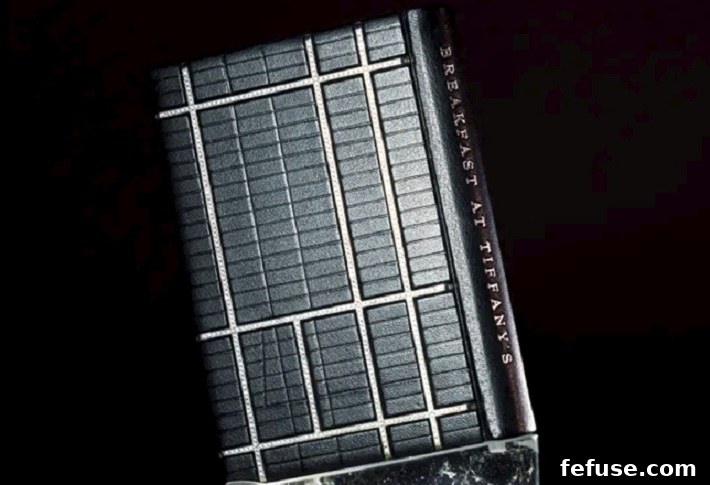
In a truly astonishing display of opulent craftsmanship and literary reverence, a signed first edition of Truman Capote’s iconic novella, “Breakfast at Tiffany’s,” has been transformed into an unparalleled work of art, commanding a staggering price of $1.5 million. This isn’t just a rare book; it’s a jewel-encrusted masterpiece, meticulously rebound with an astounding 1,000 carats of diamonds, merging the worlds of high literature, cinematic legacy, and bespoke jewelry into a single, breathtaking collectible. This extraordinary creation transcends the traditional boundaries of bookbinding, elevating it to an object of ultimate luxury and a profound symbol of the aspirational dreams encapsulated within Capote’s timeless narrative.
The Masterpiece Unveiled: A Dazzling Tribute to Manhattan and Tiffany’s
The cover of this unique edition is a testament to its intrinsic connection with the story’s setting and its titular jeweler. It features an intricately detailed map of Manhattan, rendered with astonishing precision and dazzling materials. The island’s bustling main streets are not merely printed lines but are brought to life through platinum pavé settings, shimmering with nearly 30 carats of meticulously placed white diamonds. This radiant topography guides the eye to a specific, iconic location: the intersection of Fifth Avenue and 57th Street. This address, synonymous with luxury and aspiration, marks the location of Tiffany & Co.’s legendary flagship store. To denote this hallowed ground, a magnificent two-carat emerald-cut sapphire has been precisely set, glowing in Tiffany’s signature robin’s egg blue. This singular detail not only pays homage to the jeweler central to Holly Golightly’s dreams but also encapsulates the essence of the brand’s enduring allure and its profound cultural impact. The combination of precious metals and gemstones crafts a tactile and visual experience that is as rich and complex as the city it depicts, making the cover itself a valuable piece of high jewelry.
The Literary Legacy: Truman Capote’s “Breakfast at Tiffany’s”
Before it became a diamond-studded marvel, “Breakfast at Tiffany’s” was, at its heart, a groundbreaking novella penned by the brilliant American author Truman Capote. Published in 1958, the story introduced the world to Holly Golightly, a captivating, enigmatic, and fiercely independent young woman navigating the sophisticated yet often lonely landscape of 1940s New York City. Capote’s prose is renowned for its elegance, wit, and poignant exploration of character. Holly, with her quirky charm, her penchant for late-night adventures, and her deeply felt desire for a sense of belonging, quickly became one of literature’s most enduring figures. The novella delves into themes of identity, freedom, loneliness, and the pursuit of happiness in a materialistic world, with Tiffany & Co. serving as a potent symbol of stability and aspirational luxury in Holly’s otherwise transient existence. The depth and timelessness of Capote’s writing ensure that the narrative remains relevant, continuing to enchant new generations of readers and cementing its place as a cornerstone of 20th-century American literature.
From Page to Silver Screen: The Iconic 1961 Film Adaptation
The novella’s profound cultural impact was amplified exponentially by its 1961 film adaptation, starring the incomparable Audrey Hepburn as Holly Golightly. Directed by Blake Edwards, the movie transcended its literary origins to become a cinematic touchstone, forever intertwining Hepburn’s elegance with the character of Holly. Hepburn’s portrayal of Holly Golightly, characterized by her iconic little black dress, oversized sunglasses, and timeless grace, captivated audiences worldwide. The film cemented Holly’s status as a fashion icon and a symbol of sophisticated bohemian chic. Its memorable opening scene, featuring Holly gazing into the windows of Tiffany & Co. on Fifth Avenue with a Danish pastry and coffee, became one of the most enduring images in cinematic history. This adaptation not only introduced Capote’s story to a broader audience but also indelibly linked Tiffany & Co. with dreams, aspiration, and the ultimate expression of New York luxury. The movie’s enduring popularity continues to drive interest in the original novella and the cultural phenomenon surrounding “Breakfast at Tiffany’s” even decades after its release, underscoring its profound influence on popular culture, fashion, and the perception of luxury.
The Artistry Behind the Binding: Merging Bookbinding with High Jewelry
The creation of this extraordinary diamond-bound edition is a testament to an exceptional collaboration between highly skilled artisans. The meticulous rebinding of the first edition was undertaken by award-winning British artist Kate Holland, celebrated for her innovative and exquisite work in fine binding. Holland’s expertise transformed the rare book into a three-dimensional work of art, a delicate balance between preserving the literary artifact and introducing an unprecedented level of embellishment. The dazzling diamonds, totaling an impressive 1,000 carats, were sourced by the esteemed London jewelers Bentley & Skinner. With a heritage spanning centuries, Bentley & Skinner are renowned for their expertise in acquiring and working with the finest diamonds and precious stones, often for royal families and discerning private collectors. Their involvement ensured that the diamonds used were of exceptional quality and ethical provenance. This partnership between Holland’s artistic vision and Bentley & Skinner’s unparalleled knowledge of high jewelry represents a pinnacle of craftsmanship, where traditional bookbinding techniques are elevated by the unparalleled brilliance of thousands of carefully selected diamonds, creating a piece that is as much a sculpture as it is a book.
Tiffany & Co.: An Enduring Symbol of Luxury and Aspiration
Central to the narrative of “Breakfast at Tiffany’s” and to the luxurious binding of this first edition is the venerable institution of Tiffany & Co. More than just a jewelry store, Tiffany’s has, for generations, embodied a dream of elegance, quality, and timeless aspiration. Founded in 1837, the brand quickly established itself as a purveyor of fine jewels, silver, and exquisite craftsmanship. Its distinctive robin’s egg blue, introduced for its iconic boxes, became instantly recognizable and synonymous with luxury and special occasions. For Holly Golightly, Tiffany’s was a sanctuary, a place where “nothing bad could ever happen.” This sentiment, echoed by millions, highlights the brand’s unique position not just as a retailer but as a cultural icon, representing stability, enduring value, and the fulfillment of dreams. The inclusion of a sapphire in Tiffany blue, marking the store on the diamond-studded cover, is a poignant acknowledgement of this enduring legacy and the symbiotic relationship between the brand and Capote’s narrative. It signifies not just a location, but a beacon of hope and a symbol of perfected beauty, making the book a physical manifestation of Holly’s own ultimate desires.
The Allure of Rare Books and High Collectibles: Understanding the $1.5 Million Valuation
The valuation of this diamond-bound “Breakfast at Tiffany’s” at $1.5 million places it squarely in the elite realm of ultra-luxury collectibles. This extraordinary price tag is not merely a reflection of the monetary value of its precious components—the diamonds, platinum, and sapphire—but also encompasses a multitude of factors that define the rare book market and the world of high art. Firstly, the item’s foundation as a signed first edition of a culturally significant work is inherently valuable. First editions, especially those signed by the author, are highly sought after by collectors for their historical significance and scarcity. Secondly, the bespoke, jewel-encrusted binding by renowned artisans adds an unparalleled layer of artistic and material value. This transformation elevates the book from a literary artifact to a unique piece of sculptural art and fine jewelry. Thirdly, its narrative connection to a beloved story and an iconic film enhances its desirability, appealing to collectors of film memorabilia, literary enthusiasts, and jewelry connoisseurs alike. Such items are not just purchases; they are investments in art, history, and cultural legacy, often appreciating in value due to their uniqueness and the prestige associated with their ownership. They represent the ultimate intersection of luxury, literature, and art, making them irresistible to a niche market of ultra-high-net-worth individuals who seek out objects of unparalleled beauty and historical significance.
Showcasing Rarity: Display at the ABAA New York International Antiquarian Book Fair
This magnificent diamond-bound first edition made its public debut and was on prominent display at the 64th annual ABAA New York International Antiquarian Book Fair. Held earlier this week, this prestigious event is a cornerstone of the rare book world, attracting leading dealers, passionate collectors, and institutions from across the globe. The ABAA Fair is renowned for showcasing an unparalleled selection of rare books, manuscripts, maps, and ephemera, ranging from ancient texts to modern first editions. The inclusion of such a uniquely luxurious item like the “Breakfast at Tiffany’s” edition undoubtedly served as a major highlight, drawing considerable attention and sparking conversations about the evolving landscape of collecting. Its presence at the fair underscores its status not only as a literary treasure but also as a significant piece of contemporary art and luxury craftsmanship. Such exhibitions provide a vital platform for these rare and often privately held treasures to be appreciated by a wider audience, solidifying their place in the cultural lexicon and inspiring awe with their beauty, history, and unparalleled artistry.
A Testament to Enduring Appeal: The Confluence of Culture and Craft
In conclusion, this $1.5 million diamond-bound first edition of “Breakfast at Tiffany’s” is far more than just an expensive book; it is a profound cultural artifact that brilliantly marries the enduring appeal of Truman Capote’s prose and Audrey Hepburn’s iconic portrayal with the exquisite artistry of high jewelry and bespoke craftsmanship. It stands as a powerful testament to the timeless allure of New York City, the aspirational dreams personified by Holly Golightly, and the unparalleled luxury symbolized by Tiffany & Co. This unique collectible transcends traditional categories, becoming a singular piece where literature, film, art, and opulence converge. It captures the imagination, reminds us of the power of storytelling, and reaffirms that true beauty, whether in words or in diamonds, holds an intrinsic value that transcends generations, continuing to inspire and captivate the most discerning collectors and admirers worldwide. Its existence is a celebration of enduring elegance and the boundless possibilities when creativity meets unparalleled resources.