
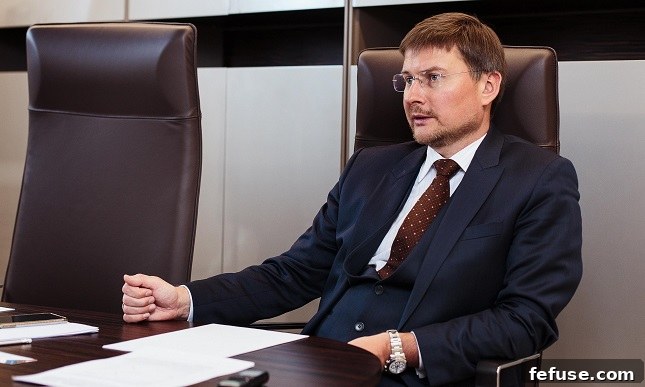
Sergey Ivanov Steps Down from Alrosa: Navigating Sanctions and Shifting Economic Tides
In a move signaling significant shifts within Russia’s corporate landscape, Sergey Ivanov is reportedly stepping down prematurely as CEO of Alrosa, the world’s leading diamond mining company and a crucial state-controlled enterprise in Russia. This development, widely circulated across various media outlets, comes as Ivanov is expected to transition into a new role within the private investment firm, Volga Group. The Volga Group, a prominent player in Russia’s industrial and energy sectors, is owned by Gennady Nikolayevich Timchenko, a billionaire businessman with long-standing ties and a close alliance with Russian President Vladimir Putin.
A Young Leader’s Tenure at Alrosa
Sergey Ivanov Jr.’s appointment to lead Alrosa in 2014 marked a notable moment in the company’s history. At just 36 years old, he became the youngest chief executive ever to head the diamond mining giant. His leadership was initially slated to continue until 2025, suggesting a planned, long-term strategic vision for the company under his guidance. Alrosa, a global powerhouse in diamond production, accounts for approximately one-third of the world’s rough diamond supply by carat, playing an indispensable role in both the global jewelry market and Russia’s national economy. Its operations, primarily concentrated in the resource-rich regions of Yakutia and Arkhangelsk, are vital for generating export revenues and employment within the country. Ivanov’s tenure was characterized by efforts to maintain Alrosa’s dominant market position amidst fluctuating global demand and evolving industry standards, including increasing focus on responsible sourcing and transparency, albeit often under the shadow of its state ownership.
However, the geopolitical landscape dramatically shifted, casting a long shadow over Russian executives and state-affiliated entities. In February, Sergey Ivanov was officially classified as a Specially Designated National (SDN) by the USA’s Office of Foreign Assets Control (OFAC). This designation is a severe measure, effectively freezing any assets he holds within U.S. jurisdiction and generally prohibiting U.S. persons from dealing with him. His father, Sergei Borisovich Ivanov, a highly influential figure described by the U.S. Treasury Department as “reportedly one of Putin’s closest allies,” also received the SDN classification. The implications of such a designation are far-reaching, isolating individuals from the international financial system and severely limiting their ability to conduct business globally. Furthermore, Sergey Ivanov Jr. holds a board position at Gazprombank, one of the significant Russian financial institutions that faced sanctions from the U.S. following Russia’s full-scale invasion of Ukraine, adding another layer of complexity to his professional standing.
The Reshaping of Russia’s Economic Elite: The Volga Group and Gennady Timchenko
The reported move to the Volga Group places Ivanov within a different, yet equally influential, segment of Russia’s economy. The Volga Group stands as a formidable private investment firm with a vast portfolio spanning energy, logistics, infrastructure, and financial services. Headed by Gennady Timchenko, a figure synonymous with Russia’s economic power structure, the group embodies the intricate connections between private wealth and state influence in the country. Timchenko, a billionaire whose relationship with Vladimir Putin dates back to the early 1990s in St. Petersburg, has built an empire that commands significant strategic assets for Russia.
The Volga Group boasts a substantial workforce of 90,000 employees, underscoring its immense scale and economic footprint. Its strategic holdings include significant stakes in key national enterprises: Novatek and Sibur. Novatek is Russia’s largest independent natural gas producer, a critical player in the global energy market, especially given Europe’s historical reliance on Russian gas supplies. The company specializes in the exploration, production, processing, and marketing of natural gas and liquid hydrocarbons, operating vast resource bases, particularly on the Yamal Peninsula. Its projects, like Yamal LNG and Arctic LNG 2, are pivotal to Russia’s strategy of expanding its share in the global liquefied natural gas (LNG) market. Timchenko’s involvement through the Volga Group ensures a close alignment of private sector ambition with national energy policy, vital for Russia’s geopolitical leverage and economic stability.
Similarly, Sibur is Russia’s largest integrated petrochemicals company and one of the fastest-growing companies in the global petrochemical industry. It operates across the entire petrochemical value chain, from gas processing and polymer production to advanced plastic materials. Sibur’s products are essential for a multitude of industries, including construction, automotive, agriculture, and consumer goods. The strategic importance of Sibur to Russia cannot be overstated; it forms a cornerstone of the country’s industrial diversification efforts and helps process vast quantities of associated petroleum gas, reducing waste and creating high-value products. The Volga Group’s significant stake in Sibur further cements its influence over critical sectors that underpin Russia’s industrial base and export capabilities.
Sanctions and Succession: Broader Implications for Russian Business
Sergey Ivanov’s departure from Alrosa and his reported move to the Volga Group must be viewed through the lens of heightened international sanctions against Russia following its actions in Ukraine. The SDN designation is not merely symbolic; it imposes real constraints on an individual’s financial and professional life. For a high-profile executive like Ivanov, operating a state-controlled entity like Alrosa while under such restrictions would undoubtedly present immense challenges, particularly in dealing with international partners, accessing global capital markets, and maintaining the company’s reputation abroad. His transition to a private firm like the Volga Group, which itself has faced Western scrutiny and sanctions related to its ownership, may reflect a strategic realignment designed to consolidate influence within Russia’s domestic economic sphere, away from the direct, day-to-day exposure of a globally integrated state-owned enterprise.
The changes in leadership at Alrosa could have various implications for the diamond industry. Alrosa’s dominant position means that any significant strategic shift or change in operational focus could ripple through the global market. While the company operates largely outside the direct scope of some Western sanctions due to the nature of rough diamonds as a commodity, the broader financial restrictions and reputation risks still affect its international dealings. The move could also be interpreted as part of a wider trend where individuals closely associated with the Kremlin, and targeted by sanctions, are repositioned into roles where their influence can still be exerted, albeit perhaps with a more domestically focused or strategically controlled mandate.
Gennady Timchenko’s Volga Group, despite being private, operates with a clear understanding of, and often in close concert with, Russia’s strategic economic interests. Ivanov joining such an entity suggests a continuity of expertise and influence within Russia’s elite circles, regardless of the specific corporate vehicle. It highlights the enduring power of these interconnected networks in managing key sectors of the Russian economy, adapting to external pressures, and furthering the nation’s strategic objectives.
Conclusion: A New Chapter in Russia’s Economic Narrative
Sergey Ivanov’s anticipated move from the helm of Alrosa to the Volga Group represents more than a simple executive reshuffle. It is a nuanced development that encapsulates the current dynamics of Russia’s political economy, particularly in the face of unprecedented international sanctions. It underscores the challenges faced by leaders of state-controlled enterprises operating on a global scale while personally sanctioned, and illustrates the adaptive strategies employed by Russia’s economic elite. This transition to a strategically vital private conglomerate like the Volga Group, under the stewardship of Gennady Timchenko, points towards a consolidation of talent and influence within a system designed to withstand external pressures and secure Russia’s long-term economic and geopolitical interests. As Alrosa seeks new leadership and the Volga Group potentially expands its operational scope with Ivanov’s addition, the episode further illuminates the intricate interplay of power, politics, and commerce shaping Russia’s path forward.