
Reinventing Amber: Poland’s Fusion of Ancient Beauty and Modern Design
For centuries, amber has captivated humanity with its warm, golden luminescence and profound historical roots. Revered as “Baltic gold,” this fossilized tree resin, often preserving ancient life within its depths, once embarked on epic journeys along the fabled Amber Road, reaching distant Mediterranean markets. Traditionally cherished for its classical elegance and symbolic value, amber is now experiencing an extraordinary renaissance in Poland, spearheaded by a new generation of visionary designers. These innovative artists are expertly blending time-honored craftsmanship with cutting-edge technology, pushing the boundaries of contemporary jewellery design and transforming an ancient material into modern masterpieces.
Gdansk: The World’s Amber Capital Embraces Innovation
At the heart of this creative revolution lies Gdansk, Poland’s enchanting Baltic coastal city, universally acknowledged as the world’s primary hub for amber. This city, with its rich heritage deeply intertwined with the amber trade, serves as the perfect crucible for designers eager to reinterpret this precious gemstone for the 21st century. The legacy of amber in Gdansk is not merely historical; it’s a living tradition that continuously inspires innovation. Here, the pursuit of beauty is intertwined with a forward-thinking approach, where the spirit of ancient artisans meets the ingenuity of digital pioneers.
The Academy of Fine Arts in Gdansk: Nurturing Digital Artisans
The vanguard of this transformation is the prestigious Academy of Fine Arts in Gdansk. Within its dynamic studios, students are engaged in a fascinating exploration of innovative techniques, striving to transform ancient fossil resin into striking, contemporary statement pieces. The academy’s curriculum is deliberately designed to foster a holistic approach, encouraging students to master both traditional craftsmanship tools, such as precision drills and sanders, and sophisticated digital systems. This dual mastery empowers young creators to transcend conventional design limitations and unlock unprecedented creative possibilities. The focus is not just on creating beautiful objects, but on understanding the entire design process, from conceptualization to flawless execution, thereby shaping the future of jewellery design.
Digital Craftsmanship: From Virtual Reality to Precision Milling
Step into the high-tech studios of the Academy, and you’ll find a vibrant ecosystem where imagination meets advanced technology. Virtual reality (VR) and sophisticated digital modeling tools have become indispensable assets, allowing students to meticulously conceptualize, visualize, and refine intricate designs in a virtual space before committing to physical production. This digital prototyping phase significantly streamlines the design process, enabling rapid iteration and perfection.
For aspiring designers like Martyna Golinska, mastering the intricate interplay between creative vision and technical execution is paramount to driving innovation. Golinska’s particular fascination lies with CNC (Computer Numerical Control) milling, a precision technology more commonly found in high-stakes industries such as aerospace engineering and medical device manufacturing. By applying such industrial-grade precision to the delicate art of jewellery, designers can achieve levels of detail and consistency previously unattainable through manual methods alone.
Her peer, Paulina Smigiel, eloquently articulates another significant challenge in this new paradigm: the complex task of translating nuanced artistic ideas into precise digital commands that machines can interpret and execute flawlessly. This process demands a unique blend of artistic sensitivity and technical acumen. When successfully navigated, these advanced techniques drastically reduce, or even entirely eliminate, the need for extensive manual intervention, leading to the creation of highly refined, geometrically perfect, and consistently reproducible pieces. This fusion of art and algorithm is fundamentally redefining the very definition of craftsmanship in the modern era.
Beyond Tradition: New Forms, Materials, and Artistic Expressions
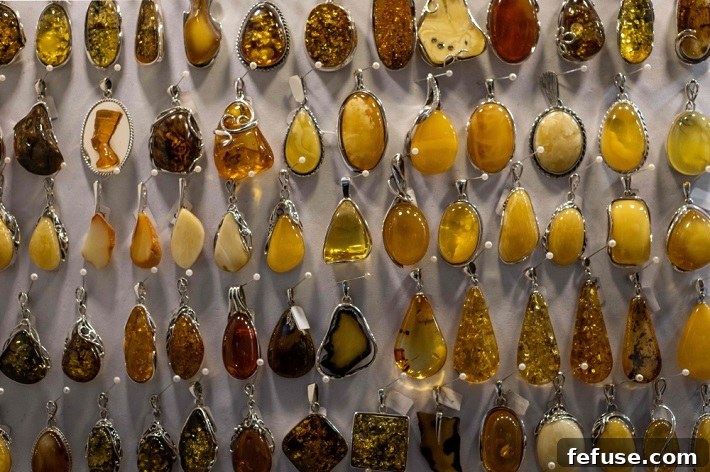
The outcomes of this innovative approach are diverse and breathtaking, moving far beyond the expected. Designers are crafting an astonishing array of jewellery, from elegant rings and graceful necklaces to more experimental and avant-garde forms such such as elaborate masks and ornate tiaras. What truly sets these creations apart is the daring integration of amber with an eclectic palette of modern materials, including lustrous gold, sleek silver, and robust titanium. These meticulously crafted pieces—whether meticulously 3D-printed or flawlessly machine-milled—represent a radical departure from the mass-produced, often generic amber souvenirs traditionally associated with Poland. They embody a fresh, contemporary aesthetic that respects amber’s heritage while propelling it into a bold new design landscape.
Zuzanna Franczak, a dynamic young instructor at the Academy, underscores the institution’s philosophy: students are not only encouraged to master established jewellery-making techniques but also to fearlessly explore cutting-edge, emerging technologies. This includes delving into the potential of artificial intelligence (AI) as a design assistant, a tool for generating new patterns, or even for optimizing manufacturing processes. This progressive outlook empowers each student to develop their own unique and distinctive design language, ensuring that their work stands out in the global jewellery market. The academy is cultivating not just designers, but true innovators who are prepared to shape the future of their craft.
Showcasing the Future: Exhibitions and Cultural Connections
The remarkable results of this creative evolution are regularly showcased in prestigious exhibitions across Poland and internationally. Notably, many of these innovative displays find a fitting home at the Amber Museum along the scenic Baltic coast. This museum is not merely a venue for showcasing new designs; it serves as a powerful bridge, connecting the vibrant contemporary work of today’s designers with the rich, storied history of amber. Situated in a region historically and inextricably linked to the ancient Amber Road trade route, the museum provides a context where visitors can appreciate how “Baltic gold” once journeyed to distant Mediterranean markets during classical antiquity, and how it continues its journey of transformation today.
Exhibitions at such venues offer invaluable platforms for these emerging designers to gain recognition, attract connoisseurs, and inspire future generations. They highlight the ongoing cultural significance of amber, demonstrating that while its physical journey as a trade commodity has changed, its artistic and conceptual journey continues with renewed vigor. These displays challenge preconceived notions of amber, positioning it not just as a historical artifact, but as a dynamic medium for contemporary artistic expression, capable of evoking both awe for its ancient origins and admiration for its modern interpretations.
The Enduring Allure of Amber: A Rich History, A Bright Future
Amber’s intrinsic appeal is deeply rooted in its geological history and unique characteristics. Formed approximately 40 million years ago from the fossilized resin of ancient trees, each piece of amber is a miniature time capsule. It frequently encapsulates perfectly preserved plant matter, tiny air bubbles, or even insects, rendering every specimen utterly unique. This captivating individuality is a cornerstone of its allure, ensuring that no two amber pieces are ever identical, offering an exclusive connection to prehistoric ecosystems.
Its cultural significance transcends mere aesthetics, spanning millennia and diverse civilizations. Amber was admired by some of history’s most influential figures, including the Roman poet Ovid, the powerful Emperor Nero, and the renowned naturalist Pliny the Elder, who meticulously documented its origins and perceived mystical properties. Beyond the Roman Empire, amber held profound symbolic and therapeutic value in regions as disparate as ancient China, where it was believed to embody the “soul of the tiger,” and across the Muslim world, where it was cherished for its perceived protective qualities and use in prayer beads. This rich tapestry of historical reverence and symbolic meaning provides a powerful foundation upon which contemporary designers can build, linking their modern creations to a lineage of timeless fascination.
Appealing to a New Generation: Originality Over Convention
Despite this incredibly deep-rooted heritage, today’s forward-thinking designers firmly believe that the true future of amber lies in courageous experimentation. Student designers, such as Dominika Afeltowicz, exemplify this philosophy, championing innovation over rigid adherence to tradition. Their strategic goal is clear: by fearlessly exploring new forms, textures, and fabrication techniques, they aim to cultivate a fresh aesthetic that resonates deeply with younger audiences. These contemporary consumers are increasingly seeking originality, personal expression, and a narrative that speaks to modern sensibilities, rather than merely reinterpreting conventional designs. This shift is not about abandoning tradition, but about recontextualizing it in a way that feels relevant and exciting to a new generation of jewellery enthusiasts.
Under the insightful guidance of accomplished artist Slawomir Fijalkowski, students are continually encouraged to evolve their creative approaches. Fijalkowski’s mentorship emphasizes a critical balance: fostering relentless innovation while simultaneously upholding the highest standards of craftsmanship. This philosophy ensures that while designs may be daring and unconventional, the quality and artistry of their execution remain impeccable. Whether these sophisticated, modern amber creations are destined for discerning commercial markets or prestigious art galleries, they collectively embody a fresh, dynamic vision. They powerfully demonstrate how an ancient, natural material can be seamlessly integrated with cutting-edge contemporary design, creating pieces that are both historically informed and strikingly forward-looking, bridging the chasm between the echoes of the past and the aspirations of the future.