
The Evolving Challenge of Moissanite Identification: Staying Ahead with Advanced Testers
The journey of synthetic moissanite within the jewelry industry has been marked by continuous innovation and, consequently, evolving challenges in its identification. When this remarkable diamond simulant first appeared on the scene in the 1990s, it quickly garnered attention for its ability to deceive traditional thermal testers. These devices, long relied upon to distinguish genuine diamonds from less convincing simulants like cubic zirconia (CZ), proved ineffective against moissanite’s unique thermal properties. This breakthrough in material science spurred a new wave of testing technology, leading to the development of specialized moissanite testers. For a period, even Charles & Colvard, then known as C3, the leading manufacturer of synthetic moissanite, offered its own detection device to help the industry navigate this new landscape.
However, the industry faces yet another sophisticated hurdle with the introduction of newer generations of moissanite, particularly the highly acclaimed “Forever One” line. Marketed for its exceptional brilliance and purer composition, Forever One moissanite presents a renewed challenge to existing identification tools, raising concerns that even the relatively newer moissanite testers might be fooled. This warning comes from industry experts like Danny Kessler, co-CEO of Sy Kessler Sales, a prominent name in jewelry testing equipment. The ongoing evolution of moissanite means that the methods of detection must continuously adapt to maintain accuracy and uphold consumer confidence in the precious metals and gemstone market.
The Shifting Sands of Moissanite Detection Technology
Early moissanite testers primarily relied on measuring the electrical conductivity of the stone, a property that differentiated first-generation moissanite from natural diamonds. While effective for its time, this method is increasingly becoming less reliable against the advancements in moissanite synthesis. According to Kessler, the electrical conductivity of Forever One moissanite is not uniform across all stones. “Some of it’s just barely electrically conductive,” he explains, highlighting the variability that complicates detection. He estimates that a significant portion—approximately half—of Forever One moissanite can still be identified by these veteran electrical conductivity testers. However, the other half remains undetectable by these established methods, creating a substantial gap in the industry’s ability to accurately identify these stones.
This variability poses a critical problem for jewelers, appraisers, and pawnbrokers who rely on quick and accurate identification. Misidentifying a moissanite as a diamond, or vice versa, can have significant financial implications and erode trust. The development of purer moissanite, closer in composition and appearance to natural diamonds, demands more advanced and nuanced detection techniques that can account for these subtle differences in physical properties.
Introducing Advanced Detection: The Power of UV Light
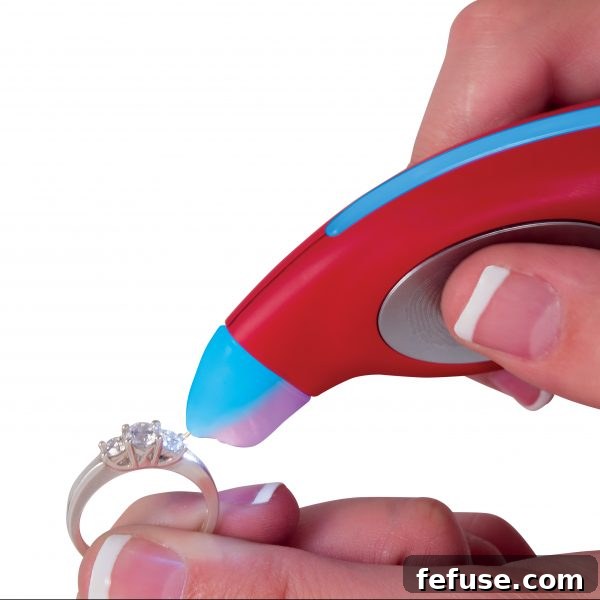
In response to these escalating challenges, companies like Sy Kessler Sales have dedicated resources to developing next-generation testing solutions. Kessler’s company, through its GemOro brand, has engineered three distinct testers designed to identify all types of moissanite, including the elusive Forever One. These innovative devices utilize an ultraviolet (UV) light mechanism, a significant departure from previous thermal or electrical conductivity methods. The principle behind UV testing involves stimulating the atoms within the moissanite, causing them to react in a specific way that makes the stones easier to identify. This reaction, often manifesting as unique fluorescence or phosphorescence under UV light, provides a more definitive identifier that is less susceptible to the compositional variations seen in newer moissanite.
The scientific basis for UV light testing is rooted in the atomic structure of moissanite. When exposed to specific wavelengths of UV light, the trace elements and structural defects within the moissanite crystal lattice absorb energy and then re-emit it as visible light, or sometimes as a different wavelength of UV light. This phenomenon, known as photoluminescence, is distinct for moissanite compared to natural diamonds or other simulants, offering a reliable spectroscopic signature. This method represents a significant leap forward, providing the industry with a powerful tool to maintain accuracy in a constantly evolving market.
Navigating Industry Risks and Mislabeled Stones
While the broader jewelry industry’s attention is currently focused on the burgeoning market of lab-grown diamonds and the challenges associated with their detection, Kessler emphasizes that the risk of mislabeled moissanite should not be overlooked. He points out a growing concern regarding moissanite being purchased unknowingly at “take-in counters” – locations where jewelers or pawnbrokers acquire stones from the public. The increasing sophistication of moissanite means that even seasoned professionals can be misled.
“I know diamond cutters that have been fooled by this new moissanite,” Kessler states, highlighting the severity of the issue. The frequent calls received by tester manufacturers underscore this problem: “As a tester manufacturer, we get calls weekly asking, ‘Why is my tester not identifying this moissanite?’” These calls are a clear indicator of the widespread confusion and the urgent need for more effective and universally reliable testing equipment.
The ramifications of misidentification extend beyond financial losses; they can damage the reputation of jewelers and erode consumer trust. If customers discover that a stone they purchased as a diamond is, in fact, moissanite, or vice versa, it can lead to legal disputes and a significant blow to the store’s credibility. Therefore, equipping every point of sale and evaluation with accurate tools is paramount to maintaining the integrity of the jewelry market.
Beyond Technology: The Human Element in Identification
Of course, traditional gemological methods, such as observing a stone’s double refractivity under magnification, can also distinguish moissanite from diamonds. Diamonds are singly refractive, while moissanite exhibits strong double refractivity, which causes a “doubling” effect when viewed through certain facets. This is a definitive visual characteristic for trained gemologists. However, Kessler is quick to point out a practical limitation: “not all people are trained gemologists.”
He elaborates, “There are a good many clerks in jewelry stores.” This observation highlights a crucial aspect of the issue: the majority of frontline staff in jewelry retail environments may not possess the specialized training required for advanced gemological identification. These individuals often rely on quick, user-friendly, and highly accurate electronic testers to perform their duties efficiently. Therefore, while gemological expertise remains invaluable, the accessibility and reliability of advanced testing equipment become indispensable for the day-to-day operations of the wider jewelry industry, ensuring consistent accuracy regardless of individual training levels.
Industry Collaboration and Future Outlook
The importance of reliable testing solutions is recognized by key players in the industry. Charles & Colvard, while stating to JCK that “it is not an expert on testers,” confirmed its collaboration with GemOro on its detection device and actively recommends it on its official website. This endorsement from the leading moissanite manufacturer itself speaks volumes about the efficacy and necessity of such advanced tools in the market.
The ongoing evolution of synthetic gemstones, particularly diamond simulants like moissanite and the increasing prevalence of lab-grown diamonds, mandates a continuous commitment to research and development in identification technology. The jewelry industry must remain vigilant, investing in the latest tools and providing comprehensive training to ensure that both consumers and businesses are protected. As new materials emerge and existing ones become more refined, the ability to accurately and confidently identify stones will remain a cornerstone of trust and transparency in the global jewelry trade. The story of moissanite detection serves as a powerful reminder that in the world of precious stones, staying ahead of technological advancements is not just an advantage, but a necessity.
News Source: http://www.jckonline.com