
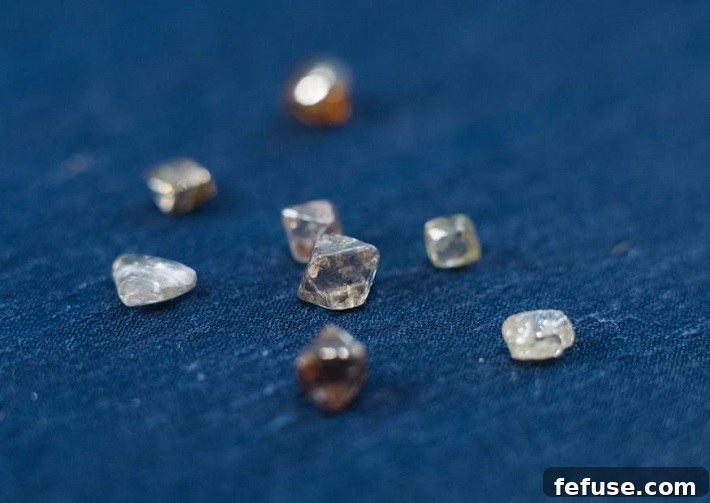
The global diamond industry, a fascinating blend of ancient geology and modern commerce, witnessed a period of significant recalibration in 2023. At the forefront of this dynamic landscape, De Beers, a world leader in diamond mining and sales, navigated a complex interplay of strategic operational shifts and evolving market dynamics. Their rough diamond production for the fourth quarter of 2023 saw a modest 3% decline, settling at 7.9 million carats. This reduction was largely a pre-planned outcome, primarily driven by the pivotal transition of the Venetia mine in South Africa from its long-standing open-pit operations to a more technologically advanced and sustainable underground mining model. While South Africa’s output temporarily scaled back, this was partially counterbalanced by robust production increases in Botswana, underscoring the company’s diversified operational footprint and strategic resource management.
Looking at the broader picture for the entire year, De Beers’ full-year 2023 diamond output registered an 8% decrease, moving from 34.6 million carats in 2022 to 31.9 million carats. This comprehensive overview highlights not only the immediate impacts of specific mining transitions but also the cumulative effects of strategic decisions and market adjustments throughout the year. Understanding these figures requires a deeper dive into the regional contributions, the challenges faced, and the strategic investments being made to secure future supply and maintain market leadership in a continually evolving global economy. These shifts reflect a conscious effort by De Beers to adapt to both environmental sustainability demands and the long-term economic viability of its key assets.
De Beers’ 2023 Diamond Production: A Regional Deep Dive
Botswana: A Pillar of Stability and Growth
Botswana, a nation synonymous with high-quality diamonds and a long-standing partner with De Beers through the Debswana joint venture, continued to be a cornerstone of the company’s production profile. In the fourth quarter of 2023, production in Botswana notably surged by 6% to 6.1 million carats. This impressive performance was principally attributed to enhanced operational efficiencies, particularly increased plant throughput at the Orapa mine. The strategic scheduling of maintenance activities, leading to planned lower downtime, allowed for continuous and optimized processing of ore, maximizing carat recovery during this critical period. For the full year, Botswana’s output demonstrated remarkable consistency, holding steady with a marginal 2% increase, reaching 24.7 million carats. This sustained high level of production from Botswana is critical for De Beers, providing a reliable supply of rough diamonds to the global market and demonstrating the success of ongoing investments in operational excellence and infrastructure within the region. The partnership with Botswana remains a model for responsible resource development and economic contribution.
South Africa: Navigating the Venetia Underground Transition
South Africa presented a more complex narrative for De Beers in 2023, primarily due to the monumental transformation underway at the Venetia mine. The fourth quarter saw a significant 54% decrease in production, falling to 0.4 million carats. This sharp decline was a direct and anticipated consequence of the planned cessation of Venetia’s open-pit operations in December 2022. The transition to underground mining is a multi-year project, representing a substantial investment in the future of diamond mining in South Africa, extending the mine’s life by several decades. During this ramp-up phase for the underground operations, Venetia will strategically continue to process lower-grade surface stockpiles. This approach allows for a staggered production flow, providing a bridge of supply while the complex infrastructure and operational systems for underground mining are fully established and optimized for full-scale production. The full-year output from South Africa starkly reflects this transitional period, plummeting 64% to 2.00 million carats. While these figures represent a temporary dip in immediate output, they are indicative of a long-term strategic pivot aimed at securing a sustainable future for the Venetia mine, ensuring its continued contribution to the local economy and global diamond supply.
Namibia: Steady Growth Amidst Operational Adjustments
De Beers’ operations in Namibia, renowned for their high-value marine diamonds, exhibited a nuanced performance throughout the year. In Q4, production saw a slight decrease of 4% to 0.6 million carats. This marginal dip was primarily due to slightly lower grades encountered in the land operations during that specific quarter. Such fluctuations in grade are a natural part of mining and are carefully managed through geological planning and extraction strategies. However, the comprehensive full-year picture painted a more positive trajectory, with Namibia’s total output growing by an impressive 9% to 2.32 million carats. This annual growth underscores the underlying strength and efficiency of De Beers’ Namdeb operations, which skillfully integrate both land-based and highly specialized marine mining techniques. The ability to consistently recover high-quality diamonds from challenging offshore environments, coupled with steady performance from land assets, demonstrates the technological prowess, strategic importance, and robust operational resilience of Namibia to De Beers’ overall portfolio.
Canada: Strategic Ore Processing and Consistent Contributions
Canada, another crucial region for De Beers’ northern operations, also contributed significantly to the overall production narrative. Q4 production experienced a modest 3% decrease, reaching 0.79 million carats. This was largely a result of the planned treatment of lower-grade ore, a common and economically sound practice in mining designed to optimize resource utilization and manage operational costs over the long term. Processing lower-grade ore allows companies to extend the life of a mine and recover additional value from existing resources. Despite this quarterly adjustment, Canada’s full-year output for 2023 registered a slight but positive growth of 1%, concluding at 2.83 million carats. This consistent contribution from Canadian mines highlights their reliability and strategic role in De Beers’ global supply network, providing a diversified source of diamonds and demonstrating effective resource management strategies tailored to local geological conditions and market demands. It reinforces De Beers’ commitment to its Canadian assets and their long-term potential.
Market Dynamics and Diamond Sales in a Shifting Landscape
The diamond market in 2023 was characterized by a palpable sense of caution among Sightholders, De Beers’ accredited buyers of rough diamonds. This cautious approach significantly influenced purchasing patterns, particularly during the fourth quarter. De Beers responded proactively by offering full flexibility for rough diamond allocations during Sights 9 and 10, a crucial measure allowing buyers to adjust their commitments in response to prevailing market conditions. These conditions were multifaceted, including broader global economic uncertainties, rising interest rates impacting consumer discretionary spending, and notably, extended cutting and polishing factory closures in India. The Indian midstream, a critical hub for diamond processing, had implemented a two-month voluntary import moratorium on rough diamonds. This unprecedented measure was taken to manage inventory levels, stabilize prices, and absorb excess supply in the pipeline, which had built up due to slower demand in key consumer markets, particularly the US and China.
Consequently, the volume of rough diamond sales directly reflected these challenging market dynamics and the cautious sentiment across the value chain. Total sales for the two Sights held in Q4 amounted to only 2.7 million carats. This figure represents a stark contrast to previous periods: 7.3 million carats from two Sights in Q4 2022 and 7.4 million carats from three Sights in Q3 2023. The significant drop underscores the severity of the market slowdown and the immediate impact of the Indian moratorium and general buyer hesitancy. It highlighted the interconnectedness of the diamond value chain, where disruptions in one segment, such as the polishing centers, quickly ripple through to impact rough diamond sales. This period emphasized the importance of agile supply chain management, responsive pricing strategies for major producers like De Beers, and clear communication with stakeholders to navigate such complex market environments effectively.
Financial Performance and Pricing Trends
The challenging market conditions also had a noticeable effect on De Beers’ financial returns and the average price realised for its rough diamonds. The full-year consolidated average realised price for De Beers’ rough diamonds experienced a significant decrease of 25%, settling at $147 per carat, compared to $197 per carat in 2022. Several factors contributed to this substantial decline, painting a clear picture of the market pressures. Firstly, there was a larger proportion of lower-value rough diamonds being sold throughout the year. This shift in sales mix can occur due to various reasons, including changes in the specific mix of diamonds recovered from mines, strategic inventory management decisions to clear certain stock, or a general preference by buyers for more affordable goods in a cautious economic climate. Secondly, and more broadly, the average rough price index itself saw a 6% decrease, indicating a general softening of rough diamond prices across the market. This reflects an imbalance between supply and demand, coupled with the cumulative effect of reduced purchasing activity from the midstream sector and broader macroeconomic headwinds. The combination of these factors underscores the significant pressure on revenue generation within the diamond industry during this period, requiring producers to carefully manage costs and adapt their sales strategies to maintain profitability.
De Beers’ Future Outlook and Strategic Guidance for 2024
Despite the headwinds experienced in 2023, De Beers remains steadfast in its strategic outlook and operational planning. The company has maintained its production guidance for 2024, projecting an output of between 29 million and 32 million carats. This consistent guidance signals confidence in their operational capabilities and a strategic commitment to meeting anticipated future demand as market conditions stabilize. It also suggests that the major transitional projects, such as Venetia’s complex shift to underground mining, are progressing as planned and are factored into these projections, indicating effective project management. Maintaining this production level is crucial for De Beers to sustain its market share and ensure a steady, reliable supply for its Sightholders as global consumer demand gradually recovers. This forward-looking stance demonstrates De Beers’ long-term vision and its foundational role in the global diamond supply chain.
Furthermore, De Beers has provided a unit cost guidance of approximately $80 per carat for 2024. This figure is a critical indicator of operational efficiency and stringent cost management. Achieving this unit cost amid ongoing inflationary pressures and the complexities of large-scale mining operations, especially during transitional periods, highlights the company’s continuous focus on optimizing its cost base. Effective cost control is paramount in an industry where rough diamond prices can fluctuate due to external market forces. By managing unit costs effectively, De Beers aims to maintain healthy margins and ensure the long-term profitability and sustainability of its mining assets. This comprehensive, forward-looking guidance provides valuable insights into De Beers’ strategic planning, balancing production volume with cost efficiency, and positioning the company to adapt proactively to the evolving global diamond market in the years to come, securing its position as a resilient industry leader.
In conclusion, 2023 was a year of strategic consolidation and significant adaptation for De Beers. While facing temporary production dips due to essential long-term projects like the Venetia underground transition and navigating a challenging market environment characterized by global economic uncertainties and a significant Indian import moratorium, the company demonstrated remarkable resilience. Its diversified global operations, particularly the consistent strength from Botswana and strategic adjustments in other regions, allowed it to mitigate some impacts. The proactive approach to market flexibility for Sightholders and a clear, stable outlook for 2024 production and costs underline De Beers’ commitment to leadership in the diamond industry, preparing for renewed growth as market conditions stabilize and consumer confidence rebuilds globally. De Beers continues to focus on operational excellence, sustainability, and market responsiveness to navigate the dynamic future of the diamond sector.