
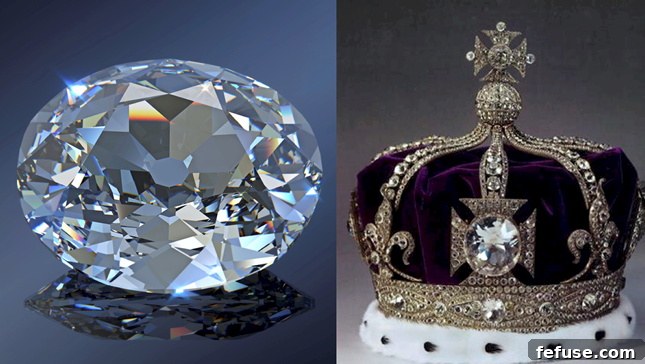
The Koh-i-Noor Diamond: India’s Resurgent Call for Repatriation
The ancient and infinitely captivating Koh-i-Noor diamond, a jewel steeped in centuries of power, conquest, and unparalleled grandeur, is once again at the forefront of a significant diplomatic discussion between India and Britain. Following the recent coronation of King Charles III, which saw Queen Camilla wear a crown notably devoid of the iconic 105.6-carat Golconda gem, the Indian government has signaled its firm intent to renew vigorous diplomatic efforts to secure the diamond’s return. This strategic move underscores a broader, deeply personal commitment by India’s leadership to reclaim its historical artifacts, marking a pivotal moment in the ongoing global debate over colonial legacies and the restitution of cultural heritage.
The decision to omit the Koh-i-Noor from Queen Camilla’s crown during the coronation ceremony was a deliberate choice, widely interpreted as an attempt by the British monarchy to de-escalate potential tensions and acknowledge the highly sensitive history surrounding the gem. However, this gesture, while significant, appears to have only strengthened India’s resolve. The renewed push for repatriation is understood to emanate directly from the highest levels of Indian government, with Prime Minister Narendra Modi personally championing the cause of bringing India’s lost treasures back home. Govind Mohan, secretary for the Indian Ministry of Culture, clearly articulated this profound commitment to the Daily Telegraph, stating, “The thrust of this effort to repatriate India’s artefacts comes from the personal commitment of Prime Minister Narendra Modi, who has made it a major priority.”
A Diamond’s Epic Journey: Tracing the Koh-i-Noor’s Path Through Empires
To truly grasp the immense historical weight and the profound controversy surrounding the Koh-i-Noor diamond, one must embark on a journey through its extraordinary and often tumultuous past. Its exact origins are shrouded in legend, but it is widely accepted that the diamond was discovered in the Kollur Mine, one of the famed Golconda mines nestled in the Krishna River basin of what is now Andhra Pradesh, India, sometime in the 13th or 14th century. For centuries, these mines held the unique distinction of being the world’s only source of diamonds, producing many of history’s most legendary and invaluable gems.
The Koh-i-Noor’s earliest historically verified owners were the Kakatiya dynasty, who presided over a powerful kingdom in South India. From there, it transitioned through the hands of various Hindu rulers before ultimately falling into the possession of the mighty Mughal Empire in the 16th century. Under the Mughals, the diamond ascended to an unparalleled status, becoming an integral part of the opulent imperial regalia. It famously adorned the fabled Peacock Throne of Emperor Shah Jahan, a testament to its immense size and breathtaking brilliance. During this era, its status as a symbol of immense wealth, divine power, and imperial grandeur was solidified, truly earning its later moniker, “Mountain of Light.”
The diamond’s journey beyond the Indian subcontinent commenced dramatically in 1739 when the Persian invader Nader Shah launched a devastating sack of Delhi. Among the vast and unimaginable treasures plundered during this invasion was the Koh-i-Noor. It was Nader Shah himself who, upon witnessing its dazzling brilliance, is said to have bestowed upon the diamond its iconic and enduring name, “Koh-i-Noor.” Following Nader Shah’s assassination, the diamond embarked on a turbulent period, changing hands repeatedly among various Afghan rulers amidst widespread political instability and violence. Eventually, after decades of peregrination, it found its way back to India, not under Mughal rule, but into the flourishing Sikh Empire.
Maharaja Ranjit Singh, the revered founder of the Sikh Empire in the early 19th century, successfully acquired the Koh-i-Noor. It quickly became the most prized possession of the Sikh kingdom, embodying its sovereignty, prosperity, and formidable power. The Maharaja famously wore it on his arm and was deeply attached to the magnificent jewel. Following his death in 1839, the diamond passed to his young successor, Maharaja Duleep Singh, marking a tragically critical juncture in its illustrious yet contentious history.
The British Acquisition: A Legacy Defined as a “Symbol of Conquest”
The mid-19th century witnessed the relentless expansion of British colonial power across the Indian subcontinent. The Anglo-Sikh Wars, fiercely fought between the formidable British East India Company and the Sikh Empire, proved decisive in altering the geopolitical landscape of the region. Following the ultimate defeat of the Sikh forces in the Second Anglo-Sikh War in 1849, the British East India Company annexed Punjab, the heartland of the Sikh kingdom. As an integral and deeply symbolic part of the Treaty of Lahore, signed on March 29, 1849, the Koh-i-Noor diamond, along with other invaluable assets of the Sikh kingdom, was formally ceded to Queen Victoria. Clause III of the treaty explicitly stipulated: “The gem called the Koh-i-Noor, which was taken by Maharajah Runjeet Singh from Shah Sooja-ool-Moolk, shall be surrendered by the Maharajah of Lahore to the Queen of England.”
This acquisition, historically characterized by Britain as a legal transfer executed under treaty, has consistently been viewed by India and numerous other nations as an unequivocal act of colonial seizure and coercion. The young Maharaja Duleep Singh, barely a child at the time, was compelled to sign the treaty, and the profoundly imbalanced circumstances surrounding the transfer have fueled enduring arguments about its moral and legal legitimacy. This crucial historical context forms the bedrock of the contemporary and increasingly vocal calls for the diamond’s repatriation. In a truly significant development earlier this year, Britain officially recognized the gem as a “symbol of conquest,” a powerful acknowledgement of the contentious and coercive manner in which the East India Company obtained the stone and subsequently presented it to Queen Victoria.
The Koh-i-Noor in Britain: From Imperial Jewel to Modern Display and Dialogue
Upon its arrival in Britain in 1850, the Koh-i-Noor initially caused a degree of disappointment due to its somewhat dull appearance and antiquated cut, which was characteristic of Indian gem cutting techniques of the era. Prince Albert, Queen Victoria’s visionary consort, personally arranged for the diamond to be meticulously re-cut by a renowned Dutch jeweler. This process dramatically reduced its weight from its original 186 carats to its current 105.6 carats, but in doing so, it vastly enhanced its brilliance and fire, aligning it with contemporary European aesthetic preferences. Since that transformation, the magnificent diamond has graced the crowns of various British queens, including Queen Alexandra, Queen Mary, and perhaps most famously, Queen Elizabeth The Queen Mother’s crown, which it adorned until very recently.
For over 170 years, the Koh-i-Noor has remained an undisputed centerpiece of the British Crown Jewels, displayed prominently within the historic walls of the Tower of London, attracting millions of visitors annually from across the globe. A new and critically acclaimed display of the Crown Jewels at the Tower of London now openly acknowledges the diamond’s contentious past. Informative placards and exhibits explain to visitors that: “The Koh-i-Noor diamond has had many previous owners, including Mughal Emperors, Shahs of Iran, Emirs of Afghanistan, and Sikh Maharajas.” This educational effort represents a subtle, yet undeniably significant, shift in how Britain presents its imperial acquisitions, moving towards a more transparent, nuanced, and historically accurate narrative.
The Global Repatriation Debate: India’s Determined Stance and International Resonance
The fervent call for the return of the Koh-i-Noor is not an isolated plea; rather, it is an integral part of a much larger, increasingly vocal global movement demanding the ethical repatriation of cultural artifacts taken during periods of colonial rule, occupation, or conflict. India’s efforts resonate deeply within this international dialogue; they align seamlessly with similar impassioned calls from nations worldwide seeking to reclaim items ranging from the iconic Elgin Marbles (Parthenon Sculptures) sought by Greece to the invaluable Benin Bronzes requested by Nigeria. These complex and often emotionally charged debates fundamentally challenge traditional museum ethics and long-held concepts of ownership, pushing cultural institutions worldwide to critically re-evaluate their collections in light of historical injustices and evolving moral standards.
For India, the Koh-i-Noor is far more profound than just a valuable gem; it is a potent and enduring symbol of national pride, a tangible and exquisite link to a glorious and powerful past, and a powerful, almost visceral reminder of the colonial subjugation it endured for centuries. Its return is perceived not merely as an act of historical correction or restitution, but as a monumental recognition of India’s sovereignty, its rich cultural heritage, and its rightful place on the global stage. Indian diplomats stationed in London are expected to formally initiate the request for the gem’s return later this year. This highly anticipated request will likely be part of a broader, comprehensive appeal for the repatriation of numerous other invaluable artifacts, including a collection of Hindu statues and the historically significant Amaravati Marbles, all of which were acquired by Britain during its extensive colonial rule from 1858 to 1947.
Political Currents and Future Prospects in the Repatriation Saga
The current political landscape in Britain introduces another intriguing layer of complexity and potential into this ongoing saga. There is considerable and widespread speculation that Rishi Sunak, Britain’s first prime minister of Indian descent, may potentially respond more favorably and empathetically to India’s demands than any of his predecessors. His unique heritage might afford him an unparalleled perspective on the deep historical and profound emotional significance that the Koh-i-Noor holds for the Indian people. However, any definitive decision on the diamond’s ultimate fate would undoubtedly be fraught with immense political complexities and potentially far-reaching repercussions, not least the significant precedent it could set for other highly contested artifacts housed in British collections.
The British government’s official acknowledgment of the Koh-i-Noor as a “symbol of conquest” in March marks a subtle but critically important shift in rhetorical approach. While this recognition does not automatically translate into a direct commitment to return the diamond, it signifies an official acceptance of the coercive and unequal circumstances of its original acquisition. This pivotal acknowledgment, combined with Prime Minister Modi’s personal and unwavering dedication to the cause, strongly suggests that the forthcoming diplomatic discussions will be far more substantive, perhaps more challenging, and certainly more high-stakes for Britain than any previous exchanges on the matter.
The path to the Koh-i-Noor’s potential repatriation remains complex, arduous, and inherently uncertain. Legal arguments, nuanced historical interpretations, evolving ethical standards, and critically, the political will of both nations, will all play profoundly significant roles. While a direct, unconditional return might be a challenging outcome to achieve quickly, other innovative solutions such as long-term loans, mutually beneficial shared ownership agreements, or even powerful symbolic gestures could potentially emerge from the intricate diplomatic dialogue. Regardless of the immediate outcome, India’s renewed and vigorous efforts ensure that the Koh-i-Noor diamond will continue to shine a powerful spotlight on the enduring questions of colonial legacy, cultural ownership, and the shared, yet often contested, histories that intricately bind nations together across continents and centuries.
As the diplomatic channels prepare to open and the world watches intently, there is a profound hope that this storied gem, once the ultimate symbol of imperial dominance and acquisition, can ultimately become a powerful catalyst for a new era of understanding, mutual respect, and resolution between former colonizer and colonized, ultimately redefining what it truly means for a nation to possess and celebrate its invaluable heritage.