
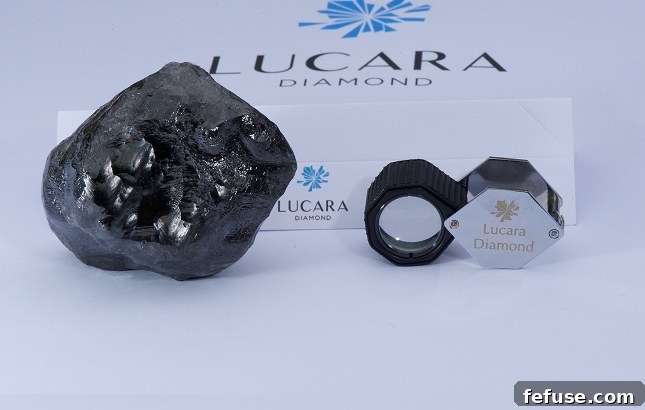
Lucara Diamond Corp. made headlines with an extraordinary discovery at its Karowe Diamond Mine in Botswana, unearthing a magnificent 1,758-carat diamond. This colossal gemstone, later named Sewelô, meaning “rare find” in the Setswana language, instantly secured its place as one of the largest diamonds ever recovered in recorded history. Its sheer size also marks it as the largest diamond ever found in Botswana and the biggest ever mined from the Karowe operation to date. The unbroken stone’s recovery was a testament to Lucara’s cutting-edge XRT (X-ray Transmission) circuit technology, a system specifically designed to efficiently identify and extract large, high-value diamonds without causing any damage during the mining process.
Weighing an impressive 352 grams and measuring approximately 83mm x 62mm x 46mm, the Sewelô diamond represents a true marvel of nature. Preliminary assessments have characterized it as “near gem” quality, exhibiting variable characteristics throughout its vast structure. Crucially, these initial analyses also identified significant domains of high-quality white gem material within the stone. This combination of size and potential for yielding exceptional quality segments makes the Sewelô an incredibly exciting prospect for the diamond industry. Detailed analysis by expert gemologists is currently underway to fully understand its internal composition, clarity, and color distribution, which will be crucial for determining its ultimate potential and value.
The discovery of the Sewelô diamond captured widespread global attention, including that of major news outlets like CNN, highlighting its immense significance beyond the confines of the diamond sector. Such monumental finds are rare, and their implications resonate across various industries and markets. Paul Zimnisky, a respected independent diamond analyst based in New York, offered valuable insights into the broader classification of natural diamonds when discussing the Sewelô. He explained that diamonds are typically categorized into three main grades: gem-quality, near-gem, or industrial-quality. This fundamental classification dictates a diamond’s primary use and, consequently, its market value.
Zimnisky elaborated further on these distinctions, noting that the vast majority of gem-quality diamonds are destined for fine jewelry, where their beauty, brilliance, and rarity are celebrated. Industrial-quality diamonds, on the other hand, are primarily utilized for abrasive applications due to their exceptional hardness, finding uses in cutting tools, drills, and polishing agents. Near-gem diamonds occupy an intriguing middle ground; they can be employed in lower-end jewelry pieces or for various industrial purposes where specific aesthetic qualities are less critical. He underscored the stark difference in value across these categories: while gem-quality diamonds can command hundreds or even thousands of dollars per carat, and exceptionally rare fancy colored diamonds can reach hundreds of thousands or even millions of dollars per carat, industrial diamonds typically fetch only about $1 per carat, reflecting their utility-driven market. This vast disparity in pricing underscores the importance of precise quality assessment for any significant diamond find.
In the specific case of the Sewelô diamond, its initial characterization as “near-gem quality with portions appearing to be gem-quality” presents a unique valuation challenge. As Zimnisky conveyed to the network, “until the true quality of the whole stone can be determined, it is very difficult to value it.” This statement highlights the complexity involved in assessing a stone of this magnitude and variability. Unlike smaller, more homogenous diamonds, a giant like Sewelô requires extensive study to map its internal structure, identify inclusions, and pinpoint areas of pristine gem material. This process is meticulous, involving advanced imaging techniques and expert analysis to understand how the rough stone can best be cut and polished to maximize its inherent beauty and value. The outcome of this detailed analysis will ultimately dictate whether the Sewelô yields one monumental polished diamond, several significant pieces, or a combination, each carrying its own unique market potential.
The Karowe Diamond Mine, located in Botswana, has an established reputation as one of the world’s most prolific sources of large, exceptional diamonds. Lucara Diamond Corp. has consistently pushed the boundaries of diamond recovery, with the Sewelô being just one of several record-breaking stones unearthed from this remarkable kimberlite pipe. Prior to Sewelô, Karowe was already celebrated for producing the 1,109-carat Lesedi La Rona in 2015 and the 813-carat Constellation diamond in the same year, both of which set new benchmarks in the industry. This track record is not merely luck but a direct result of Lucara’s strategic investment in innovative mining technologies, particularly the XRT large diamond recovery circuit. This technology allows for the detection and extraction of stones exceeding 100 carats before they enter the crushing circuits, thereby preserving their integrity and maximizing their potential value. The Sewelô’s successful recovery is a powerful endorsement of this approach.
The economic impact of such a discovery is substantial, both for Lucara Diamond Corp. and for Botswana, a nation whose economy is significantly bolstered by its diamond industry. For Lucara, the Sewelô represents a significant asset that can substantially enhance its revenue and shareholder value. For Botswana, the continued success of mines like Karowe reinforces its position as a global leader in ethical and responsible diamond production, contributing to national development and employment. The proceeds from these diamonds often flow into vital public services, infrastructure, and education, creating a tangible link between natural resources and societal progress. The find also stimulates investor confidence in the long-term viability and potential of Botswana’s diamond reserves, attracting further investment into the sector.
Beyond its economic implications, the Sewelô diamond carries immense symbolic value. It serves as a potent reminder of the Earth’s geological wonders and the enduring allure of precious gemstones. Its journey from a deep underground kimberlite pipe, formed billions of years ago, to potentially becoming a world-renowned polished jewel, captivates the imagination. The process of transforming a rough stone of this size and complexity into a finished masterpiece is an art form in itself, requiring the unparalleled skill and vision of master cutters. These artisans will meticulously study the stone’s every facet, identifying the optimal way to cleave, cut, and polish it to unleash its maximum brilliance and fire. This transformation could take years, culminating in a historical piece that will join the ranks of the world’s most famous diamonds.
Lucara’s commitment to responsible mining practices also adds another layer of significance to the Sewelô discovery. The company operates with a strong focus on environmental stewardship, community engagement, and ethical sourcing, ensuring that its diamond finds contribute positively to all stakeholders. This ethical framework is increasingly important to consumers and industry participants alike, who seek assurance that their diamonds are conflict-free and mined sustainably. The Karowe mine’s ability to consistently produce these exceptional stones, coupled with Lucara’s transparent operations, reinforces trust in the diamond supply chain and the value of natural diamonds. As the detailed analysis of the Sewelô diamond continues, the global diamond community eagerly anticipates its eventual unveiling in its polished form, a moment that promises to be a landmark event in the history of precious gemstones.
In conclusion, the unearthing of the 1,758-carat Sewelô diamond by Lucara Diamond Corp. at the Karowe Mine in Botswana stands as a monumental achievement, solidifying the mine’s reputation as an unparalleled source of extraordinary large diamonds. This “near gem” quality stone, with its promising domains of high-quality white material, represents not only a significant economic asset but also a testament to geological heritage and human ingenuity. The meticulous process of its valuation and eventual transformation into a polished masterpiece will undoubtedly captivate the world, further cementing the legacy of Lucara, the Karowe Mine, and Botswana in the annals of diamond discovery. The Sewelô diamond is poised to become an iconic symbol of rarity, beauty, and the enduring magic of nature’s most precious treasures.