
Empowering India’s Gem & Jewellery Sector: A Landmark Dialogue with the Finance Ministry
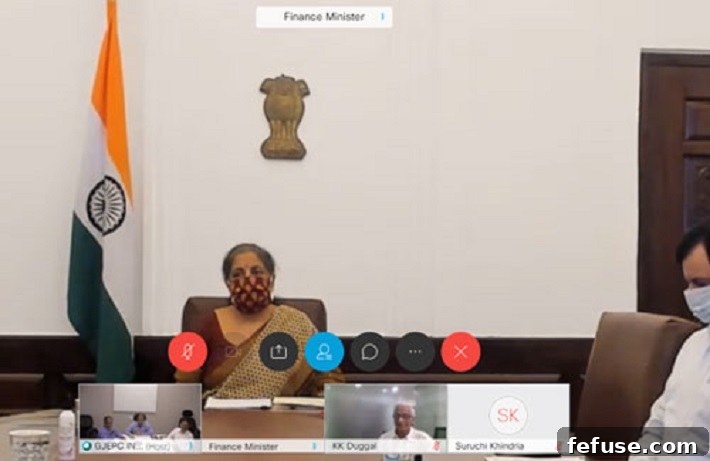
India’s gem and jewellery sector holds a distinguished position on the global stage, celebrated for its exquisite craftsmanship, significant export contributions, and its role as a major employment generator. Recognizing the dynamic nature of this industry and the evolving challenges it faces, the Indian government, under the visionary leadership of Hon’ble Finance Minister Smt. Nirmala Sitharaman, has taken a pivotal step towards fostering its sustainable growth and resolving critical operational hurdles. In a significant virtual review meeting held on August 18th, involving the Finance Ministry and the Gem & Jewellery Export Promotion Council (GJEPC), a crucial decision was made: the formation of a ‘Special Group’. This high-powered body, comprising essential officials from Customs and banking, is specifically tasked with addressing and resolving all issues impacting the gem and jewellery sector. This proactive measure underscores the government’s unwavering commitment to enhancing the ‘ease of doing business’ for this vital Indian industry, ensuring its continued prominence in the global market.
The establishment of this Special Group represents a strategic leap forward, providing a dedicated and direct channel for industry stakeholders to articulate their concerns and seek concrete solutions. Minister Sitharaman herself reinforced the significance of this initiative, stating that if the industry does not receive satisfactory resolutions from the Special Group, the issues may be escalated directly to her office. This robust, two-tiered mechanism offers both an immediate problem-solving framework and a clear path for higher-level intervention, thereby instilling greater confidence and transparency within the sector. Such a structured and responsive engagement model demonstrates a profound understanding of the industry’s complex operational landscape and the imperative for agile, supportive policy adjustments to maintain and enhance India’s competitive advantage in international trade.
Key Stakeholders Converge: A Collaborative Path to Progress
The virtual review meeting itself was a testament to the adaptability of governance in modern times, facilitating crucial discussions among key policy-makers and industry representatives. The esteemed attendees included Ms. Nirmala Sitharaman, the Hon’ble Finance Minister; Mr. Sandeep Bhatnagar, Member Customs; and Mr. G. D. Lohani, Joint Secretary (TRU). Representing the industry’s collective voice were Mr. Colin Shah, Chairman of GJEPC; Mr. Vipul Shah, Vice Chairman of GJEPC; and Mr. Sabyasachi Ray, Executive Director of GJEPC. This synergistic assembly of diverse expertise ensured a comprehensive and nuanced review of the sector’s current performance, existing challenges, and future aspirations, laying a solid foundation for targeted policy interventions and collaborative strategies aimed at sustained prosperity.
Expressing deep gratitude for the Finance Minister’s timely intervention and the dedicated review, Mr. Colin Shah, Chairman of GJEPC, articulated a cautiously optimistic outlook for the sector. “The exports of the gem and jewellery sector are witnessing some encouraging signs of recovery,” Mr. Shah observed, highlighting the inherent resilience of the industry. He further added, “We are hopeful that the market will recover soon as exports to key markets like USA, Europe, and China have commendably commenced.” The GJEPC leadership emphasized the sector’s capacity for sustained growth, particularly when supported by robust governmental frameworks and streamlined processes. The formation of the Special Group, specifically under the guidance of a Member of Customs, was hailed as a particularly strategic move, poised to “address sectoral concerns and resolve trade-related bottlenecks,” thereby directly contributing to a more efficient and favorable business ecosystem for the Indian gem and jewellery trade.
Navigating Critical Industry Challenges: A Deeper Look into Policy Reform Needs
During the impactful meeting, the GJEPC meticulously presented a comprehensive array of issues that have historically posed impediments to the sector’s full operational and export potential. These challenges span various critical domains including trade facilitation, taxation structures, and intricate operational logistics, necessitating precise and well-considered policy adjustments. The core of the discussions centered on pivotal areas such as streamlining the direct sale of rough diamonds in the Special Notified Zone (SNZ) in Mumbai, the pressing need for a reduction in polished diamond import duty, seeking definitive clarifications on the Online Equalisation Levy for B2B International Diamond Auctions, advocating for the allowance of reverse job work within Special Economic Zones (SEZ), and addressing broader Goods and Services Tax (GST)-related complexities.
Enhancing Efficiency: Direct Sale of Rough Diamonds in the Special Notified Zone (SNZ), Mumbai
A significant portion of the dialogue focused on facilitating and liberalizing the direct sale of rough diamonds by international miners within India’s Special Notified Zone (SNZ) in Mumbai. This initiative is paramount for solidifying India’s preeminent position as the world’s leading diamond cutting and polishing hub. Allowing direct sales from global mining companies within the SNZ offers manifold advantages: it significantly enhances supply chain transparency, effectively reduces the costs associated with multiple intermediaries, and most importantly, grants Indian manufacturers direct and unfettered access to a wider and more diverse range of rough diamond assortments. This direct sourcing channel is expected to considerably boost the operational efficiency and global competitiveness of the Indian diamond processing industry. Officials provided a reassuring update, indicating that the issue is currently under active and detailed examination, with strong positive indications that a specific provision may be incorporated into the upcoming Union Budget or the Finance Act. Furthermore, the Transfer Pricing Committee is diligently reviewing the matter, committed to developing a viable and equitable solution that mutually benefits both international miners and the domestic industry, thereby streamlining the critical raw material supply chain and reinforcing Mumbai’s stature as a premier international diamond trading and manufacturing center.
Boosting Competitiveness: The Call for Reduced Polished Diamond Import Duty
Another pressing issue brought to the forefront by the GJEPC was the urgent appeal for a substantial reduction in the import duty on polished diamonds. The industry advocates for a decrease from the existing 7.5% to a more globally competitive rate of 2.5%. This appeal is fundamentally driven by the imperative to create a more level playing field for Indian diamantaires when competing against international counterparts, especially within the crucial re-export markets. A lower import duty on polished diamonds would empower Indian businesses to import and subsequently re-export finished goods more competitively, thereby facilitating trade, fostering greater value addition, and enhancing economic activity within the country. Such a reduction would also strategically position India as a more attractive and dynamic trading hub for both rough and polished stones, drawing in a larger volume of global buyers and sellers. While explicit immediate commitments were not outlined, the prominent inclusion of this point in the review meeting unequivocally signifies its recognition as a critical factor in enhancing the sector’s global competitiveness and maximizing its vital contribution to India’s overall export revenues and economic prosperity.
Clarifying the Landscape: Online Equalisation Levy for B2B International Diamond Auctions
The application and interpretation of the Online Equalisation Levy (EL) to B2B international diamond auctions emerged as a particularly contentious and critical point of discussion. The Joint Secretary (TRU) clarified the government’s stance, stating that the Equalisation Levy applies universally to all sales conducted through online platforms, including B2B transactions. Consequently, online diamond auctions fall squarely within the ambit of this levy. However, Mr. Sabyasachi Ray, Executive Director of GJEPC, expressed profound and passionate concerns regarding this blanket application. He vehemently argued, “Since there is no import duty on the import of rough diamonds, the imposition of EL will severely hamper our industry; this will be a significant and detrimental setback for the industry.” The crux of his argument rests on the established fact that rough diamonds serve as the fundamental raw material for India’s globally renowned and massive cutting and polishing industry. Their import has been strategically kept duty-free to actively promote domestic manufacturing and value addition. Imposing an Equalisation Levy on the online procurement of these essential rough diamonds, even if categorized as a digital service tax, essentially introduces an additional cost layer to a duty-free commodity. This directly impacts the already finely tuned cost structures for manufacturers. Such an unintended consequence, if not judiciously addressed, risks eroding India’s crucial cost advantage, potentially diverting vital rough diamond sourcing to other less encumbered international channels, and ultimately diminishing the global competitiveness of Indian polished diamonds in the international market. This makes the Equalisation Levy for B2B diamond auctions a critically important area demanding urgent reconsideration and a more nuanced policy approach that carefully distinguishes between general digital services and the procurement of essential raw materials for a key export industry.
Optimizing Operations: Reverse Job Work in Special Economic Zones (SEZ)
The existing prohibition on ‘Reverse Job Work’ within Special Economic Zones (SEZ) was another significant operational issue highlighted by the GJEPC. In the context of the gem and jewellery industry, ‘job work’ typically involves sending raw materials or semi-finished goods for specific processing steps (such as cutting, polishing, or specialized setting) and subsequently receiving them back after completion. ‘Reverse job work’ would logically extend this concept, allowing materials that have undergone initial processing or value addition outside an SEZ to be brought into the SEZ for further specialized finishing, final value addition, or additional processing, thereby leveraging the advanced infrastructure, skilled workforce, and fiscal benefits associated with SEZ units. Mr. Colin Shah acknowledged the current restriction but delivered promising news, indicating that officials have provided assurances that active discussions are underway between the Department of Commerce (DoC) and the Department of Revenue. He further added that a definitive decision on this matter is pending, as the Ministry is currently undertaking a comprehensive review of a larger overarching policy framework and meticulously assessing the recommendations outlined in the Baba Kalyani report, which often addresses SEZ-related reforms. Permitting reverse job work could substantially enhance operational flexibility for manufacturers, optimize resource utilization, and significantly bolster the competitiveness of SEZ units by enabling a more integrated and agile supply chain. This policy shift would undoubtedly contribute to higher value addition, stimulate increased production, and create additional employment opportunities within these crucial economic zones.
Streamlining Compliance: Addressing GST-Related Issues and Simplification
While the original content briefly mentions “GST issues” without delving into specific details, it is widely recognized that the complexities surrounding the Goods and Services Tax (GST) frequently present substantial challenges across various sectors, including the intricate gem and jewellery industry. For a sector that heavily relies on elaborate supply chains, a multitude of B2B transactions, and a strong export orientation, GST compliance can often prove to be an arduous and resource-intensive endeavor. Typical issues that arise include complexities with input tax credit mechanisms, nuanced classification of diverse products, inherent valuation challenges for unique and high-value items, and the pervasive need for simplified administrative procedures specifically tailored for exporters. The GJEPC’s inclusion of GST issues in its formal representation unequivocally signals the industry’s collective call for greater clarity, streamlined processes, and potentially, specific rate rationalizations that are harmonized with global benchmarks and do not inadvertently inflate the overall cost of doing business. Addressing these crucial concerns is paramount for significantly reducing compliance burdens and associated costs, improving cash flow for businesses, and ensuring that the Indian gem and jewellery sector maintains its attractiveness for both robust domestic trade and expansive international commerce, thereby reinforcing the government’s broader objective of tax simplification and fostering an environment of ease of doing business.
Rationalizing Risk Management System (RMS) Valuation for Expedited Trade
In a concerted effort to further streamline trade processes and mitigate unnecessary delays, Mr. Colin Shah also put forward highly pertinent suggestions concerning the Risk Management System (RMS) valuation protocols. He astutely highlighted that goods valued at less than US$50,000, along with those specifically imported for certification purposes, could logically be exempted from the often-rigorous and time-consuming valuation process. The RMS is fundamentally designed to identify and flag high-risk consignments for detailed examination and scrutiny. However, applying the same stringent and resource-intensive process to low-value items or those solely intended for certification purposes can invariably lead to unwarranted delays, escalate logistical costs, and impose significant administrative burdens on businesses. Exempting such specific categories would enable significantly quicker clearances for a substantial volume of trade, thereby allowing Customs officials to strategically focus their valuable resources on genuinely higher-risk consignments. This targeted and pragmatic approach would dramatically enhance efficiency at ports and customs checkpoints, accelerate the movement of goods, and contribute immensely to the overall ease of conducting international trade for the gem and jewellery sector, further cementing India’s well-earned reputation as a reliable, efficient, and forward-thinking global trading partner.
A Resilient Sector Poised for Unprecedented Growth
The comprehensive nature of the review meeting and the subsequent unequivocal commitment from the Finance Ministry to establish a dedicated Special Group unequivocally underscore the Indian government’s strategic and unwavering focus on empowering the gem and jewellery sector. As this dynamic industry adeptly navigates the complexities of global economic shifts and actively seeks to capitalize on emerging market opportunities, the implementation of targeted policy interventions and the establishment of a responsive administrative framework are not merely beneficial but absolutely paramount. The GJEPC’s proactive and constructive engagement, seamlessly coupled with the government’s receptive and supportive stance, paints a vividly optimistic picture for the sector’s future trajectory. By systematically and diligently addressing long-standing trade bottlenecks, providing greater clarity on intricate tax policies, and simplifying cumbersome operational procedures, India is poised to further solidify its already robust position as a global leader in diamond cutting, polishing, and exquisite jewellery manufacturing. This concerted effort will undoubtedly drive substantial economic growth, generate a significant number of employment opportunities across the value chain, and substantially boost the nation’s vital foreign exchange earnings. This powerful and synergistic collaborative spirit between the government and the industry serves as an invaluable catalyst for sustained progress, ensuring that India’s magnificent gem and jewellery sector continues to shine with unparalleled brilliance on the world stage for years to come.