
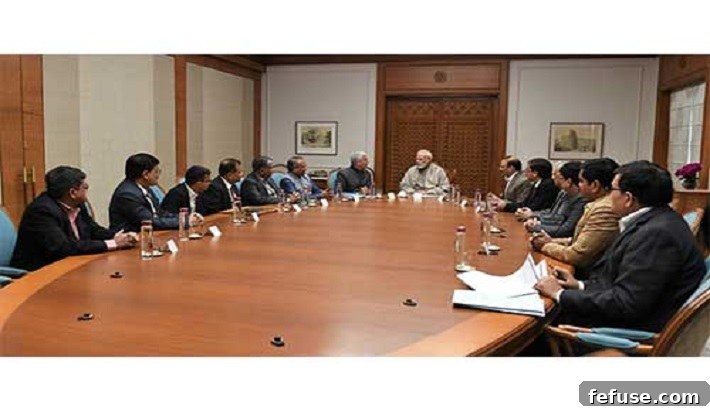
Surat Trade Delegation Engages PM Modi on Crucial Gems & Jewellery Sector Challenges
A significant trade delegation hailing from Surat, India’s undisputed hub for diamond and jewellery manufacturing, held a pivotal meeting with the Hon’ble Prime Minister Shri Narendrabhai Modi on December 27. The primary agenda of this high-level engagement was to present detailed representations concerning a myriad of pressing trade issues currently impacting various critical sectors within the region, particularly highlighting the challenges faced by the globally renowned gems and jewellery industry.
Representing the vibrant and economically crucial gems and jewellery sector, Mr. Dinesh Navadiya, the esteemed Regional Chairman – Gujarat for the Gem & Jewellery Export Promotion Council (GJEPC), articulated the industry’s concerns with meticulous detail. His presentation underscored the urgent need for government intervention and supportive policy frameworks to ensure the sustained growth and global competitiveness of this vital sector, which is a cornerstone of India’s export economy and a significant employer.
Addressing Core Issues: A Deep Dive into the Gems & Jewellery Sector’s Demands
The delegation’s comprehensive presentation to the Prime Minister covered several strategic areas, each critical for enhancing the operational efficiency, financial stability, and international standing of the Indian gems and jewellery industry. Mr. Navadiya specifically brought to the forefront the following key issues, urging swift and effective governmental measures:
- Input Tax Credit (ITC) accumulation stemming from the inverted duty structure in diamond manufacturing.
- Challenges related to Bank Finance for the sector.
- The imperative introduction of Presumptive Taxation in Special Notified Zones (SNZs).
- The need for a robust Technology Upgradation Scheme specifically tailored for the Gems and Jewellery sector.
- Implementation of an advanced Risk Management System (RMS) to foster a profile-based monitoring approach for efficient clearance of import and export shipments.
Navigating the GST Labyrinth: Input Tax Credit Accumulation
One of the most significant pain points highlighted was the persistent issue of Input Tax Credit (ITC) accumulation, a direct consequence of the inverted duty structure prevalent in the diamond manufacturing segment. An inverted duty structure occurs when the tax rate on inputs (raw materials or services) is higher than the tax rate on the finished output product. For the diamond industry, this disparity leads to a substantial blockage of working capital. Manufacturers pay higher GST on rough diamonds or other inputs but can only claim a lower GST on polished diamonds or finished jewellery when sold domestically, or sometimes face challenges in claiming refunds for exports.
This accumulation of ITC ties up valuable financial resources that could otherwise be utilized for business expansion, technology investment, or meeting day-to-day operational expenses. It particularly impacts small and medium-sized enterprises (SMEs) within Surat’s vast diamond processing ecosystem, hindering their cash flow and competitiveness in the global market. The delegation urged the government to review and rationalize the GST structure to mitigate this issue, streamline refund processes, or introduce mechanisms that ensure faster and more efficient liquidation of accumulated ITC, thereby freeing up crucial capital for businesses.
Strengthening Financial Lifelines: Challenges in Bank Finance
Access to adequate and affordable bank finance remains a perennial concern for the gems and jewellery sector. The industry, inherently capital-intensive and dealing with high-value goods, often faces unique challenges in securing credit. Banks frequently perceive the sector as high-risk, leading to stringent collateral requirements, higher interest rates, and often, a reluctance to extend sufficient working capital limits. This perception has been exacerbated by past incidents, despite the industry’s overall robust performance and significant contribution to national exports.
Mr. Navadiya emphasized the critical need for financial institutions to adopt a more nuanced understanding of the sector’s operational dynamics and unique business models. The delegation proposed the introduction of specialized lending schemes, a re-evaluation of risk assessment parameters, and potentially, government-backed guarantees to encourage banks to extend credit more readily and on favorable terms. Enhanced access to finance is crucial not only for meeting daily operational needs but also for funding modernization, technological advancements, and expanding market reach, all vital for India to maintain its leadership position in the global gems and jewellery trade.
Facilitating Global Trade: Presumptive Taxation in Special Notified Zones (SNZs)
The concept of Special Notified Zones (SNZs) was introduced to facilitate the viewing and trading of rough diamonds by foreign mining companies and traders in India, without attracting customs duty, specifically for re-export. This initiative aims to make India a global trading hub for rough diamonds, complementing its strong manufacturing base. However, the existing taxation framework within these zones can be complex, potentially deterring some international players.
The delegation advocated for the introduction of presumptive taxation within SNZs. Presumptive taxation is a simplified tax regime where tax is levied on an estimated profit margin rather than on detailed accounting of actual profits. This approach significantly reduces the compliance burden and simplifies tax calculations, making SNZs far more attractive for foreign diamond companies. By streamlining the tax process, India can enhance its ‘ease of doing business’ quotient for international participants, boost trade volumes, and firmly establish itself as the preferred destination for rough diamond trading, thereby consolidating its position across the entire diamond value chain.
Pioneering Modernization: The Technology Upgradation Scheme
To remain competitive in an increasingly globalized and technologically advanced market, the Indian gems and jewellery sector must continuously innovate and upgrade its manufacturing capabilities. Many small and medium-sized units, however, struggle to invest in state-of-the-art machinery and processes due to financial constraints and lack of awareness.
The call for a dedicated Technology Upgradation Scheme (TUS) is thus a forward-looking demand. Such a scheme would provide crucial financial assistance, subsidies, or incentives for units to adopt modern technologies like CAD/CAM (Computer-Aided Design/Manufacturing), laser cutting, automated polishing systems, 3D printing for jewellery, and advanced quality control instruments. This would not only enhance productivity, reduce waste, and improve product quality but also foster innovation in design and manufacturing. A TUS would empower Indian manufacturers to produce goods that meet international standards, cater to evolving consumer preferences, and compete effectively with global counterparts, ultimately strengthening the “Make in India” initiative within the sector and creating a highly skilled workforce.
Streamlining Logistics: Advanced Risk Management System (RMS) for Shipments
The efficient and timely clearance of import and export shipments is paramount for a sector heavily reliant on international trade, where goods are often high-value and time-sensitive. Current customs procedures can sometimes lead to delays, increasing logistics costs and impacting delivery schedules, thereby affecting India’s reputation as a reliable trade partner.
The delegation proposed the implementation of a sophisticated Risk Management System (RMS) that employs a profile-based monitoring approach for import and export consignments. An advanced RMS uses data analytics, historical compliance records, and real-time intelligence to assess the risk profile of shipments. This allows customs authorities to fast-track the clearance of low-risk consignments from trusted traders, allocating resources more effectively to scrutinize high-risk shipments. The benefits are manifold: faster customs clearance, reduced dwell time at ports, lower transaction costs, improved predictability for businesses, and enhanced trade facilitation. Such a system would significantly improve the ease of doing business for the gems and jewellery sector, making India a more attractive destination for global trade.
A Vision for Growth and Global Leadership
The meeting with Prime Minister Modi underscores the government’s commitment to engaging directly with industry stakeholders to address critical challenges. The representations made by the Surat trade delegation, particularly by Mr. Dinesh Navadiya on behalf of the GJEPC, reflect the industry’s proactive approach to collaborative problem-solving. Each of the points raised – from rectifying structural tax anomalies and easing financial access to fostering technological advancement and streamlining trade logistics – is vital for ensuring the continued vitality and expansion of India’s gems and jewellery sector.
By addressing these pivotal issues, the government can empower this labor-intensive and export-oriented industry to achieve even greater heights, contribute significantly to India’s GDP, generate millions of livelihoods, and solidify the nation’s position as a global leader in the intricate and magnificent world of gems and jewellery. The industry looks forward to constructive dialogue and decisive policy actions that will pave the way for a more robust, competitive, and innovative future.
News Source: gjepc