
Rewilding the Arctic: ALROSA Partners with Pleistocene Park to Combat Climate Change
In a significant move towards global climate action, ALROSA, a world leader in diamond mining, officially announced its partnership with Pleistocene Park on September 30, 2021. This collaboration marks a pivotal moment for a large-scale environmental project dedicated to recreating a highly productive ecosystem reminiscent of the Late Pleistocene era’s mammoth steppe. Often referred to as the “Serengeti of the North,” Pleistocene Park is an ambitious experimental undertaking designed to validate a groundbreaking theory proposed by the renowned Russian researcher, Sergey Zimov. His hypothesis posits that vast pasturelands teeming with diverse wildlife, much like those that thrived in the Arctic over 15,000 years ago, possess the remarkable ability to prevent the thawing of permafrost, thereby significantly slowing down the escalating threat of global warming.
The Vision of Pleistocene Park: Recreating an Ancient Ecosystem
Established in 1996, Pleistocene Park spans an impressive 14,400 hectares within the Nizhnekolymsky District of Yakutia, a region in northeastern Siberia. The park’s foundational premise is rooted in the understanding that during the Late Pleistocene epoch, vast stretches of the Arctic were not barren tundra but rather a rich and diverse grassland ecosystem – the mammoth steppe. This vibrant environment supported an astonishing array of megafauna, including woolly mammoths, woolly rhinoceroses, steppe bison, and wild horses. These large herbivores played a crucial role in maintaining the health and resilience of the steppe, compacting snow, fertilizing the soil, and preventing the growth of insulating mosses and shrubs that now dominate the modern tundra. The project seeks to re-establish this dynamic balance, bringing back not only the animals but also the ecological processes that once characterized this ancient landscape. By transforming sparse tundra into productive grasslands, the park aims to restore the natural mechanisms that kept the permafrost stable for millennia.
A Diverse Menagerie: Bringing Life Back to the Steppe
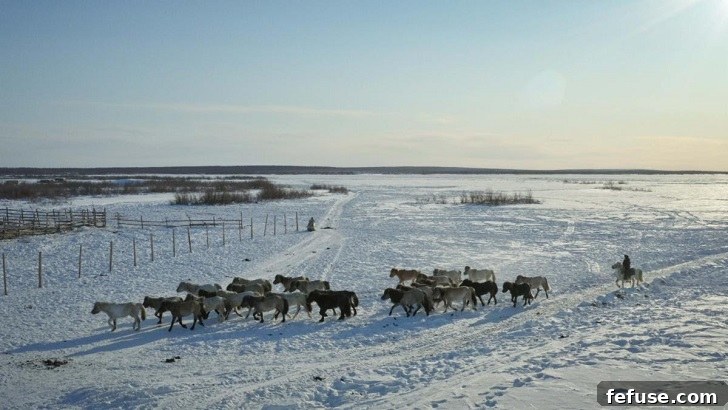
Today, Pleistocene Park is home to an evolving population of 11 species of large herbivores, carefully selected from various regions to mimic the past ecosystem. These include hardy reindeer, resilient Yakut horses, majestic elks, robust steppe bison, imposing aurochs (recreated through selective breeding), shaggy muskox, powerful yaks, distinctive Kalmyk cows, adaptable sheep, agile goats, and even camels. Each species plays a vital role in shaping the landscape, grazing, trampling, and disrupting the snow cover, thereby contributing to the desired ecological transformation. The park’s vision extends even further with a pioneering joint project alongside Colossal Biosciences, an innovative American company dedicated to de-extinction. This collaboration is focused on the ambitious endeavor of cloning the woolly mammoth. If this scientific feat is successful, there are grand plans to reintroduce the woolly mammoth back into the natural world within the expansive boundaries of Pleistocene Park, potentially completing the rewilding of the Arctic’s iconic megafauna.
Scientific Foundations: A Proven Approach to Climate Mitigation
The scientific underpinnings of the Pleistocene Park project have garnered significant recognition and validation, being extensively detailed in publications by leading international scientific journals such as Science, Nature, and others. The rigorous research conducted over more than two decades has yielded compelling results, strongly suggesting that the restoration of the mammoth steppe ecosystem in the permafrost zone is indeed having a profound and positive impact on the environment. These findings offer concrete evidence that the rewilding efforts are not merely an ecological experiment but a viable and promising strategy for climate change mitigation. The observed benefits are multifaceted, addressing some of the most critical environmental challenges facing humanity today.
Carbon Sequestration: Pastureland’s Powerhouse Role
One of the primary positive impacts observed is related to carbon sequestration. At high latitudes, pastureland ecosystems demonstrate an exceptional capacity for quickly accumulating atmospheric carbon in their extensive root systems. This absorption rate is remarkably efficient, estimated to be 5 to 10 times greater than in areas covered by forest. This is due to the dense, fibrous root networks of grasses, which can store carbon deep within the soil, creating a long-term carbon sink. In contrast, boreal forests tend to store more carbon above ground, which is vulnerable to disturbances like fires. By converting tundra into productive grasslands, Pleistocene Park is actively enhancing the natural carbon capture capabilities of the Arctic, drawing down greenhouse gases from the atmosphere and locking them away in the soil for potentially centuries.
Battling Methane Emissions and Harnessing the Albedo Effect
Secondly, the restoration of pastureland ecosystems contributes significantly to mitigating the release of methane, a highly aggressive greenhouse gas. In pastureland environments, surface moisture evaporates more efficiently compared to marshy or shrub-dominated areas. This increased evaporation leads to a gradual reduction in marshland, which are natural sources of methane (CH4) emissions. By drying out these wet areas and promoting robust grass growth, the park is effectively curbing one of the potent contributors to global warming. Thirdly, the increased area of lighter-colored pastureland gives rise to the crucial “albedo effect.” Steppe environments, with their lighter soil and grass cover, tend to reflect more solar radiation back into space compared to darker forests and dense bushes that absorb more heat. This enhanced reflectivity helps to reduce the amount of heat absorbed by the Earth’s surface, thereby directly contributing to a reduction in the speed of global warming. It’s a natural cooling mechanism that the park actively promotes.
Preserving Permafrost: The Hooves and Snow Effect
Beyond the atmospheric and carbon benefits, the restoration of these mammoth ecosystems holds profound implications for the preservation of permafrost itself. In winter, the large herbivores repeatedly dig up the insulating snow cover in search of forage. This constant disruption of the snow layer significantly reduces its thermal insulating properties, allowing the frigid winter air to penetrate deeper into the ground. As a result, the soil freezes more intensely and to a greater depth during the cold season. Consequently, this deeper and more intense freezing means that the permafrost thaws more slowly and to a lesser extent during the warmer summer months. This ingenious natural engineering by the animals directly counteracts the thawing processes driven by climate change, reinforcing the stability of the vast carbon stores locked within the permafrost, which if released, could trigger a catastrophic feedback loop of warming.
ALROSA’s Commitment: Driving Sustainable Development in Yakutia
ALROSA’s partnership with Pleistocene Park underscores its deep commitment to environmental stewardship and sustainable development, particularly within its operational region of Yakutia. Mikhail Dubovichev, head of ALROSA’s Innovation and Technology Center, articulated the company’s perspective on this collaboration:
“We are keeping a very close watch on Pleistocene Park and the research findings obtained by its creators and the working groups from leading global research centers active on the ground. If Zimovs’ theory is confirmed, humanity will have a new and efficient tool for combating global warming with good scaling potential. It is important to note that this will work in two ways: by absorbing CO2 here and now, and by preventing atmospheric emissions of the huge volumes of carbon captured in the permafrost, which, according to various estimates, exceed 1 trillion tons. This dual action makes the project exceptionally powerful in the global fight against climate change.”
Polina Anisimova, ALROSA’s Chief Ecologist, further elaborated on the broader implications of the project and ALROSA’s longstanding commitment to ecological health:
“The project’s overall potential extends not only to preserving the climate but also to restoring Yakutia’s biodiversity. We have previously taken part in a project to import bison from Canada, demonstrating our commitment to rewilding efforts, and for many years, we have sponsored the Living Diamonds of Yakutia nature park, supporting local conservation. Our involvement in the development of Pleistocene Park is yet another crucial step together with scientists to advance the sustainable development of the region. After all, animal species are among the key elements of Earth’s ecosystems, and it is their biodiversity that underlies the biosphere’s structural and functional organization and its ability to support life.”
Director’s Vision: Progress and Future Goals
Nikita Zimov, the Director of Pleistocene Park and son of its founder, offered an update on the progress and shared insights into the park’s future trajectory:
“In the course of the experiment, the impact of animals on vegetation in enclosures has been visible to the naked eye. We are witnessing a remarkable transformation. In many areas of the park, grasses and cereals have become predominant, replacing less productive tundra vegetation. Concurrently, the carbon content in the soil is consistently growing, and the speed of the biocycle is increasing, indicating a healthier, more dynamic ecosystem. While we cannot claim that we’ve already managed to create a fully highly productive pastureland ecosystem – there is still much to be done and many challenges to overcome – the positive trend is undeniably obvious and extremely encouraging. One exceptionally important stage of our project is populating the park with a large number of animals to further accelerate these ecological changes. One of the priorities for the near future is to significantly expand the muskox population by bringing them in from other locations, as they are crucial for breaking up snow and promoting grass growth. We are profoundly grateful to ALROSA for its invaluable support, which will help us to achieve these crucial goals and carry out many other essential activities to bring our vision to fruition.”
The Broader Implications: A Blueprint for Global Climate Action?
The Pleistocene Park project, bolstered by ALROSA’s partnership, represents more than just a regional conservation effort; it is a globally significant experiment with the potential to offer a scalable solution to one of humanity’s most pressing challenges. By demonstrating that ecosystem restoration, particularly through rewilding with large herbivores, can effectively mitigate climate change, the park is laying the groundwork for similar initiatives in other permafrost regions around the world. The sheer scale of carbon locked in the Arctic permafrost makes this endeavor critically important. Preventing its release could avert a climate catastrophe, and the methods pioneered in Yakutia could become a blueprint for international climate action. This ambitious undertaking emphasizes the critical link between biodiversity, ecological health, and global climate stability, offering a beacon of hope for a sustainable future.
The collaboration between ALROSA and Pleistocene Park embodies an innovative approach to environmental conservation. It merges corporate responsibility with groundbreaking scientific research, demonstrating how strategic partnerships can drive significant progress in combating climate change and restoring vital ecosystems. As the “Serengeti of the North” continues to evolve, it offers not just a glimpse into the past, but a compelling vision for a more stable and resilient future for our planet.