
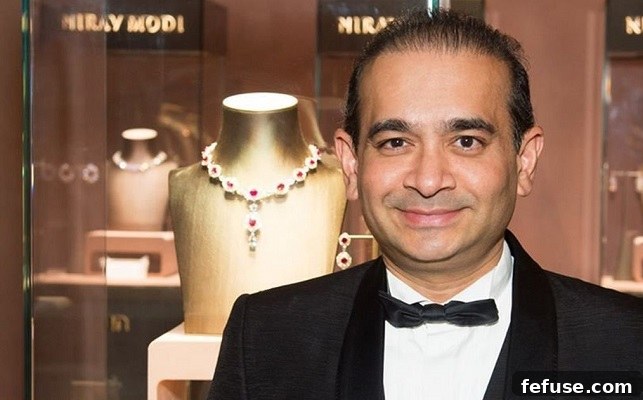
Manhattan, New York – In a significant legal development underscoring the relentless pursuit of financial fraud, Nehal Modi, the younger brother of the notorious fugitive diamantaire Nirav Modi, has been convicted by a US court. The conviction centers on charges of fraudulently obtaining diamonds valued at more than $2.6 million, marking a decisive victory for justice against high-stakes deception in the heart of New York City’s esteemed diamond district.
The Deceptive Scheme Unveiled: A Deep Dive into Nehal Modi’s Fraud
Nehal Modi, a 41-year-old diamond trader, meticulously orchestrated a sophisticated scheme between March and August 2015. During this period, he engaged in a series of elaborate false representations, leveraging the reputable name of Costco Wholesale Corporation to deceitfully acquire a substantial cache of diamonds from LLD, also known as Lev Leviev Diamonds. The meticulously planned deception allowed Modi to bypass standard business protocols and secure valuable gems under fraudulent pretenses.
The core of Modi’s illicit operation involved misleading LLD into believing that he had a legitimate and impending deal with Costco for the resale of these diamonds. By invoking Costco’s brand, a company renowned for its stringent vetting processes and significant market presence, Modi successfully established a façade of credibility. This strategic misrepresentation was crucial in convincing LLD to release the diamonds without the comprehensive due diligence typically associated with transactions of such high value. Once the diamonds were in his possession, Modi acted swiftly, liquidating the precious stones for his personal financial gain, abandoning any pretense of a deal with Costco, and leaving LLD significantly out of pocket.
The Mechanics of Deception: How the Fraud Unfolded
The fraudulent scheme was characterized by several key stages. Initially, Modi approached LLD, expressing interest in purchasing a significant quantity of diamonds. To facilitate the transaction and gain trust, he presented himself as an intermediary for Costco, claiming to have a confirmed agreement to sell these diamonds to the retail giant. This assertion provided a seemingly secure and lucrative exit strategy for LLD’s inventory, making the deal appear highly attractive and low-risk from their perspective.
Modi’s representations included fabricated purchase orders or commitments, implying Costco’s direct involvement and guaranteed payment. These documents, though ultimately spurious, were crafted to mimic authentic corporate communications, effectively misleading LLD’s sales and finance teams. The illusion of a forthcoming high-volume transaction with a credible retail partner like Costco significantly reduced any immediate suspicion that LLD might have harbored regarding the true nature of Modi’s intentions.
Once the diamonds were released on credit or through other temporary arrangements based on these false promises, Nehal Modi diverted them from their purported destination. Instead of delivering them to Costco, he swiftly moved to sell the diamonds to third-party buyers, converting them into liquid assets for his own use. This swift liquidation ensured that by the time LLD discovered the deception, the diamonds were gone, and the trail of money had been obscured, making recovery exceedingly difficult without robust legal intervention.
Justice in Manhattan: The Legal Proceedings and Verdict
The meticulous investigation and subsequent prosecution were spearheaded by the Manhattan District Attorney’s Office, under the leadership of Alvin Bragg Jr. The case against Nehal Modi was brought before a New York State Supreme Court jury, highlighting the serious nature of the charges and the commitment of New York’s legal system to protecting its business community from fraud.
In a press release following the conviction, Manhattan District Attorney Alvin Bragg Jr. emphasized the severity of Modi’s actions, stating, “This scheme unfolded in the heart of New York City’s historic diamond district, where Mr. Modi conned and defrauded a Manhattan business out of millions.” He further underscored the strength of the evidence presented, asserting, “Here, there was clear and conclusive evidence that Mr. Modi obtained these diamonds under false pretenses and used them for quick cash.” The conviction by a New York State Supreme Court jury on charges of first-degree grand larceny reflects the gravity of the crime and the overwhelming proof of Modi’s guilt.
Understanding First-Degree Grand Larceny in New York
In New York State, first-degree grand larceny is a serious felony offense, typically involving the theft of property valued above a specific threshold, or in cases involving specific types of property or methods of theft. For a conviction of grand larceny in the first degree, the value of the property stolen must exceed $1 million. Nehal Modi’s fraudulent acquisition of over $2.6 million worth of diamonds unequivocally placed his actions within the parameters of this severe classification, warranting the highest degree of grand larceny charges.
The conviction not only carries significant prison sentences but also imposes substantial financial penalties, restitution requirements, and a permanent criminal record. It sends a clear message that sophisticated financial crimes, particularly those targeting established businesses within New York’s crucial economic sectors, will be met with rigorous prosecution and severe consequences.
The Broader Context: The Modi Family’s Entanglement in High-Value Fraud
Nehal Modi’s conviction inevitably draws parallels and attention to his elder brother, Nirav Modi, whose name has become synonymous with one of India’s largest banking frauds. Nirav Modi is currently wanted in India in connection with a staggering $1.85 billion fraud against the Punjab National Bank (PNB), an event that sent shockwaves through the global financial and diamond industries.
Nirav Modi remains in custody in Britain, where he has been fighting extradition requests from India. His legal battles have been protracted and complex, with his legal team citing concerns over his mental health, including claims that he is a suicide risk, as grounds to oppose his transfer to Indian jurisdiction. The parallels between the brothers’ legal predicaments, although differing in scale and specific charges, paint a concerning picture of a family deeply embroiled in high-stakes financial malfeasance.
Connecting the Dots: A Pattern of Deception?
While Nehal Modi’s case is distinct from his brother’s, the family connection undeniably casts a shadow and raises questions about potential systemic issues or shared operational philosophies. Both cases involve the illicit acquisition of significant assets, albeit through different mechanisms – Nehal through direct fraud against a diamond supplier leveraging a major retailer’s name, and Nirav through a massive bank fraud involving fraudulent letters of undertaking. The public perception often links such high-profile siblings, creating a narrative of a family operating outside the bounds of established legal and ethical business practices.
The international scope of both brothers’ alleged and proven activities further highlights the challenges faced by law enforcement agencies in combating transnational financial crime. The movement of assets across borders, the use of complex corporate structures, and the exploitation of international trade mechanisms are common tactics employed by individuals seeking to evade accountability for large-scale fraud.
Impact and Implications: Reaffirming Trust in the Diamond Industry
The conviction of Nehal Modi carries significant implications, not only for the individual involved but also for the broader diamond industry and the general business environment. The diamond trade, by its very nature, relies heavily on trust, reputation, and established networks. Fraudulent activities like Nehal Modi’s scheme erode this foundational trust, making legitimate businesses more vulnerable and increasing the overall risk perception within the industry.
This case serves as a stark reminder of the importance of rigorous due diligence and robust verification processes, even when dealing with seemingly credible individuals or entities. Businesses must continuously adapt their security measures and legal safeguards to counter increasingly sophisticated fraudulent tactics employed by unscrupulous actors. The message from the Manhattan District Attorney’s office is clear: New York City will not tolerate such deceitful practices, and those who engage in them will face severe legal repercussions.
Ultimately, Nehal Modi’s conviction represents a triumph for the rule of law and a deterrent against similar future crimes. It reaffirms the commitment of the justice system to protect businesses and uphold the integrity of financial markets. As the legal proceedings surrounding the Modi family continue to unfold on various international stages, these cases collectively underscore the global imperative to combat financial fraud and ensure accountability, irrespective of the complexity or magnitude of the scheme.
The outcome of this trial sends a potent message to individuals contemplating similar illicit endeavors, emphasizing that even the most cunningly devised schemes can and will be unravelled, leading to accountability under the law. It reinforces the importance of ethical conduct and transparency in all business dealings, particularly within high-value sectors such as the diamond trade.