
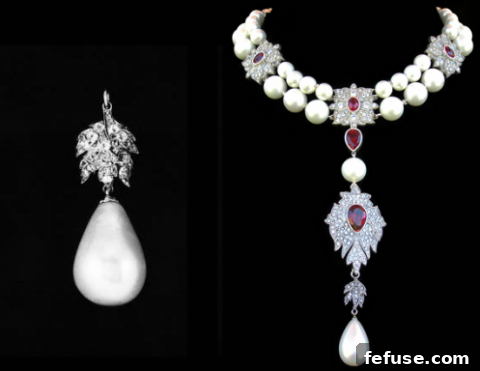
La Peregrina: Richard Burton’s Legendary Gift to Elizabeth Taylor in 1969
In the annals of extraordinary romantic gestures and iconic celebrity gifts, few rival the moment in 1969 when the incomparable Richard Burton presented his beloved wife, Elizabeth Taylor, with a piece of history that transcended mere jewelry: La Peregrina. This wasn’t just any pearl; it was a testament to enduring beauty, royal lineage, and a fascinating journey spanning centuries. For a woman known for her dazzling collection of jewels, La Peregrina stood out as a truly unique and breathtaking acquisition, cementing its place in the lore of both natural wonders and Hollywood glamour.
Burton, ever the passionate and extravagant lover, outbid a member of the Spanish Royal family at auction to secure this unparalleled gem. His winning bid of $37,000 for the 16th-century treasure was, even then, a significant sum, but utterly dwarfed by the pearl’s historical and intrinsic value. La Peregrina, meaning “the Pilgrim” or “the Wanderer,” is celebrated not only for its immense size but also for its exquisitely perfect pear shape and exceptional luminosity. Its discovery in the mid-16th century marked the beginning of an incredible odyssey, a journey that saw it become one of the most celebrated and coveted pearls in the entire world, forever linked to power, prestige, and ultimately, unparalleled love.
The Pilgrim’s Royal Journey: From Panama Shores to European Courts
The story of La Peregrina begins dramatically on the coast of the isle of Santa Margarita in the Gulf of Panama. Here, in the mid-16th century, an African slave discovered this massive gem, a find that would forever alter the course of pearl history. Its extraordinary size and perfect form immediately set it apart. Shortly after its discovery, the pearl found its way into the hands of Spain’s King Philip II, becoming a prized possession within the Spanish Crown Jewels. For over 250 years, La Peregrina graced the necks of Spanish queens, a symbol of their nation’s wealth and imperial power. It was famously depicted in several royal portraits by renowned artists, solidifying its status as an enduring emblem of the Spanish monarchy.
However, the pearl’s moniker, “the Wanderer,” proved remarkably prescient. Its royal provenance took a fascinating turn during the Napoleonic Wars. When Napoleon Bonaparte’s brother, Joseph Bonaparte, ascended to the throne of Spain as King Joseph I in the early 19th century, he inherited a portion of the Spanish Crown Jewels, including La Peregrina. Upon his abdication and flight from Spain, Joseph Bonaparte famously took the pearl with him, marking its departure from Spanish hands. After his death, it passed to his nephew, Napoleon III, further extending its journey through European aristocracy. Eventually, the pearl found its way into British aristocratic circles, becoming a cherished possession of James Hamilton, the Duke of Abercorn, remaining in his family for generations until its monumental appearance at auction in 1969.
Elizabeth Taylor: A Love Affair with Jewels and a Perilous Puppy
For Elizabeth Taylor, acquiring La Peregrina was more than just adding another gem to her legendary collection; it was embracing a piece of living history. She understood its profound significance and cherished it deeply. Her personal account of an incident involving the pearl, detailed in her candid book, Elizabeth Taylor: My Love Affair With Jewelry, perfectly encapsulates her unique relationship with her precious possessions and provides a heartwarming glimpse into her life.
Taylor recounted a terrifying moment shortly after receiving the pearl from Burton. She wrote, “At one point I reached down to touch La Peregrina and it wasn’t there! I glanced over at Richard and thank God he wasn’t looking at me, and I went into the bedroom and threw myself on the bed, buried my head into the pillow, and screamed. Very slowly and very carefully, I retraced all my steps in the bedroom. I took my slippers off, took my socks off, and got down on my hands and knees, looking everywhere for the pearl. Nothing. I thought, It’s got to be in the living room in front of Richard. What am I going to do. He’ll kill me! Because he loved the piece.” The sheer panic and despair Taylor felt are palpable in her words, highlighting not only the pearl’s immense value but also Burton’s deep affection for the gift he had so carefully chosen.
The resolution to this harrowing experience is as remarkable as the pearl itself. After her frantic search yielded no results, a peculiar sight caught her eye: one of her adorable puppies was playfully chewing on something in the living room. With a mixture of trepidation and fading hope, Taylor approached the small canine. “I just casually opened the puppy’s mouth and inside his mouth was the most perfect pearl in the world. It was—thank God—not scratched.” The relief she must have felt, discovering the priceless pearl unharmed within a puppy’s mouth, speaks volumes about the unpredictable charm of life with Elizabeth Taylor. This anecdote became a beloved part of La Peregrina’s modern legend, humanizing an object of such immense historical and monetary worth.
The Cartier Transformation: A Modern Interpretation of Ancient Splendor
Despite its rich history, Elizabeth Taylor understood that a jewel, however magnificent, could always be enhanced to reflect contemporary elegance while honoring its past. Years after receiving La Peregrina, Taylor commissioned the renowned jewelry house Cartier to design a bespoke setting for the pearl. Her vision was to create a necklace that would complement the pearl’s unique beauty and pay homage to its royal heritage, specifically drawing inspiration from historical portraits.
The resulting masterpiece was a breathtaking ruby and diamond necklace, an exquisite symphony of vibrant color and sparkling brilliance. The design featured the luminescent pear-shaped pearl suspended gracefully at its center, allowing it to swing freely and catch the light with every movement. This intricate setting was reportedly inspired by the majestic portraits painted by Diego Velázquez, particularly those of Spain’s Queen Margarita and Queen Isabel, who were often depicted wearing the pearl as a necklace. Cartier’s artisans meticulously crafted a piece that blended historical grandeur with modern sophistication, ensuring that La Peregrina would continue to captivate and enchant for generations to come, a perfect embodiment of Taylor’s exquisite taste and deep appreciation for both art and history.
An Enduring Legacy: The Auction and Beyond
After decades as a treasured centerpiece of Elizabeth Taylor’s private collection, La Peregrina, still magnificently set in its Cartier necklace, made headlines once again. Following Taylor’s passing, the entire legendary collection was put up for auction by Christie’s in December 2011. The world watched as this iconic pearl, with its incredible journey and Hollywood connection, went under the hammer. The bidding was fierce, reflecting the pearl’s unparalleled status in the world of fine jewelry and historical artifacts. When the final hammer fell, La Peregrina fetched an astonishing $11 million, setting a new world record at the time for a natural pearl at auction.
This staggering price underscored not only the intrinsic rarity and beauty of the pearl but also the immense legacy of Elizabeth Taylor herself. La Peregrina is more than just a gem; it is a captivating narrative woven through centuries of discovery, royalty, conflict, romance, and the unforgettable personal stories of its owners. From the depths of the Panama Gulf to the dazzling lights of Hollywood, and finally to a historic auction block, La Peregrina remains a timeless symbol of luxury, enduring beauty, and the extraordinary tales that jewels can tell. Its story continues to inspire awe and fascination, a true testament to its legendary status as one of the world’s most iconic and historically significant pearls.