
For millennia, India has been renowned globally as the fabled ‘Land of Gems and Diamonds.’ Its mystical allure drew kings, emperors, and intrepid traders from every corner of the world, all captivated by the untold riches hidden within its ancient mines. From the legendary brilliance of Golconda diamonds, celebrated for their exceptional purity, to the captivating hues of rubies and sapphires, India’s gemstones were far more than mere decorative adornments. They were pivotal players in shaping grand alliances, igniting devastating wars, and weaving intricate legends that resonate powerfully even in our modern age.
At J K Diamonds Institute of Gems & Jewelry, we delve deep into the heart of this rich heritage. This comprehensive guide explores some of India’s most famous gemstones – those magnificent treasures that not only altered the course of history but continue to mesmerize gem enthusiasts and historians alike with their profound stories and unparalleled beauty.
1. The Koh-i-Noor Diamond: A Saga of Power, Prestige, and Imperial Legacy
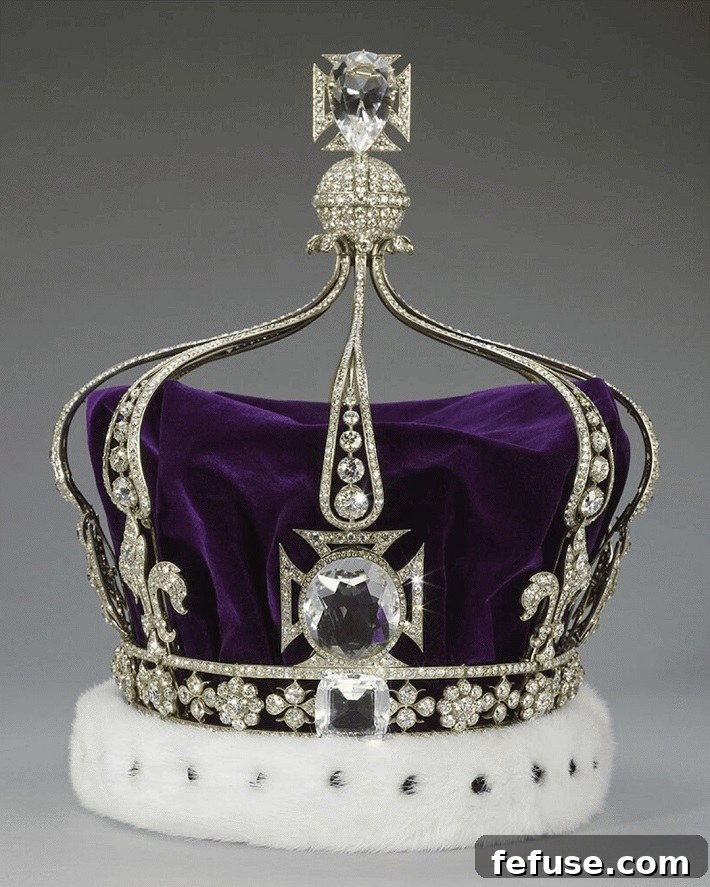
Few gemstones command as much global recognition and intense historical debate as the Koh-i-Noor diamond. Its journey began in the legendary Golconda mines of Andhra Pradesh, a region synonymous with some of the world’s finest diamonds. Originally, it was believed to be the largest diamond ever discovered, a stone of immense size and unparalleled brilliance. Its extraordinary journey saw it pass through the hands of numerous powerful dynasties: from the illustrious Mughals, who first brought it into their imperial treasury, to the conquering Persians, the formidable Afghans, and the valiant Sikhs. Each empire that claimed the Koh-i-Noor saw it as a symbol of their supreme power and legitimacy. Finally, it was acquired by the British during their colonial rule in India.
Today, the Koh-i-Noor is a prominent fixture in the British Crown Jewels, residing within the State Crown of Queen Elizabeth The Queen Mother. Yet, its presence there continues to ignite fervent discussions and debates regarding ownership, repatriation, and the complex issues surrounding cultural heritage. Beyond its dazzling sparkle, the Koh-i-Noor diamond stands as a powerful, albeit controversial, symbol. It embodies the relentless power struggles between empires, the ebb and flow of historical dominance, and the lasting impact of colonial conquests. Its multifaceted history, marked by both glory and bloodshed, makes it one of the most studied and passionately discussed diamonds in human history.
2. The Hope Diamond: A Captivating Enigma in Deep Blue

Another unparalleled treasure unearthed from the fabled Golconda mines, the Hope Diamond, is arguably one of the most mysterious and visually striking gems ever discovered. Renowned globally for its breathtakingly rare and intense deep blue hue, the diamond’s allure is further amplified by the captivating and often tragic “curse” associated with its ownership. Its epic voyage began as a larger stone known as the Tavernier Blue, a magnificent rough diamond brought to Europe by the French merchant Jean-Baptiste Tavernier in the 17th century. It was eventually recut and acquired by King Louis XIV of France, becoming the French Blue and a centerpiece of the French Crown Jewels.
During the tumultuous French Revolution, the French Blue was stolen and resurfaced years later in a recut form, becoming the Hope Diamond. From successive French royalties, including the ill-fated Louis XVI and Marie Antoinette, to various European aristocrats and wealthy American collectors like Evalyn Walsh McLean, the Hope Diamond traversed continents, leaving a trail of both unparalleled glory and inexplicable misfortune for many of its owners. This dramatic history only deepened the mystique of its infamous curse. Today, it is the crown jewel of the Smithsonian National Museum of Natural History in Washington D.C., attracting millions of visitors annually. Its profound blue color, caused by trace amounts of boron, combined with its legendary curse and documented provenance, makes it one of the most scientifically studied and culturally fascinating diamonds in the annals of gemology.
3. The Great Mogul Diamond: A Vanished Jewel of Immeasurable Scale

Discovered in the celebrated Golconda mines in the mid-17th century, the Great Mogul Diamond was, for a period, considered one of the largest and most magnificent stones in the world. Its colossal rough form reportedly weighed over 700 carats, a truly staggering size for any diamond. The French gem merchant Jean-Baptiste Tavernier, whose meticulous records have provided invaluable insights into the gem trade of the era, famously described this monumental diamond during his visit to India. He witnessed it in the court of the Mughal Emperor Aurangzeb and documented its characteristics, noting its rose-cut and somewhat irregular shape, as well as the flaws that marred its surface.
However, despite its initial grandeur and documented existence, the Great Mogul Diamond’s current whereabouts remain one of gemology’s most enduring mysteries. After its public appearance, it vanished from historical records, leading to widespread speculation about its fate. Many gem historians and experts propose that the diamond was likely recut into several smaller stones due to its imperfections and the prevailing cutting techniques of the time. Intriguingly, one prominent theory suggests that fragments of the Great Mogul Diamond might have been incorporated into other famous gems, with the Orlov Diamond in the Russian Crown Jewels often cited as a possible descendant. Its dramatic disappearance only amplifies its mythical status, transforming it from a mere gemstone into a symbol of lost grandeur and the ephemeral nature of earthly treasures, continuing to fuel the imagination of historians and gemologists alike.
4. The Orlov Diamond: From Deity’s Eye to Imperial Sceptre
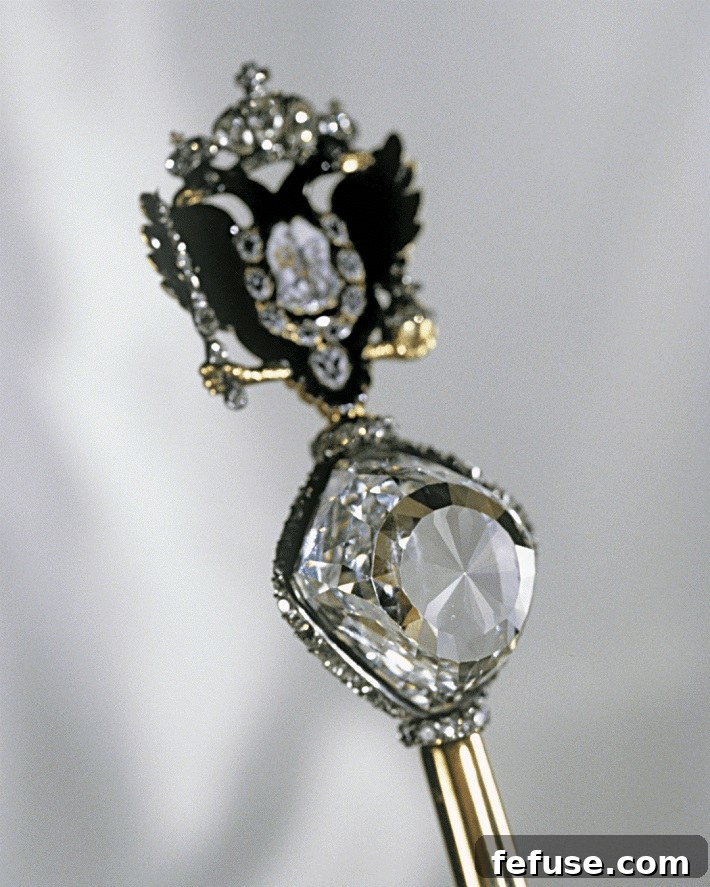
Another extraordinary diamond, widely believed to have originated from the fertile depths of the Golconda mines in India, is the magnificent Orlov Diamond. This captivating gem now holds a place of honor, set majestically in the Imperial Sceptre of the Russian Crown Jewels, a testament to its illustrious history and breathtaking beauty. The legend surrounding the Orlov Diamond traces its origins to a South Indian temple, where it was revered as one of the deity’s eyes, a sacred and invaluable treasure embodying spiritual power. The story recounts its audacious theft from this holy site, marking the beginning of its incredible journey across continents and cultures.
Following its removal from the temple, the diamond embarked on a circuitous path, passing through various hands and regions before eventually making its way to Russia. It was famously acquired by Count Grigory Grigorievich Orlov, a favorite of Empress Catherine the Great, who reportedly purchased it for a staggering sum to present to her. The Empress, deeply impressed by its grandeur, had it incorporated into the Imperial Sceptre, instantly elevating it to one of the most prized possessions of the Russian monarchy. The Orlov Diamond, with its unique cut and storied past, continues to be revered not just as a marvel of nature, but as a powerful fusion of spiritual legacy, grand imperial power, and exquisite craftsmanship, bridging ancient Indian devotion with the opulence of Russian royalty.
5. The Nassak Diamond: A Journey of Cultural and Economic Transformation
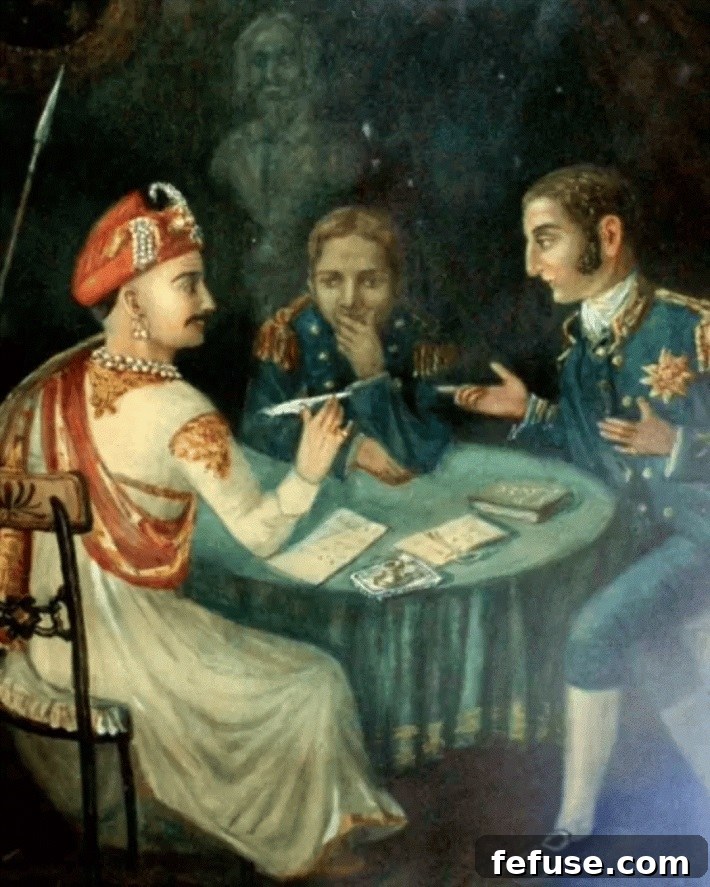
The Nassak Diamond’s history is a compelling narrative of cultural transition, colonial influence, and the evolving world of gem cutting. Its journey began in a temple in Nashik, Maharashtra, where it was revered as a sacred gem, adorning an idol of a Hindu deity for centuries. This precious diamond was an integral part of the local heritage, imbued with spiritual significance and cultural value. However, its fate took a dramatic turn during the Anglo-Maratha Wars in the early 19th century, a period of intense conflict that saw the British East India Company expand its dominion across India. The diamond was among the treasures acquired by the British, marking its departure from its sacred origins.
Upon its arrival in Europe, the Nassak Diamond underwent a significant transformation. Initially cut in a traditional Indian style, it was later re-cut by European jewelers to conform to contemporary fashion and maximize its brilliance, reflecting the Western aesthetic of the time. This recutting significantly altered its original form and, to some extent, its historical identity. Over the centuries, it passed through the hands of several notable European aristocrats and eventually found its way to American collectors, being auctioned off multiple times. The Nassak Diamond stands as a poignant symbol of how Indian gemstones carried immense cultural weight, embodying centuries of spiritual devotion, but also became significant economic assets that fueled global trade and influenced the fortunes of empires. Its metamorphosis from a revered temple treasure to a celebrated jewel of the Western world powerfully reflects the shifting tides of history, colonial legacy, and the enduring global fascination with Indian diamonds.
India’s Enduring Gemstone Legacy: More Than Just Sparkle
The narrative of Indian gemstones transcends mere geological wonders; they are vibrant chronicles of human history, artistry, and ambition. For centuries, these sparkling treasures didn’t just radiate beauty; they rewrote chapters of global history. India, particularly through its legendary Golconda mines, was not merely a source but the undisputed epicenter of the ancient world’s diamond trade. The gems extracted from its earth fueled vast global trade networks, enriched empires, influenced complex royal politics, and became potent symbols of power, spirituality, and divine favor. The Golconda region, famed for its alluvial diamonds, produced stones of unparalleled brilliance, purity, and size, many of which remain unmatched even today.
Beyond Golconda, other regions like Panna also contributed to India’s reputation as a gem powerhouse. The ancient Indian techniques of mining, cutting, and polishing diamonds, often using rudimentary tools, yielded magnificent results, proving the ingenuity of early Indian artisans. These gemstones were not just commodities; they were integral to Indian mythology, astrology, and royal regalia, embodying spiritual significance and holding immense cultural value. They inspired poets, captivated artists, and motivated expeditions, shaping the cultural and economic landscape of both India and the world.
Even in the contemporary era, these famous historical stones continue to remind us that gemstones are far more profound than simple ornaments. They are tangible pieces of living history, each carrying intricate tales of power, unwavering devotion, and the capricious hand of destiny. They connect us to ancient civilizations, to the skilled hands of miners and artisans, and to the powerful figures who once owned them. The legacy of Indian gemstones is a testament to the country’s unparalleled natural wealth and its deep-rooted cultural connection to these extraordinary gifts of the earth.
Beyond Brilliance: The Cultural Tapestry of Indian Gems
The stories of the Koh-i-Noor, the Hope Diamond, the Great Mogul, the Orlov, and the Nassak are not isolated incidents but threads in a rich tapestry that illustrates India’s pivotal role in the global history of gems and jewelry. These diamonds, with their complex provenances and dramatic narratives, serve as invaluable cultural artifacts. They offer insights into geological formations, ancient mining practices, historical trade routes, the artistic evolution of gem cutting, and the socio-political dynamics of various empires. Studying them allows us to understand the interconnections between natural science, human ambition, and cultural identity.
For aspiring gemologists, historians, and jewelry enthusiasts, delving into the world of these legendary Indian gemstones offers an enriching educational experience. It goes beyond merely identifying gem types or understanding their physical properties; it’s about uncovering the profound interplay of culture, history, and scientific discovery that imbues each gem with its truly priceless value. These stories inspire contemporary jewelry design, inform historical research, and deepen our appreciation for the enduring magic of the natural world.
This holistic approach is precisely what we foster at J K Diamonds Institute of Gems & Jewelry. Our institution is dedicated to blending traditional wisdom with cutting-edge modern gemology. Here, students don’t just learn to identify and grade gemstones; they embark on a journey of discovery, uncovering the captivating stories, the rich cultural heritage, and the profound historical significance that render each gem a timeless legend. We believe that true mastery in gemology comes from understanding not just the sparkle, but the soul of every stone.