
Navigating Economic Headwinds: A Deep Dive into US Watch and Jewelry Sales Decline
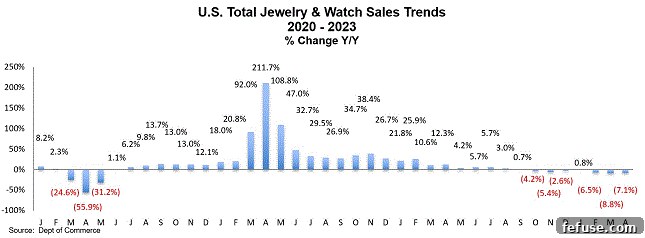
The United States luxury market, particularly the watch and jewelry sectors, continues to grapple with significant economic headwinds. Recent figures from the US Department of Commerce reveal a persistent downward trend in sales, underscoring the challenging environment faced by retailers and brands. In April, watch and jewelry sales experienced a notable decline of 7.1 percent. While this represents a slight improvement compared to the sharper 8.8 percent drop recorded in March, it nonetheless confirms a sustained period of contraction within these discretionary spending categories.
This ongoing downturn is not an isolated incident but rather a continuation of a trend that became pronounced in late 2022. Year-on-year sales data indicates a period of modest growth up to May 2022. However, the trajectory shifted dramatically, with sales dipping below zero in October 2022. Since then, the market has largely remained in negative territory, with only a solitary exception: a marginal 0.8 percent rise observed in January. This pattern paints a clear picture of consumers tightening their belts, particularly when it comes to high-value, non-essential purchases like watches and fine jewelry.
The Shadow of Inflation and Cumulative Consumer Impact
A primary driver behind this subdued consumer sentiment and reduced spending power is the lingering effect of inflation. Although the US inflation rate has shown signs of moderation, reaching 4.9 percent in April, its cumulative impact over many months has significantly eroded household budgets. Inflation peaked dramatically last June, soaring to over nine percent, a level not seen in decades. For an extended period, the cost of everyday necessities, from groceries to fuel and housing, surged relentlessly, forcing consumers to re-evaluate their financial priorities.
The compounding effect of these sustained price increases means that even as inflation slows, many households have less disposable income than they did before the inflationary spike. Savings may have been depleted, and the cost of living remains elevated compared to pre-inflationary levels. This economic reality directly impacts the luxury market, as consumers are naturally more cautious about making significant purchases when their financial security feels less certain. Watches and jewelry, often seen as investments or aspirational items, become less accessible or desirable when basic financial obligations are stretched.
The psychological impact of inflation also plays a crucial role. A prolonged period of rising prices can foster a sense of economic instability and future uncertainty. This can lead to a shift in consumer behavior towards saving rather than spending, especially on items that are not considered essential. Luxury retailers must navigate this complex interplay of eroded purchasing power and cautious consumer sentiment, adapting their strategies to appeal to a more discerning and financially constrained customer base.
Federal Reserve’s Tightening Grip: Interest Rate Hikes and Their Ripple Effects
Adding another layer of complexity to the economic landscape is the aggressive monetary policy adopted by the Federal Reserve. In its relentless battle against inflation, the Fed has been consistently hiking interest rates month after month. The primary objective of these rate increases is to cool down an overheating economy by making borrowing more expensive, thereby reducing demand and ultimately bringing inflation back down to its target level.
However, these higher interest rates have far-reaching consequences across the economy. For consumers, increased borrowing costs translate into higher mortgage rates, more expensive car loans, and elevated credit card interest. This further strains household budgets, reducing the funds available for discretionary spending on items like luxury watches and jewelry. Businesses also feel the pinch, as borrowing for expansion, inventory, or operational costs becomes more expensive, potentially leading to reduced investment, hiring freezes, or even layoffs. The cumulative effect is a slowdown in economic activity, which is precisely what the Fed aims for to combat inflation, but it comes at a cost to growth and consumer spending.
The Fed’s actions create a delicate balancing act. While necessary to stabilize prices, an overly aggressive tightening cycle risks pushing the economy into a recession. The specter of job losses and broader economic contraction makes consumers even warier about making significant purchases, reinforcing the downward pressure on luxury sales. The ongoing question for economists and policymakers alike is whether the Fed can achieve a “soft landing” – bringing inflation under control without triggering a severe downturn – or if the current path makes a recession an increasingly likely outcome.
Recessionary Fears: An Unavoidable Economic Reality?
The consensus among many economists is that a recession is now not just a possibility but an inevitable consequence of the current economic conditions and policy responses. A recession, typically defined as a significant, widespread, and prolonged downturn in economic activity, brings with it a host of challenges: rising unemployment, decreased consumer and business spending, and a contraction in GDP. The indicators pointing towards this outcome are numerous, from inverted yield curves in financial markets to slowing manufacturing output and declining consumer confidence.
For the watch and jewelry market, a recession would undoubtedly amplify the existing pressures. In times of economic uncertainty and job insecurity, consumers prioritize essential spending, and luxury items are often the first to be cut from budgets. Even affluent consumers, while less directly impacted by job losses, may adopt a more cautious approach, deferring non-essential purchases or opting for less expensive alternatives. The overall mood of the economy significantly influences the willingness to splurge on high-end goods, and a recession typically dampens this appetite considerably.
Businesses within the luxury sector would face increased pressure on profit margins, potentially leading to inventory build-ups, price reductions, and intensified competition. Marketing strategies would need to shift, perhaps focusing more on the investment value or enduring quality of luxury items, rather than pure aspirational appeal. The ability of luxury brands to navigate such a downturn depends heavily on their brand strength, customer loyalty, and financial resilience, but even the most established players would feel the impact.
Strategic Responses and Industry Resilience
In response to these challenging market conditions, businesses within the US watch and jewelry sector are likely adopting various strategies to maintain viability and attract customers. This might include optimizing inventory management to reduce carrying costs, offering targeted promotions, or enhancing customer loyalty programs. Many brands may also focus on digital transformation, improving their e-commerce capabilities and leveraging online channels to reach a wider audience, especially as physical foot traffic may decline.
Furthermore, an emphasis on value, craftsmanship, and sustainability could resonate more strongly with consumers who are making fewer, but more considered, purchases. The narrative around luxury items could shift from pure indulgence to conscious acquisition, focusing on the longevity, repairability, and intrinsic value of a piece. Brands with a strong heritage and reputation for quality may be better positioned to weather the storm, as consumers seek reassurance in their investments during uncertain times.
The industry might also observe a bifurcation in the market. While accessible luxury segments may struggle as mid-tier consumers pull back, the ultra-high-net-worth segment might remain relatively resilient, continuing to purchase rare or iconic pieces. However, even this segment is not entirely immune to broader economic sentiment, as major financial market corrections can impact even the wealthiest consumers’ spending habits. Adaptability and innovation will be key for survival and eventual recovery.
Looking Ahead: The Future of the US Watch and Jewelry Market
The immediate outlook for the US watch and jewelry market remains challenging, shadowed by ongoing inflation concerns, elevated interest rates, and the looming threat of a recession. For a significant rebound to occur, several economic factors would need to align favorably. A sustained and significant cooling of inflation, allowing the Federal Reserve to pause or even reverse its rate hikes, would provide much-needed relief to consumer budgets and borrowing costs. A subsequent increase in consumer confidence and a stabilization of the job market would also be crucial catalysts.
In the long term, the intrinsic appeal of watches and fine jewelry as symbols of status, personal expression, and even investment is likely to endure. However, the path to recovery will likely be gradual and uneven. Brands that can innovate, understand evolving consumer values, and maintain strong relationships with their customer base will be best positioned to thrive once economic conditions improve. The current period of contraction serves as a powerful reminder of the deep interconnectedness between the broader economic health of a nation and the discretionary spending habits that fuel the luxury goods market.
Ultimately, the performance of the US watch and jewelry sector will continue to be a bellwether for the wider economy’s health. Until there is clear evidence of economic stability and renewed consumer confidence, retailers in this segment must brace for continued volatility and adapt their strategies to navigate what remains a deeply uncertain market environment.