
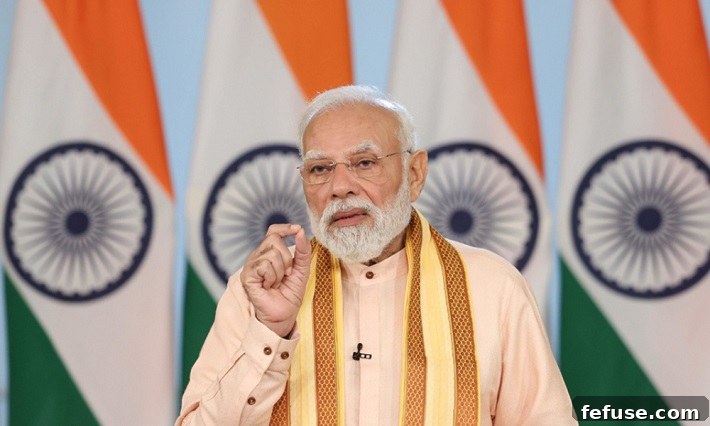
New Delhi, November 2025: In a pivotal high-level strategy meeting, India’s commitment to cementing its position as a global trade leader took center stage. Chaired by the esteemed Hon’ble Prime Minister Shri Narendra Modi, this exclusive gathering convened an elite group of business stalwarts representing the nation’s most dynamic export-driven industries. Among these influential figures was Mr. Kirit Bhansali, Chairman of the Gem & Jewellery Export Promotion Council (GJEPC), who actively participated in the closed-door session. The primary agenda revolved around crafting robust strategies to amplify India’s global trade footprint and meticulously charting the course for the nation’s ambitious, long-term export vision.
The Indian gem and jewellery sector, a cornerstone of the nation’s economy, boasts an impressive valuation of over $30 billion and contributes a significant nearly 7% to India’s total merchandise exports. Representing this vital industry, Mr. Bhansali presented a forward-thinking and comprehensive roadmap designed to elevate India into the world’s foremost gem and jewellery hub by the year 2047. This ambitious vision is meticulously aligned with the Government’s overarching “Viksit Bharat” (Developed India) initiative, aiming for holistic economic development and global prominence. Bhansali’s presentation underscored the sector’s immense potential for growth, innovation, and its critical role in realizing India’s broader economic aspirations. He highlighted strategic pillars such as technological advancement, skill enhancement, ethical sourcing, and market diversification as crucial enablers for achieving this transformative goal. By positioning India as a global leader in gems and jewellery, the sector anticipates creating millions of jobs, attracting significant foreign investment, and enhancing Brand India’s prestige on the international stage.
In his address, Mr. Bhansali extended profound gratitude to the Prime Minister for his “transformational leadership,” which has been instrumental in navigating India’s economic trajectory. He particularly lauded the strategic foresight behind landmark trade agreements, citing the resounding success of the India–UAE Comprehensive Economic Partnership Agreement (CEPA). This groundbreaking pact has demonstrably propelled a remarkable 47.4% annual growth in plain gold jewellery exports between FY2023 and FY2025, underscoring the tangible benefits of streamlined trade policies. Furthermore, Bhansali commended the significant progress achieved in the ongoing Free Trade Agreements (FTAs) with key global partners, including the UK, Australia, and the European Free Trade Association (EFTA) nations. He voiced profound optimism that the anticipated ratification of the upcoming US Bilateral Trade Agreement (BTA) and the comprehensive India–EU FTA would unlock unprecedented opportunities for the gem and jewellery sector, fostering new market access, reducing trade barriers, and stimulating further export expansion. These agreements are not merely trade deals; they are strategic alliances designed to integrate India more deeply into the global supply chain, diversify its export portfolio, and enhance its competitive edge in a rapidly evolving international marketplace. The GJEPC anticipates that these pacts will not only boost export volumes but also encourage product innovation, quality enhancement, and adherence to international standards, thereby solidifying India’s reputation as a reliable and high-quality source for gems and jewellery.
“It was an immense privilege to participate in this select industry dialogue, personally chaired by Hon’ble Prime Minister Shri Narendra Modi,” remarked Mr. Bhansali. “Under his dynamic and visionary leadership, India’s gem and jewellery industry has witnessed unparalleled progress in fostering an enabling environment for businesses, significantly improving the ease of doing business, and achieving remarkable export expansion. The supportive policy framework and strategic initiatives championed by the government have truly empowered our industry to thrive on the global stage. With continued steadfast policy support and a collaborative approach, we are not just aiming, but are resolutely committed to transcending the current milestones. Our ambitious targets include crossing a staggering US$100 billion in exports and cultivating a robust US$500 billion domestic market for gems and jewellery by the auspicious year 2047. This transformative journey is designed to unequivocally establish India as a true global hub for gems and jewellery, renowned for its craftsmanship, ethical practices, and innovative prowess. This vision extends beyond mere economic figures; it encompasses a holistic development paradigm that includes skill enhancement, technological adoption, sustainability, and robust infrastructure, ensuring India’s leadership in every facet of the gem and jewellery value chain for decades to come.”
During the insightful session, Mr. Bhansali meticulously articulated several strategic policy recommendations, each designed to bolster the sector’s global competitiveness, enhance operational efficiency, and accelerate its growth trajectory. These proposals reflect a deep understanding of industry challenges and a proactive approach to leveraging India’s inherent strengths. The recommendations address critical areas ranging from regulatory reforms to infrastructure development and financial accessibility, forming a comprehensive blueprint for sustainable expansion.
1. Modernising the Customs Act, 1962 for Seamless Trade
Drawing inspiration from India’s commendable recent criminal code reforms and the widely acclaimed success of faceless income tax assessments, Mr. Bhansali passionately advocated for the urgent and comprehensive digital transformation of the Customs Act, 1962. He put forth a visionary proposal advocating for the seamless integration of an advanced Risk Management System coupled with AI-driven Digital Appraisals. This synergistic approach aims to fundamentally revolutionize customs clearance processes, making them significantly faster, profoundly more transparent, and remarkably cost-effective. Such a modernization effort is not merely an upgrade; it is a critical imperative for substantially improving the overall ease of doing business in India. By reducing manual intervention, minimizing delays, and enhancing predictability, these digital enhancements would significantly cut down transaction costs and time for exporters, thereby boosting their international competitiveness. This move would align India’s customs procedures with global best practices, attracting more foreign investment and fostering a more efficient trade ecosystem. The adoption of AI in appraisals would ensure fairness, accuracy, and standardization, mitigating potential disputes and accelerating the flow of goods across borders.
2. Ensuring Affordable Export Credit Access for MSMEs
Highlighting a critical disparity in financing costs that places Indian exporters at a disadvantage compared to their counterparts in competing economies, Mr. Bhansali strongly recommended the immediate introduction of a concessional export credit scheme specifically tailored for Micro, Small, and Medium Enterprises (MSMEs). He powerfully underscored that providing targeted measures such as interest subvention and crucial ECGC (Export Credit Guarantee Corporation) premium subsidies would serve as a vital lifeline. These financial support mechanisms would significantly empower Indian exporters, particularly the smaller players, to compete far more effectively and robustly in the highly competitive global market. Access to affordable credit is often a make-or-break factor for MSMEs seeking to expand their international reach. By reducing the financial burden, these subsidies would enable them to invest in technology, improve product quality, and undertake larger export orders without being hampered by prohibitive borrowing costs. This strategic intervention would not only level the playing field but also unlock the untapped potential of thousands of MSMEs, contributing substantially to India’s overall export growth and job creation.
3. Expediting the SEZ Act Amendment for Optimal Utilization
Recognizing the immense contribution of Special Economic Zones (SEZs) to the sector, particularly noting that nearly 65% of India’s studded jewellery exports originate from these zones, Mr. Bhansali issued a fervent appeal for the swift passage of the SEZ Act amendment. This crucial amendment seeks to permit limited domestic sales with equitable duty adjustments for units operating within SEZs. He meticulously explained that such a progressive move would be instrumental in optimizing capacity utilization within these zones, particularly during lean periods when export demand might fluctuate. More critically, it would play a pivotal role in supporting employment continuity and ensuring job security for a significant workforce. The current restrictions often lead to underutilized infrastructure and skilled labor during periods of reduced export orders. Allowing controlled domestic sales would provide a vital buffer, enabling manufacturers to maintain production levels, retain skilled artisans, and ensure the long-term viability of their operations without diluting the primary export focus of SEZs. This flexibility would make SEZ operations more resilient and attractive, further incentivizing investment and expansion.
4. Establishing a National Gem & Jewellery Park Policy for Integrated Growth
To strategically bolster domestic manufacturing capabilities, foster innovation, and actively attract substantial international investment into the sector, Mr. Bhansali proposed the establishment of a dedicated National Gem & Jewellery Park Policy. This visionary initiative is envisioned to be meticulously modelled on the highly successful cluster-development frameworks observed in other prominent export-oriented sectors, such as the textile and leather industries. Such a policy would facilitate the creation of state-of-the-art integrated parks offering world-class infrastructure, shared facilities, advanced R&D centers, and specialized skill development institutes. These parks would serve as magnets for both domestic and foreign investors, creating synergistic ecosystems where businesses can thrive, collaborate, and innovate. By concentrating resources and expertise, these parks would drive economies of scale, reduce operational costs, and enhance the overall competitiveness of the Indian gem and jewellery sector. They would also provide a conducive environment for ethical sourcing, sustainable practices, and the development of a highly skilled workforce, solidifying India’s reputation as a responsible and leading global manufacturing hub.
Further enriching his recommendations, Mr. Bhansali also suggested the imperative development of a comprehensive White Paper on the gem and jewellery sector. This foundational document would serve as a crucial strategic resource, meticulously consolidating invaluable insights derived from GJEPC’s extensive submissions to the influential NITI Aayog, alongside key findings from a recent authoritative Exim Bank report. This holistic compilation would provide a robust, data-driven framework essential for guiding long-term policy direction, ensuring that future government initiatives are well-informed, targeted, and maximally effective in fostering sustainable growth and global competitiveness for the sector. The White Paper would act as a definitive guide, identifying key challenges, opportunities, and strategic priorities, thereby enabling a coherent and impactful policy environment.
In his concluding remarks, Mr. Bhansali powerfully underscored a fundamental truth: India’s next decisive phase of export growth and economic prosperity will hinge critically on its successful transformation into a true trading economy. This means evolving beyond merely exporting raw materials or basic goods to becoming a sophisticated global player that adeptly leverages its abundant natural advantages, strategically strengthens its global trade alliances through robust FTAs and BTAs, and relentlessly modernizes its policy frameworks. Only by embracing these integrated strategies can India unleash its full, monumental potential on the world stage, positioning itself not just as a manufacturing hub, but as an indispensable global trading partner renowned for its quality, reliability, and innovation. The journey towards Viksit Bharat is intrinsically linked to this transformation, where the gem and jewellery sector stands as a shining example of India’s ambition and capability.