
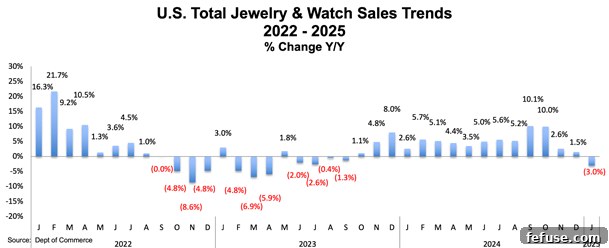
The highly dynamic US watch and jewelry market, a significant indicator of luxury consumer spending, recently experienced a notable shift in momentum. January witnessed a significant downturn in sales, marking the first decline in over a year. According to the latest comprehensive data released by the US Department of Commerce, sales within this prestigious sector dipped by a concerning 3.0% when compared to January of the previous year. This initial data point signals a potential cooling in demand for luxury goods and warrants a deeper analysis of the underlying economic currents.
January’s Sharp Dip: A Wake-Up Call for the Luxury Sector
The 3.0% year-over-year decline in January is not merely a statistical anomaly; it represents a tangible impact on retailers and manufacturers across the United States. Following a prolonged period of robust growth and consumer confidence in discretionary spending, this sudden contraction has prompted industry analysts to re-evaluate their projections for 2024. The data from the US Department of Commerce, widely regarded as a benchmark for retail sector performance, underscores a critical juncture for the luxury watch and fine jewelry segments. This dip raises immediate questions about the sustainability of recent market highs and the resilience of high-end consumer purchasing power amidst broader economic uncertainties.
Examining specific categories within the market, while detailed breakdowns for January are still emerging, the overall decline suggests a broad-based slowdown. Both luxury watches, known for their investment value and aspirational appeal, and various segments of fine jewelry, from engagement rings to designer pieces, appear to be navigating a more cautious consumer environment. Retailers are likely already adapting their inventory strategies and promotional activities to address this evolving demand landscape, emphasizing the need for flexibility and insightful market analysis.
Revised Figures Paint a Cautious Picture for Late 2023
Further adding to the concerns, recent revisions to the sales figures for November and December have revealed a slower-than-expected growth trajectory in the preceding months. These updated statistics, crucial for accurate market assessment, are now based on actual point-of-sale transactions rather than initial estimates, providing a more precise reflection of market activity. The original reports had suggested gains of 3.0% for November and a robust 4.0% for December. However, the revised data now reflects significantly lower gains of only 2.6% and 1.5% for November and December, respectively.
These downward revisions are particularly impactful because November and December typically represent peak shopping seasons, driven by holiday demand. The fact that actual sales fell short of optimistic projections suggests that the underlying consumer enthusiasm might have been overestimated. This retrospective adjustment indicates that the growth streak leading into 2024 was perhaps less vigorous than initially perceived, setting a more modest foundation for the current year. For businesses and investors, such revisions can influence inventory management decisions, marketing budgets, and overall strategic planning, fostering a more conservative outlook on market expansion.
A Shifting Market Momentum: From Resurgence to Reassessment
This recent downturn signifies a notable shift in momentum for the US watch and jewelry sector. The industry had been enjoying a period of steady growth since October 2023, following a prolonged phase of recovery. The market experienced a significant resurgence, hitting a peak in September and October of 2023, with impressive year-over-year increases reaching approximately 10%. This robust performance was a welcome change, particularly after the industry had faced a general decline that began in October 2022 and persisted through much of the subsequent year.
The period from late 2022 to mid-2023 saw various challenges, including rising inflation, increased interest rates, and a general post-pandemic normalization of spending patterns, where consumers began prioritizing experiences and other categories over luxury goods. The strong rebound in late 2023 was fueled by a combination of factors: resilient consumer confidence, strategic holiday promotions, and perhaps a degree of pent-up demand. However, the January data suggests that this surge may have been temporary or is now moderating, prompting a re-evaluation of the market’s underlying health and future trajectory.
Key Factors Driving the Current Slowdown
The slowdown in the US watch and jewelry market raises critical questions about several interconnected economic and social factors:
- Shifting Consumer Spending Habits: As inflationary pressures persist and the cost of living remains elevated, consumers may be prioritizing essential goods and services over discretionary luxury purchases. There’s a potential shift towards more conscious spending, with consumers opting for fewer, more significant investments or delaying high-ticket purchases.
- Economic Uncertainty: Broader economic indicators, including fluctuating interest rates, concerns about potential recessionary pressures, and geopolitical instability, can significantly impact consumer confidence. When the economic outlook is uncertain, consumers tend to become more conservative with their spending, particularly on non-essential luxury items.
- Market Corrections: After months of strong performance and reaching peak growth rates, the market might naturally be undergoing a correction. Periods of rapid expansion are often followed by consolidation or a slight contraction as demand normalizes and supply chains adjust. Retailers might also be clearing excess inventory from the holiday season, leading to temporary dips in new orders.
- High Interest Rates: The Federal Reserve’s sustained high interest rates make borrowing more expensive, which can deter consumers from financing larger purchases, including luxury watches and fine jewelry. This directly impacts purchasing power and willingness to spend.
- Post-Pandemic Normalization: The “revenge spending” phenomenon observed in the immediate post-pandemic era, where consumers splurged on luxury items, might be tapering off. As travel and experiential spending rebound, the share of wallet allocated to physical luxury goods could decrease.
Industry Response and Forward Outlook
Industry analysts and market participants will be closely monitoring the coming months to assess whether this January dip is merely a temporary fluctuation or if it signals a broader and more enduring trend in luxury goods spending. The performance of the watch and jewelry sector is often viewed as a bellwether for the overall health of the discretionary consumer market.
Retailers and brands are likely to respond with agile strategies:
- Enhanced Customer Experience: Focusing on personalized services, bespoke offerings, and unique in-store or online experiences to differentiate themselves and add perceived value.
- Strategic Pricing and Promotions: Carefully managed discounts and promotions to stimulate demand without diluting brand equity.
- Inventory Optimization: Prudent inventory management to align with evolving demand, avoiding overstocking in a cautious market.
- Diversification and Innovation: Introducing new product lines, focusing on sustainable practices, or exploring novel materials to attract new demographics and maintain relevance.
- Digital Transformation: Strengthening e-commerce platforms and digital marketing efforts to reach consumers where they are most active.
The watch and jewelry market has historically demonstrated resilience and adaptability through various economic cycles. While the current data suggests a period of caution, the long-term appeal of these timeless pieces remains strong. The industry’s ability to innovate, connect with evolving consumer values, and navigate economic shifts will be crucial in determining its trajectory for the remainder of 2024 and beyond. All eyes will be on the Q1 and Q2 reports to determine if the January dip was an isolated event or the beginning of a more prolonged period of adjustment for this glittering segment of the US retail landscape.