
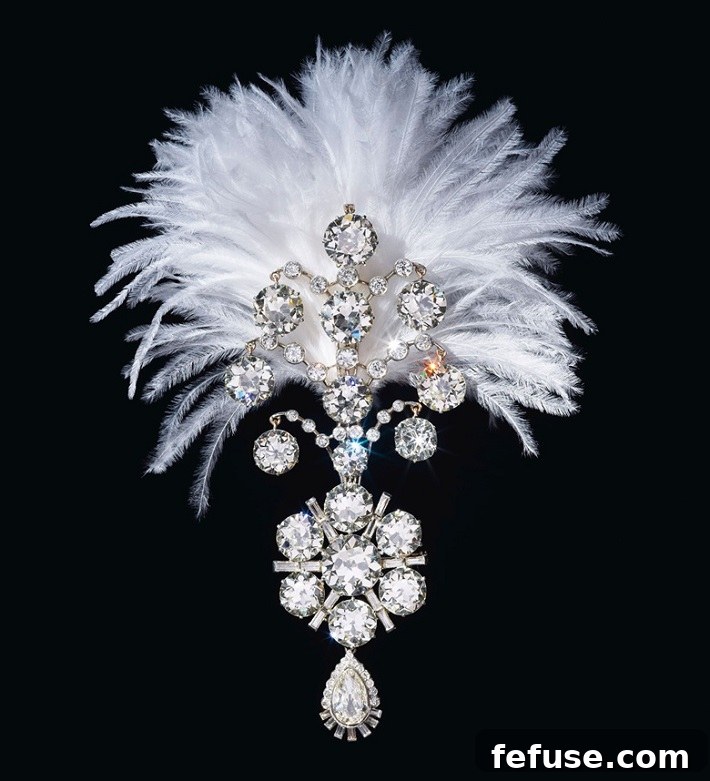
Unearthing a Royal Legacy: Christie’s Auction of Maharaja and Mughal Jewels from The Al Thani Collection
The world of haute joaillerie and historical artifacts is currently abuzz with anticipation as Christie’s, the globally renowned auction house, has announced an unprecedented sale of magnificent jewels spanning the illustrious Maharaja and Mughal eras. Scheduled for June 19, 2019, in New York, this monumental auction promises to be a landmark event for collectors, historians, and admirers of unparalleled craftsmanship and regal heritage. Sourced meticulously from the celebrated Al Thani Collection, these precious pieces offer a rare glimpse into centuries of Indian royal splendor, combining exquisite artistry with profound historical significance.
The Al Thani Collection: A Testament to India’s Enduring Opulence
Comprising an extraordinary 400 lots, the collection on offer is a breathtaking panorama of artistry, featuring an exceptional array of diamonds, vibrant coloured stones, intricate jewellery, and highly decorative jewelled objects. Christie’s aptly describes this curated selection as an “unparalleled collection of Mughal jewels, European-Indian hybrid designs and 20th-Century creations by leading Jewellery houses.” More than just precious gems, these artifacts collectively narrate “over 500 years of history and sovereign power on the subcontinent,” charting the evolution of style and patronage from the early Mughal dynasty through the grand era of the Maharajas.
Rahul Kadakia, International Head of Jewellery at Christie’s, encapsulated the profound essence of the collection, stating, “This is living history in your hand.” This sentiment perfectly captures the tactile connection to a past era of unparalleled wealth and artistic innovation. The pieces trace their origins back nearly five centuries, to the very inception of the Mughal dynasty in 1526, a powerful empire that profoundly shaped Indian culture, art, and governance until its decline in 1857. The collection not only showcases the personal adornments of royalty but also the cultural exchange and intricate craftsmanship that defined these periods.
India’s Geological Riches: The Cradle of Legendary Gems
The sheer opulence of Indian royal jewellery is not merely a testament to human artistry but also a direct result of India’s astonishing natural endowments. As Christie’s highlights, “India’s rich culture of jewellery is partly the result of natural circumstance.” The legendary mines of Golconda, nestled in the southern part of India, were historically the world’s primary source of the highest grade, most coveted diamonds, many of which still hold prominent places in global collections today. Beyond diamonds, the verdant valleys of Kashmir yielded the rarest and most beautiful sapphires, renowned for their intense, velvety blue hue. Furthermore, the greatest emeralds, though originating from distant Colombia, found their way to India through sophisticated commercial exchanges facilitated by the Portuguese-controlled ports of Goa, demonstrating India’s central role in the global luxury trade routes for centuries. This unique convergence of local resources and international trade made India an unrivaled hub for fine gemstones.
Masterpieces of Royal Adornment and Objet d’Art
Among the hundreds of lots, several categories stand out, each telling a distinct story of wealth, power, and aesthetic refinement. The collection features an array of stunning necklaces, majestic turban ornaments, and a fascinating assortment of exquisite jewelled objects that transcended mere decoration to become symbols of authority and personal identity.
The Nizam of Hyderabad Necklace: A Symbol of Princely Grandeur
One particularly significant neckpiece is the “Nizam of Hyderabad Necklace,” dating from the mid to late 19th century. Christie’s describes this breathtaking creation as being crafted from gold, adorned with “seven large foiled triangular diamonds, each framed in an openwork panel of Kundan-set diamond leaves.” At its opulent front center hangs a captivating triangular diamond pendant, further encircled by twelve diamond leaves, and elegantly mounted on an inner edge with a distinct melon-cut emerald bead. This intricate piece exemplifies the sophisticated Kundan setting technique, an ancient Indian method of setting gemstones by encasing them in pure gold foil, which enhances their brilliance and creates a unique aesthetic.
The auction house emphasizes that spectacular parade necklaces like this became a defining hallmark of Indian royal attire in the late 19th century. They were not merely accessories but powerful statements of status, wealth, and lineage, worn on ceremonial occasions to project the immense prestige of the wearer. The Nizam of Hyderabad Necklace stands as an especially spectacular example of Indian princely jewellery, encapsulating the lavish tastes and unparalleled craftsmanship of the era.
Jewelled Objects: Artistry Beyond Adornment
Beyond personal adornments, the collection also boasts a mesmerizing array of jewelled objects, showcasing the diverse applications of precious stones in daily life and ceremonial contexts. Highlights include a rare gold pen case and inkwell, dating from 1575-1600, exquisitely jewelled with diamonds, rubies, and emeralds. Such items were not only functional but also symbols of scholarship and refined taste within the Mughal court.
Another captivating piece is a ceremonial dagger, originating from either Tanjore or Mysore, crafted between 1790 and 1810. Christie’s detailed description paints a vivid picture: “The gold hilt of the dagger has been crafted in the form of a yali, a mythical lion-headed beast which is well known in the architecture of southern India, and is Kundan-set with foiled table-cut diamonds, cabochon rubies and cabochon emeralds.” This dagger is a stunning example of how mythical imagery, architectural motifs, and exceptional gem-setting techniques converged to create objects of profound cultural and artistic value, reflecting the unique syncretism of South Indian craftsmanship.
Legendary Diamonds: From Golconda to Global Royalty
The Al Thani Collection also shines a spotlight on several outstanding individual diamonds, many of which carry histories as rich and captivating as their brilliance. Among these are the “Mirror of Paradise Diamond” and the “Arcot II Diamond,” both originating from India’s legendary Golconda mine. Golconda holds a unique place in history as the earliest diamond mine known to humanity, having produced some of the world’s most famous and historically significant diamonds, including the Koh-i-Noor, the Hope Diamond, and the Daria-i-Noor.
The Arcot II Diamond: A Royal Journey
The “Arcot II Diamond” is particularly noteworthy, a magnificent brilliant-cut, pear-shaped, D-colour stone weighing a substantial 17.21 carats. Its journey is steeped in royal connections. Christie’s reveals that this diamond was one of two such diamond ear drops sent as diplomatic gifts to Queen Charlotte (1744-1818), the wife of King George III, from the Nawab of Arcot in the late 18th century. These gifts underscored the complex political and trade relationships between Indian rulers and the British monarchy during the colonial era.
The narrative of the Arcot II Diamond continues through European aristocracy. The diamonds were later acquired at auction by the Marquess of Westminster, a prominent British nobleman. Subsequently, they were mounted into the magnificent Westminster Tiara, an heirloom that has graced several significant royal occasions. Most notably, the Westminster Tiara, featuring these historic Golconda diamonds, was worn at the coronation of Queen Elizabeth II in 1953, linking an Indian royal gift directly to a pivotal moment in British history. This illustrious provenance significantly adds to the diamond’s intrinsic value and historical importance.
Cartier’s Indian Inspiration: A Fusion of East and West
The auction also celebrates the enduring influence of Indian artistry on Western jewellery houses, particularly Cartier, one of the world’s most renowned jewellers. In the early years of the 20th century, Jacques Cartier, a visionary figure in the company, recognized the immense artistic potential and unique aesthetic of Indian jewellery. He embarked on frequent visits to India, forging close personal and professional links with numerous Indian princes and royal families. These interactions allowed him unprecedented access to the intricate designs, vibrant colours, and exotic gemstones that characterized Indian royal collections, profoundly influencing Cartier’s design philosophy.
The 1922 Platinum Belt Brooch: A Testament to Cross-Cultural Design
Naturally, the June auction will feature several exquisite pieces of Cartier jewellery that bear the unmistakable imprint of Indian inspiration. It is widely acknowledged that “Cartier’s finest jewels from this period were inspired by Indian architecture, gems and jewels,” translating the grandeur of Mughal palaces into wearable art. One such example is a stunning 1922 platinum belt brooch, a true masterpiece set with diamonds, emeralds, and sapphires. Christie’s describes its design with precision: “The calibré-cut sapphire trim and diamond detail are reminiscent of ornate archways present in Mughal palaces and royal quarters.” This brooch beautifully illustrates how Cartier’s designers absorbed the architectural grandeur and intricate patterns of Indian art and seamlessly integrated them into their Art Deco creations.
The historical significance of this particular brooch is further elevated by its distinguished provenance. “This incredible piece was part of the collection of Sybil Sassoon, Marchioness of Cholmondeley, and daughter of Sir Edward Sassoon and Baroness Aline de Rothschild.” A figure of immense social standing, Sybil Sassoon chose to wear this remarkable brooch, alongside her most important jewels, for two pivotal moments in British royal history: the coronation of King George VI in 1937 and the subsequent coronation of Queen Elizabeth II in 1953. Its appearance at these events firmly places it within the annals of 20th-century history, adding another layer of allure to this already magnificent object.
A Global Spectacle: Viewing Opportunities and Auction Details
The list, detailed descriptions, and captivating stories surrounding these fascinating jewels could truly go on indefinitely. They serve as a poignant reminder of the profound romance that Indian royalty shared with gemstones and jewellery, transforming them into not just objects of beauty but vessels of history, power, and cultural identity. For those genuinely interested in beholding these historical beauties and experiencing their splendor firsthand, Christie’s has organized an exclusive series of viewing highlights across major international cities.
These scheduled viewings provided a unique opportunity for connoisseurs and the public alike to appreciate the collection’s breadth and magnificence: Shanghai (April 25-28), Geneva (May 10-14), New York (May 10-14), and Hong Kong (May 24-27). These global showcases underscored the international appeal and historical importance of the Al Thani Collection, drawing attention from diverse audiences across continents. Finally, Christie’s also announced that the entire, unparalleled collection would be on full public view in New York from June 14-18, allowing for a comprehensive appreciation before the highly anticipated auction commenced on June 19, 2019.
This auction represents more than just a sale of valuable items; it is a celebration of centuries of extraordinary craftsmanship, a tribute to the enduring legacy of Indian royalty, and a unique opportunity to acquire pieces of tangible history. Each jewel, each object, carries with it a whisper of ancient courts, powerful rulers, and timeless beauty, promising to captivate and inspire future generations.