
More than a year and a half after its previous season premiered, the highly anticipated Netflix period drama, ‘Bridgerton,’ has finally returned to our screens. With its third series split into two captivating parts, viewers are once again immersed in a world of dazzling balls, scandalous gossip, and, most importantly, an abundance of blossoming love stories, hopeful engagements, and, as always, an exquisite display of fabulous jewellery.
For those who have found themselves utterly enchanted by the romantic allure of the Regency era and are now dreaming of an engagement ring that echoes its distinctive charm, you are in luck. Steven Stone’s esteemed Leading Diamond Expert, Maxwell Stone, has generously shared his invaluable insights, revealing the essential characteristics for choosing a truly ‘Bridgerton-esque’ design. Furthermore, he offers a closer look at some of the most iconic rings from the beloved series, providing a masterclass in period-appropriate elegance.
The Enduring Appeal of Regency Era Jewellery
The Regency period, spanning roughly from 1811 to 1820 in Great Britain, was a fascinating time of transition, not just in politics and society, but also in fashion and jewellery design. It marked a distinct shift from the more opulent and elaborate styles of the Georgian era, embracing a renewed appreciation for classical simplicity, natural beauty, and delicate craftsmanship. This aesthetic deeply influenced the jewellery of the time, making it uniquely captivating and increasingly sought after today.
“The Regency period championed natural beauty above all else,” explains Maxwell Stone. “This philosophy extended directly to jewellery, which was typically dainty, delicate, and designed to complement rather than overpower. Hair and makeup were minimal, allowing the subtle sparkle of finely crafted pieces to truly shine. While engagement rings were not strictly a universal necessity as they are today, wealthy gentlemen frequently presented them to their beloved partners as a profound symbol of their affection and commitment.”
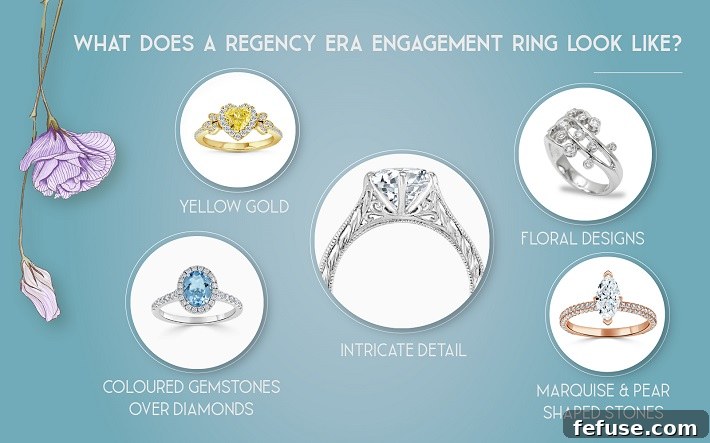
Stone further elaborates on the striking contrast between Regency rings and modern designs. “These weren’t the colossal diamond solitaires or elaborate halo settings we commonly see today. Instead, Regency engagement rings typically featured smaller, understated stones, often set on a warm yellow gold band. The true hallmarks were vibrant coloured gemstones, lustrous pearls, or charming floral motifs. Interestingly, during the early 1800s, it was uncommon for men to wear a wedding ring, while it was a widely accepted tradition for women.” This historical detail adds another layer of authenticity to the Bridgerton universe’s portrayal of marital traditions.
Daphne Bridgerton’s Wedding Ring: A Symbol of Understated Elegance
In the inaugural series of ‘Bridgerton,’ viewers witnessed the blossoming romance between Daphne Bridgerton and the enigmatic Duke of Hastings, Simon Basset. Their journey culminated in a marriage that, despite their immense wealth and status, was sealed with a wedding ring that perfectly encapsulates the understated elegance of the Regency era. Far from ostentatious, Daphne’s ring is a testament to delicate design and intricate detail, truly fitting for the period in which the series is meticulously set.
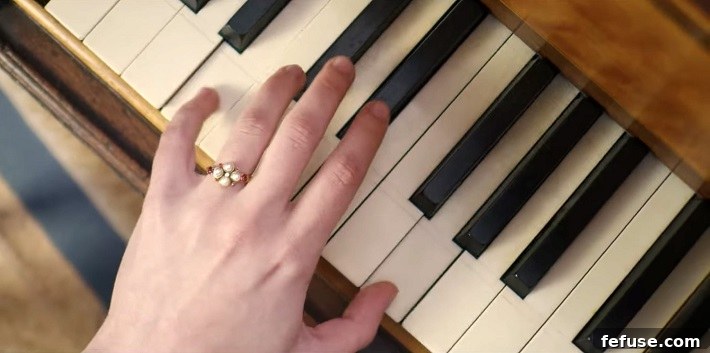
The ring’s most striking feature is its arrangement of four luminous pearls of equal size, carefully set in a cross-like formation upon a refined yellow gold band. These exquisite pearls are gracefully flanked by two slightly larger stones and four smaller ones, which appear to be either rich rubies or deep garnets, adding a subtle touch of colour and warmth. Nestled precisely in the very centre of this captivating arrangement is a small, sparkling diamond, lending the entire piece a pretty and distinctly floral design. This combination of pearls, coloured gemstones, and a central diamond, all set in yellow gold, is a superb example of Regency jewellery, reflecting the era’s preference for meaningful symbolism over sheer carat weight.
Kate Sharma’s Engagement Ring: A Legacy of Love
Series Two of ‘Bridgerton’ brought another captivating love story to the forefront, revolving around the fiery chemistry between Anthony Bridgerton and Kate Sharma. A pivotal piece of jewellery in this narrative is the cherished engagement ring that matriarch Violet Bridgerton passes down to her eldest son, Anthony. This ring, originally bestowed upon Violet by her beloved deceased husband, Edmund, carries a deep emotional resonance and significant family history.
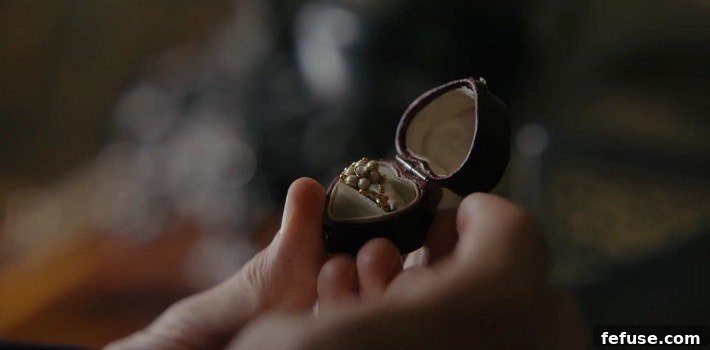
Anthony initially proposes to Edwina Sharma with the ring, but after a tumultuous journey of ‘will-they, won’t-they,’ filled with undeniable glances and heartfelt confessions, the ring ultimately finds its rightful home on Kate Sharma’s finger, signifying a true connection built on genuine love and respect. The design of Kate’s ring is equally enchanting and reflective of the era’s aesthetic principles. It features six perfectly arranged pearls, forming the delicate shape of a flower, symbolising purity and new beginnings. At the very heart of this pearl flower sits a striking, bezel-set diamond-like stone, offering a focal point of subtle sparkle.
Crafted from radiant yellow gold, the ring boasts a distinctive split-shank band, which is adorned with intricate, curled detailing. This level of meticulous artistry speaks volumes about the craftsmanship of the period. Further enhancing its romantic allure, this delicate piece of jewellery is presented and safely stored within a charming heart-shaped box, adding another layer of sentimentality to its already rich story. Both Daphne and Kate’s rings serve as exquisite examples of how Bridgerton masterfully weaves authentic Regency jewellery into its captivating storylines.
How to Choose Your Own Regency-Inspired Engagement Ring
Captivated by the elegance of Daphne and Kate’s rings? Here’s how to capture the essence of Regency-era romance in your own engagement ring, guided by expert advice from Steven Stone.
Embrace the Warmth of Yellow Gold
One of the most defining characteristics of Regency jewellery is the prominence of yellow gold. While white gold was also used, yellow gold was overwhelmingly more common for wedding and engagement rings during this period. Its rich, warm hue perfectly complemented the delicate gemstones and pearls favoured by the era, creating a timeless and sophisticated aesthetic.
“Yellow gold immediately imparts a vintage feel to an engagement ring, which is essential for a true Bridgerton-inspired look,” explains Maxwell Stone. “In the 1800s, yellow gold was the preferred metal because white gold, as we know it today, didn’t really gain widespread popularity until around 1912. If your goal is to recreate that authentic Regency charm, yellow gold is undoubtedly the way to go. To further enhance this period-specific appeal, remember to incorporate a vibrant coloured gemstone or a lustrous pearl alongside it.” The malleability of gold also allowed for the intricate engravings and delicate filigree work so characteristic of the time.
Prioritise Coloured Gemstones Over Modern Diamonds
While diamonds reign supreme in today’s engagement ring market, the Regency era had a different love affair. Coloured gemstones were the stars of the show, celebrated for their beauty, symbolism, and individual character. Pearls, sapphires, rubies, and garnets were extensively utilised in Georgian and Regency jewellery, often cut into romantic shapes like cabochons or teardrops, which softened their sparkle and enhanced their natural lustre. Rubies and pearls, in particular, formed a highly fashionable combination, as exquisitely demonstrated on Daphne’s wedding ring – a pairing that epitomises period elegance.
“It’s crucial to understand that the modern emphasis on large, brilliant-cut diamonds for engagement rings is a relatively recent phenomenon,” Stone clarifies. “The Regency and Victorian eras cherished colourful stones, including deep sapphires, passionate rubies, regal amethysts, fiery garnets, brilliant topaz, and serene pearls. These rings were often further embellished with intricate filigree work and delicate hand engraving, adding layers of artistry that went beyond the mere size of a central stone. Each gemstone held its own meaning, from pearls symbolising purity to sapphires representing loyalty and truth.”
Consider Marquise and Pear-Shaped Stones, or Authentic Old Cuts
Interestingly, the description of Daphne’s wedding ring in Julia Quinn’s novel, ‘The Duke and I’ (the literary foundation for ‘Bridgerton’), differs from its on-screen portrayal. In the book, the ring is depicted as a “large, marquise-cut emerald” flanked by two diamonds, set on a white gold band. While the Netflix team made a creative choice to alter the ring’s style for the adaptation, both versions undeniably reflect the prevailing aesthetics of the Regency era.
“In the ‘Bridgerton’ era, stones were predominantly ‘old cut’ – a term that refers to diamonds and gemstones cut without the precision and symmetry achieved with modern techniques,” Maxwell Stone explains. “These stones tend to appear slightly rougher and possess a more subtle sparkle compared to today’s laser-cut gems due to their inherent lack of perfect symmetry. While it is still possible to acquire antique old-cut stones, if you are seeking a brand new engagement ring that captures that vintage essence with superior brilliance, we highly recommend choosing a marquise, cushion, or pear-shaped stone. These cuts beautifully mirror the antique feel while offering a higher quality of cut and sparkle.” Other period-appropriate cuts included rose cuts and table cuts, which offered a broad, flat surface to showcase the gem’s colour.
Embrace Feminine Floral Designs
The natural world, with its inherent beauty and delicate forms, was a significant source of inspiration during the Regency era. Consequently, feminine floral designs were highly favoured in jewellery. These motifs, often crafted with an array of coloured gemstones, were typically small, intricate, and detailed, rather than large and overtly bold. They offered a subtle yet potent expression of romance and connection to nature.
“Pretty floral designs were immensely popular throughout the 1800s,” Maxwell Stone confirms, “and they look absolutely stunning when combined with coloured gemstones. We’ve seen a significant resurgence in their popularity recently, largely thanks to their charming aesthetic. Celebrities like Katy Perry and even royalty such as Princess Eugenie both sport engagement rings featuring beautiful floral designs, which has undoubtedly sparked a wave of renewed interest among shoppers looking for something uniquely romantic and timeless.” These designs often incorporated natural elements like leaves, vines, and blossoms, each carrying symbolic meaning.
Appreciate Intricate Detail and Craftsmanship
A striking difference between modern-day wedding and engagement rings and those from the 1800s lies in the level of intricate detail. Regency rings were not just adornments; they were often deeply personal artefacts. They were commonly engraved with meaningful messages, initials, or dates – often called “posy rings” for their poetic inscriptions – solidifying the profound bond between a husband and wife. Moreover, immense attention was paid to the finishing process of a ring from the 1800s; they frequently featured elaborate patterns, delicate filigree, or ornate designs that showcased the artisan’s skill.
Interestingly, the 1800s also witnessed a fascinating influx of designs inspired by groundbreaking archaeological discoveries, particularly from the opening of ancient Egyptian and Etruscan tombs. This led to a surge in ‘archaeological revival’ jewellery, where motifs from antiquity were reinterpreted. Bearing this historical context in mind can open up a world of creative possibilities when contemplating your own unique Regency-inspired design.
“While contemporary tastes often steer us towards focusing on the carat weight and clarity of the diamond or gemstone used in an engagement ring, the 1800s placed its emphasis squarely on the detail and artistry,” Maxwell Stone highlights. “The sheer level of craftsmanship and meticulous detail poured into vintage engagement rings remains unparalleled, even to this day. Many new designs aim to imitate this timeless vintage style, but it’s equally important to ensure that these modern interpretations truly capture and contain the same exceptional level of intricate detail and hand-finishing that defined the original pieces.”
Discover Your Perfect Bridgerton-Inspired Piece at Steven Stone
If you’re seeking to infuse your jewellery collection with the captivating charm of the Regency era, or if you’re on the hunt for that perfect Bridgerton-inspired engagement ring, Steven Stone invites you to explore our extensive and exquisite collection. Whether your heart desires a dazzling necklace, a pair of elegant diamond earrings, or a truly unique engagement or wedding ring, we are confident you will find a piece that speaks to your aesthetic. Our vast range includes both contemporary designs and pieces that beautifully echo the intricate craftsmanship and romantic spirit of historical periods.
Should you not immediately discover a piece that perfectly captures your vision within our existing collections, do not despair. Steven Stone proudly offers a bespoke jewellery design service. Our highly skilled and experienced designers will collaborate closely with you to transform your dreams into reality, creating a unique, one-of-a-kind piece of jewellery that ticks every single box and perfectly embodies your personal style and the timeless elegance of the Regency era. Let us help you craft your own romantic legacy, much like those seen on the screens of ‘Bridgerton.’