
Unmasking the Impostors: HRD Antwerp Exposes Topaz Manipulated to Mimic Rough Diamonds
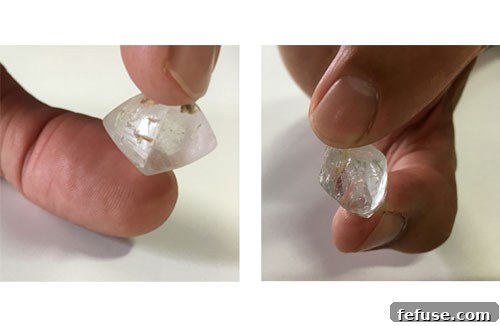
In the intricate and often high-stakes world of precious gemstones, the distinction between genuine articles and their clever imitations remains a constant, critical challenge. Buyers and sellers alike rely on expert analysis to ensure authenticity and protect their investments. A recent and significant incident brought to light by HRD Antwerp, a leading authority in diamond certification, has underscored this challenge with alarming clarity. What were initially believed to be two substantial, near-colourless rough diamonds, weighing an impressive 50.08 and 38.18 carats respectively, were definitively identified as topaz after a rigorous examination by the lab’s research department. This discovery serves as a crucial warning to the global diamond trade, highlighting the sophisticated methods employed in attempting to deceive unsuspecting buyers of rough diamonds.
Topaz, while a beautiful gemstone in its own right, has long been recognized as one of the colourless diamond simulants prevalent in the market. Its physical characteristics can, under certain circumstances, make it remarkably difficult to distinguish from genuine diamonds without the aid of advanced gemological tools and expertise. The incident reported by HRD Antwerp is particularly noteworthy because the deception was so cunningly executed that initial, standard identification methods proved insufficient, allowing the stones to potentially pass as rough diamonds in a typical trading environment.
The Initial Deception: Why Standard Tests Failed in Identifying Rough Diamond Simulants
The core of this sophisticated deception lay in topaz’s inherent properties. HRD Antwerp’s announcement explicitly noted a critical factor: topaz possesses a density remarkably similar to that of diamond. This characteristic meant that the submitted stones could not be accurately identified as diamond imitations through conventional hydrostatic measurement—a common technique used by traders to determine specific gravity by submerging a gem in water. This method, while fundamental, becomes unreliable when dealing with simulants that closely match a diamond’s density profile.
Furthermore, the use of a 3D-scanner, which calculates volume and combines it with weight to infer density, also failed to flag the stones as simulants at the initial trader’s office level. These are fundamental preliminary tests often conducted by rough diamond traders to quickly assess parcels and identify obvious fakes. The fact that these basic yet crucial initial screenings were bypassed by the topaz’s similar properties underscores the meticulous planning and understanding of gemological tests by those behind the manipulation. For rough diamond buyers, particularly those operating with significant volume and requiring quick assessments, the failure of these initial tests could have disastrous financial consequences.
Relying solely on such preliminary evaluations without further in-depth analysis by certified gemological laboratories increases vulnerability to sophisticated imitations. This incident highlights a growing need for enhanced vigilance and more comprehensive testing protocols throughout the diamond supply chain, especially when dealing with rough material that presents fewer immediate diagnostic features than cut and polished stones. The initial challenge in distinguishing these topaz stones from rough diamonds underscores the importance of advanced gemological investigation.
HRD Antwerp’s Meticulous Gemological Investigation: Advanced Diamond Authenticity Testing
When the stones reached HRD Antwerp’s research department, they underwent a series of advanced diagnostic procedures. The lab’s commitment to scientific rigor and its arsenal of cutting-edge technology were pivotal in unmasking the true identity of these impostors. The comprehensive investigation moved beyond superficial observations, delving into the intrinsic properties and internal structures of the gemstones.
Microscopic Investigation: Unveiling Internal Growth Patterns of Topaz vs. Diamond
One of the first critical steps in HRD Antwerp’s in-depth analysis involved a meticulous microscopic investigation. Under high magnification, expert gemologists examined the internal structure of the two submitted gemstones. This crucial examination revealed distinct internal growth planes that reflected an orthorhombic growth system. This particular crystallization pattern is highly characteristic of topaz, a mineral known for its distinctive crystal habits.
In stark contrast, diamonds crystallize in the regular (or isometric) system, exhibiting distinct octahedral or cubic growth habits. The presence of orthorhombic growth patterns served as an immediate and significant red flag, providing concrete evidence that the stones were not diamonds. Microscopic analysis is a cornerstone of gem identification, allowing expert gemologists to observe subtle internal features—such as growth patterns, inclusions, and structural anomalies—that are often unique to specific minerals. In the case of these rough stones, the ability to discern the fundamental crystallographic differences between topaz and diamond proved instrumental. This level of detail is typically beyond the scope of preliminary evaluations conducted in a trading office, necessitating the specialized equipment and trained eyes of a professional gemological laboratory.
Raman Analysis: The Molecular Fingerprint for Definitive Gem Identification
To further solidify their findings, HRD Antwerp employed Raman spectroscopy, a powerful analytical technique commonly utilized in chemistry and materials science to provide a structural fingerprint of molecules. This non-destructive method works by measuring the inelastic scattering of monochromatic light, generating a spectrum that is unique to the chemical bonds and crystal structure of a material. When applied to the heavily included stones, the Raman analysis produced a spectrum that unequivocally indicated the presence of topaz, not diamond.
Raman analysis is highly effective because it directly probes the atomic vibrations within a crystal lattice. Each mineral has a distinct Raman signature, making it an invaluable tool for definitive identification, especially when visual or basic physical tests might be inconclusive or misleading. The clarity of the Raman results in this instance provided irrefutable scientific proof, leaving no room for doubt about the stones’ true identity. Its accuracy makes it a vital tool in combating sophisticated gem fraud and ensuring diamond authenticity.
Detailed Study of Inclusions: A Tale of Two Minerals
Beyond the growth patterns and molecular fingerprints, HRD Antwerp also conducted a detailed study of the rather large inclusions present within the stones. Inclusions—internal features within a gemstone—can be incredibly diagnostic, often providing clues to a gem’s origin, formation conditions, and even its identity. The investigation revealed the presence of typical bi-phase inclusions, characterized by both liquid and gas phases, which are commonly found in topaz. These unique characteristics are formed under specific geological conditions that favor the crystallization of topaz.
Crucially, such bi-phase inclusions are, as a rule, not found in natural diamonds. Diamonds typically host solid mineral inclusions (e.g., olivine, garnet, or graphite) or, less commonly, fluid inclusions that are distinctly different from the bi-phase inclusions observed in topaz. The meticulous study of these inclusions provided yet another layer of compelling evidence. The presence of inclusions that are characteristic of topaz and conspicuously absent from diamonds further reinforced the findings from the microscopic investigation and Raman analysis. This multi-pronged approach, leveraging various advanced gemological techniques, ensures the highest level of accuracy and confidence in diamond identification.
The Deception Unveiled: Intentional Manipulation of Topaz to Mimic Rough Diamonds
Following these comprehensive investigations, HRD Antwerp arrived at a definitive and concerning conclusion. Given the octahedral shapes of the submitted stones—a common habit for rough diamonds—it became evident that the topaz crystals were not merely misidentified but had been intentionally manipulated and polished. The purpose of this manipulation was clear: to artificially create and enhance features that would mimic the typical growth lines and growth structures of rough diamonds, specifically to deceive any potential buyer.
This revelation highlights a disturbing trend towards more sophisticated forms of fraud in the rough gem market. The perpetrators went beyond simply presenting a look-alike; they actively altered the physical characteristics of the topaz to enhance its resemblance to rough diamonds. This level of deliberate alteration signifies an advanced understanding of both gemological characteristics and market vulnerabilities, making it particularly dangerous for less experienced or less equipped buyers. The careful crafting of these simulants demonstrates a calculated effort to exploit the very visual cues that rough diamond buyers often rely upon.
A Global Warning: Vigilance is Key in the Rough Diamond Market
HRD Antwerp concluded its report with a stark and urgent warning to the global diamond industry: “More and more topaz are cut” worldwide in a concerted effort “to fool rough diamond buyers.” This isn’t an isolated incident but part of a broader, emerging trend. The economic incentive to pass off less valuable materials as highly prized rough diamonds drives fraudsters to develop increasingly ingenious methods. The availability of rough topaz, coupled with the rising market value of diamonds, creates an environment ripe for such fraudulent activities, demanding heightened vigilance from all stakeholders.
This phenomenon poses a significant threat to the integrity and trustworthiness of the rough diamond trade. It can lead to substantial financial losses for individuals and businesses, undermine consumer confidence, and tarnish the reputation of the industry as a whole. For rough diamond dealers, jewelers, and investors, the message is unequivocal: vigilance and professional gemological verification are more critical than ever. The long-term stability of the market depends on robust authentication processes and the ability to confidently distinguish genuine rough diamonds from sophisticated diamond simulants.
To mitigate these risks, industry stakeholders must prioritize detailed and independent laboratory testing for any significant rough diamond purchase. Relying on reputable gemological laboratories like HRD Antwerp ensures that stones are subjected to a full spectrum of advanced diagnostic tests that can differentiate between genuine diamonds and even the most expertly manipulated simulants. Investing in rigorous authentication processes is not merely an expense but a vital safeguard for the health and sustainability of the diamond market.
The incident serves as a powerful reminder that while technology advances, so too do the methods of deception. Continuous education, staying abreast of emerging fraudulent techniques, and unwavering adherence to professional gemological standards are the best defenses against such sophisticated scams. The beauty and value of natural diamonds demand nothing less than absolute certainty, provided by unbiased expert analysis.
News Source: gjepc.org