
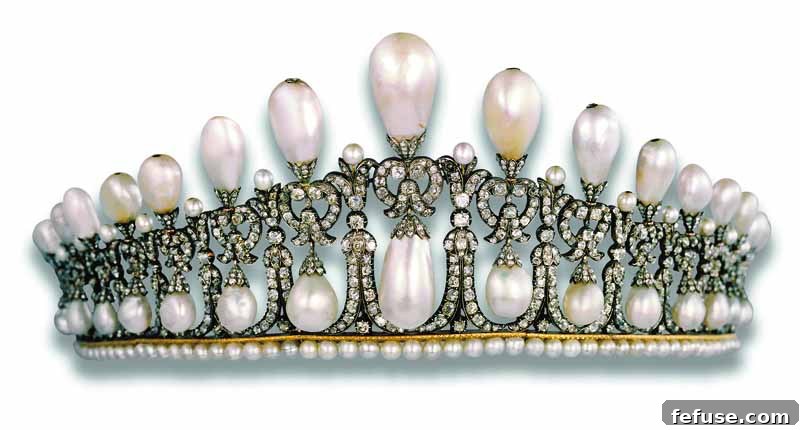
For 250 years, Christie’s has stood as an undisputed titan in the world of luxury, art, and collectible treasures. Its legacy isn’t merely etched in record-breaking sales and prestigious auctions, but profoundly woven into the very fabric of history through the magnificent jewels that have passed through its hallowed halls. François Curiel, chairman of Christie’s Asia-Pacific, eloquently captures this sentiment in the foreword to the compelling new book, Christie’s: The Jewellery Archives Revealed: “This is the story of Christie’s and its 250 years as the world’s leading auction house, written in jewels, the most fascinating language of all.” This statement perfectly encapsulates the essence of Christie’s enduring impact on the global jewelry market and its unique role in chronicling human stories through exquisite gems.
The book’s author, Vincent Meylan, delves deep beyond the shimmering surfaces of these precious objects, illuminating the vibrant, often tumultuous, lives of their original owners. He masterfully demonstrates how these jewels became more than mere adornments; they were witnesses to historical upheavals, symbols of power, wealth, and sometimes, tragic destiny. Through meticulous research and compelling narrative, Meylan reveals how these extraordinary pieces not only reflected their era but also, in many ways, helped to define Christie’s reputation as a custodian of history and an authority in fine jewelry auctions.
As the familiar adage suggests, the true histories uncovered by Meylan are often far more captivating and peculiar than any work of fiction could ever aspire to be. The intricate tales surrounding these celebrated jewels provide a rare glimpse into the intimate lives of historical figures, revealing secrets, ambitions, and heartbreaks that transcend time. Each jewel, with its unique provenance, tells a silent story of love, loss, betrayal, or triumph, making the study of Christie’s archives a journey through centuries of human drama and the evolution of the luxury market.
One of the most enthralling narratives unearthed is that of Madame La Comtesse du Barry, the famed official mistress of King Louis XV of France. Her ascent to prominence was marked by an extravagant lifestyle, lavish gifts, and an astonishing collection of jewels bestowed upon her by the enamored monarch. Her personal fortune, much of it comprised of dazzling diamonds, sapphires, and emeralds, represented the pinnacle of aristocratic opulence in pre-revolutionary France. This collection was not merely a display of personal wealth but a reflection of the absolute power and excess of the Ancien Régime. However, the tides of history were about to turn dramatically, and with them, the fate of the Comtesse and her treasures.
With the death of Louis XV and the escalating turmoil of the French Revolution, the Comtesse, now more often referred to by her birth name, Jeanne Bécu, found herself in an increasingly precarious position. The very wealth and status that had once protected her now made her a target. Her magnificent jewelry collection, a testament to her past glory, became a liability. During this turbulent period, Bécu suffered a devastating robbery, losing a significant portion of her accumulated riches. Among the reported losses were “30 or so rings with inserts of sapphires, emeralds and large diamonds,” alongside “64 loose diamonds,” and a myriad of other precious items. The total estimated value of these stolen jewels was a staggering 1.5 million livres, the French currency of the day, a colossal sum that underscored both her immense wealth and the audacity of the theft.
In a desperate attempt to recover her beloved jewels, Bécu took the audacious step of publicly advertising a reward for their safe return. However, living in the shadow of the French Revolution, such a public display of wealth was an act fraught with extreme peril. The revolutionary fervor scorned opulence, viewing it as a symbol of the monarchy and aristocracy they sought to overthrow. Flaunting riches in such a climate was akin to painting a target squarely on one’s back, inviting the scrutiny and wrath of the very forces that were systematically dismantling the old order.
News soon surfaced of individuals attempting to sell jewelry in London that bore an uncanny resemblance to Bécu’s stolen treasures. Driven by an unwavering desire to reclaim her precious items, Bécu embarked on a perilous journey, traveling repeatedly between Paris and London. These arduous journeys were undertaken not just to pursue the thieves but to navigate the complex legal quagmire that enveloped the recovered pieces. International law, conflicting jurisdictions, and the chaotic political environment made the retrieval process agonizingly slow and uncertain. Each trip was a testament to her determination, yet also a grave risk, as the situation in France grew increasingly volatile.
The amethyst and diamond necklace of Queen Alexandra. The Property of Princess Maud, Countess of Southesk.
(Christie’s London)
A diamond tiara, from the collection of Elizabeth Taylor.
(Christie’s New York)
The cameo in the belt presented to Empress Marie-Louise by Napoleon I.
(Christie’s London)
An emerald and diamond necklace by Bulgari, from the collection of Elizabeth Taylor.
(Christie’s New York)
Despite urgent advice from her attorneys, who strongly urged her to remain in the relative safety of London, far from the escalating violence of the revolution, Jeanne Bécu’s attachment to France and perhaps a misguided sense of security drew her back. This fateful decision sealed her tragic destiny. She remained in France, ultimately falling victim to the revolutionary purges. She was arrested by revolutionaries, tried, and sentenced to death, a brutal end to a life that had once embodied royal favoritism and unbounded luxury. Her story serves as a stark reminder of the unforgiving nature of revolutionary justice and the dramatic reversal of fortune that swept through France.
In her final, desperate moments, with her life hanging in the balance, Bécu harbored a faint hope that her jewels, which had once been symbols of her undoing, might now offer a path to redemption or at least a reprieve. She revealed the hidden locations of her remaining, staggering jewelry collection to the authorities, attempting to use them as a bargaining chip for her life. This extraordinary collection, once intended for personal adornment, was instead seized by the revolutionary government. These valuable jewels, now stripped of their royal context, were subsequently sold to finance the revolutionary war effort, becoming an ironic instrument in the very movement that condemned her. Ultimately, her frantic efforts proved futile; she was executed in 1793, a mere matter of weeks after Queen Marie Antoinette, ending her extraordinary life on the guillotine.
The story of Bécu’s jewels, however, did not end with her tragic demise. Just two years later, in a remarkable twist of fate, her stolen and fragmented jewelry found its way into the hands of James Christie, the visionary founder of the auction business in 1766. This acquisition marked a pivotal moment, intertwining the personal tragedy of Madame du Barry with the burgeoning legacy of what would become the world’s premier auction house. The ability of Christie’s to acquire and then auction such historically significant items, even in their dismembered state, underscored its growing influence and its keen eye for valuable, albeit controversial, provenance.
Vincent Meylan’s account vividly describes this particular auction, revealing the state in which the jewels were presented: “The auction comprised 65 lots, featuring 1,000 pearls; 150 brilliant diamonds, weighing between 1 and 12 carats; 1,200 smaller diamonds; and some stones of colour. Unfortunately, none of the stones were mounted. The stolen jewels had been broken up by the thieves to avoid suspicion.” This detail is crucial, as it highlights the illicit journey these gems had undertaken. The dismantling of such magnificent pieces into individual stones was a common tactic for thieves to obscure their origins and facilitate their clandestine sale. Yet, even in this fragmented state, their immense value and historical significance were undeniable, captivating buyers and adding another layer to the already rich tapestry of Christie’s early history.
Christie’s: The Jewellery Archives Revealed continues to recount the fascinating provenances of countless other lots that have passed through the auction house’s doors throughout its illustrious history. The book serves as an unparalleled compendium of fine jewelry, showcasing pieces owned by royalty, such as the ill-fated Mary, Queen of Scots, and Her Royal Highness, Princess Margaret, whose personal collections offered a glimpse into royal taste and tradition. It also spotlights jewels from the dazzling world of Hollywood, featuring iconic actresses like Merle Oberon and the incomparable Elizabeth Taylor, whose legendary collection, including the La Peregrina Pearl and the Elizabeth Taylor Diamond, captivated the world and achieved record-breaking sales at Christie’s.
Ultimately, Christie’s sales history transcends mere commercial transactions; it transforms into a powerful microscope through which to meticulously examine the intricate evolution of human society, culture, and socioeconomic situations across centuries. Each auction, each jewel, each owner’s story offers profound insights into prevailing aesthetic tastes, technological advancements in jewelry making, shifts in wealth distribution, and the enduring human desire for beauty, status, and legacy. While many of these exceptional jewels may eventually disappear from public view, receding into the private collections of discerning connoisseurs, the meticulous records they leave behind in Christie’s archives, and now immortalized in this fascinating tome, become permanent fixtures. These records ensure that the captivating stories of these precious objects, and the remarkable individuals who owned them, will continue to inspire and educate for generations to come, solidifying Christie’s unparalleled position as a guardian of history’s most sparkling narratives. This enduring legacy solidifies Christie’s reputation as the world’s leading auction house, a place where history, luxury, and human stories brilliantly converge.