
HRD Antwerp Uncovers Sophisticated Moissanite Imposters Masquerading as Rough Diamonds
The global diamond industry relies heavily on trust, expertise, and the integrity of its supply chain. However, a recent alarming discovery by HRD Antwerp, one of the world’s leading diamond certification laboratories, has brought into sharp focus the escalating sophistication of diamond imitations. The lab reported encountering two synthetic moissanite stones, meticulously crafted to mimic the appearance and even the ‘feel’ of natural rough diamonds, posing a significant challenge to traditional identification methods.
The Deceptive Discovery: Moissanite Stones Fool Experts
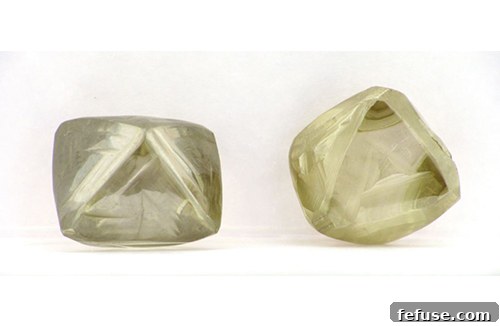
HRD Antwerp recently detailed its encounter with two particular stones, weighing 7.14 and 5.01 carats respectively. These specimens displayed a slight greenish hue, a characteristic often found in natural rough diamonds, and their physical cut was deliberately fashioned to replicate the unpolished, natural form of a diamond. What made this case particularly concerning was the level of deception achieved. According to the lab, despite being moissanite, these stones “felt” strikingly similar to rough diamonds, a tactile sensation that experienced traders often rely on. More critically, even common diamond testing pens, which operate based on thermal conductivity – a primary method for distinguishing diamonds from many other stones – incorrectly identified these moissanite fakes as genuine diamonds.
This incident underscores a critical vulnerability in the initial stages of the diamond trade, where rough stones are first assessed. The traditional quick checks and basic equipment, while generally effective against simpler imitations, proved insufficient against these highly advanced fakes. The true identity of these deceptive stones could only be definitively established through more advanced, scientific analysis, specifically relying on precise density measurements.
Moissanite: A Formidable Adversary in Gemstone Identification
Moissanite, scientifically known as silicon carbide (SiC), is a powerful contender in the realm of diamond imitations, both in its polished and now, unsettlingly, its rough form. While natural moissanite is exceedingly rare, often found only in microscopic crystals associated with meteorites and some igneous rocks, synthetic moissanite has been mass-produced since the late 1990s. Its remarkable physical and optical properties make it an incredibly convincing diamond look-alike:
- Exceptional Hardness: With a Mohs scale rating of 9.25, moissanite is second only to diamond (10) in terms of hardness. This property makes it highly durable and scratch-resistant, similar to diamond, and complicates identification through basic scratch tests.
- High Refractive Index: Moissanite boasts a very high refractive index, ranging from 2.65 to 2.69. This is significantly higher than diamond’s (2.42), resulting in moissanite often exhibiting more brilliance and a greater dispersion of light, commonly referred to as “fire.” While this can sometimes be a clue in polished stones, in rough forms, its impact is less obvious.
- Superior Thermal Conductivity: This is arguably moissanite’s most deceptive property. Unlike most other diamond imitations (such as cubic zirconia or glass), moissanite conducts heat extremely well, mimicking diamond’s characteristic thermal properties. This is precisely why standard thermal diamond testers – which measure how quickly heat dissipates through a stone – fail to differentiate between moissanite and diamond.
These combined properties allow moissanite to fool many experienced jewelers and traders who rely on tactile assessment, visual cues, and basic thermal testing equipment. The ability to now replicate the rough form adds another layer of complexity to this challenge.
Implications for the Rough Diamond Trade: Alarm Bells and Mixed Parcels
HRD Antwerp rightly pointed out that while such convincing imitations would undoubtedly “set off the alarm bells of any experienced rough diamond trader or polisher” upon close inspection, the real danger lies in subtle infiltration. The risk is significantly heightened if these sophisticated rough moissanite imitations, or even smaller sizes of polished moissanite, are intentionally or unintentionally mixed into parcels of legitimate rough diamonds. Such commingling could lead to substantial financial losses, reputational damage, and a general erosion of trust within the supply chain.
For traders operating on high volumes, especially those dealing with smaller, less thoroughly inspected stones, the presence of even a small percentage of these fakes could be devastating. Polishers, investing significant time and resources into processing rough stones, would face the nightmare scenario of discovering they’ve been working on a valueless imitation, only after significant effort has been expended.
Beyond Thermal Conductivity: The Imperative for Advanced Gemological Testing
The discovery reiterates that relying solely on thermal conductivity for diamond verification is no longer sufficient, especially with the advancement of synthetic materials. HRD Antwerp highlighted that the true identity of these moissanite fakes could only be ascertained through density measurements. This points to the need for a multi-faceted approach to gem identification, employing various scientific principles:
- Density (Specific Gravity): This remains a crucial and often definitive test. Diamond has a specific gravity of approximately 3.52 g/cm³, while moissanite is distinctly lower at around 3.22 g/cm³. Precise weighing and displacement techniques can accurately determine this difference, making it a powerful diagnostic tool.
- Birefringence (Double Refraction): Unlike diamond, which is singly refractive, moissanite is birefringent or doubly refractive. This means that light entering moissanite is split into two rays. Under magnification, especially when viewing through the pavilion facets or a specific cut orientation in polished stones, one can observe a distinct “doubling” effect of facet junctions or inclusions. While harder to spot in rough, its inherent crystal structure difference (hexagonal/trigonal for moissanite vs. cubic for diamond) provides fundamental distinction.
- Magnification and Visual Inspection: Close examination under a microscope can reveal subtle differences. Moissanite can sometimes exhibit needle-like inclusions or subtle growth patterns distinct from those found in natural diamonds. Additionally, observing the facet junctions for doubling effects (in polished stones) or the crystal habit for structural differences (in rough) is vital.
- Electrical Conductivity: While diamond is an insulator (except for rare Type IIb diamonds, which are semi-conductors), moissanite is a semiconductor. Specialized electrical conductivity testers can differentiate based on this property, offering another layer of verification.
- Spectroscopy: Advanced gemological laboratories employ techniques like Raman spectroscopy and infrared spectroscopy to analyze the unique atomic structure and chemical composition of a stone, providing an irrefutable fingerprint for identification.
- UV Fluorescence: While not always definitive, observing the reaction of a stone under long-wave and short-wave UV light can sometimes provide clues, as moissanite and diamond can exhibit different fluorescence patterns.
A Recurring Challenge: The Evolution of Diamond Impersonation
This incident is not an isolated one, but rather part of a growing trend of increasingly sophisticated diamond imitations entering the market. HRD Antwerp itself reported a similar discovery in July, detailing two topaz crystals that had also been cut to mimic rough diamonds. This pattern highlights a clear effort by unscrupulous individuals to exploit gaps in current identification protocols and deceive buyers at various stages of the diamond pipeline.
The continuous emergence of new imitation materials and enhanced fraudulent techniques necessitates constant vigilance and ongoing research within gemological institutions. It serves as a stark reminder that the battle against fakes is perpetual, requiring the industry to consistently upgrade its knowledge, tools, and best practices.
Safeguarding the Industry: The Indispensable Role of Gemological Laboratories
In this evolving landscape of advanced imitations, the role of independent gemological laboratories like HRD Antwerp becomes absolutely indispensable. These institutions are at the forefront of gemological research, developing and implementing state-of-the-art technologies and methodologies to accurately identify gemstones. They invest heavily in:
- Cutting-Edge Equipment: Utilizing advanced instruments such as Raman spectrometers, FTIR spectrometers, sophisticated microscopes, and precise density measurement apparatus.
- Expertise and Training: Employing highly trained gemologists and scientists who possess deep knowledge of gem identification and stay updated on the latest synthetic and imitation materials.
- Research and Development: Continuously researching new methods to detect emerging fakes and developing protocols to protect the integrity of the gemstone trade.
- Education and Awareness: Disseminating crucial information and findings to the wider industry, helping to educate traders, jewelers, and consumers about potential threats.
Their rigorous testing and certification processes provide the assurance and trust that are vital for the smooth functioning and credibility of the diamond market.
Protecting Your Investment: Essential Advice for Professionals and Consumers
Given the increasing sophistication of diamond imitations, it is more critical than ever for all stakeholders in the diamond value chain to exercise extreme caution and adopt robust verification procedures. Here is some essential advice:
- Source from Reputable Suppliers: Always purchase rough or polished diamonds from established and trusted suppliers with a proven track record of integrity.
- Seek Independent Certification: For any significant diamond purchase, especially for polished diamonds, insist on a grading report from a globally recognized and independent gemological laboratory like HRD Antwerp, GIA, or IGI. For rough, seek origin and authenticity documentation.
- Invest in Advanced Testing Equipment: While thermal pens have their place, professionals dealing with rough diamonds should invest in more sophisticated equipment capable of measuring density, detecting birefringence, and potentially electrical conductivity.
- Continuous Education and Training: Stay informed about the latest trends in synthetic and imitation materials. Regular training for staff on gem identification techniques is crucial.
- Perform Due Diligence: Never rush a purchase. Take the time to thoroughly inspect stones using magnification, and if possible, conduct multiple tests.
- Understand the Properties: Familiarize yourself with the key distinguishing characteristics of diamonds versus their most common imitations, especially moissanite.
The recent findings by HRD Antwerp serve as a potent reminder that the vigilance against fraud in the diamond industry must be unceasing. As technology advances, so too does the ability of fraudsters to create ever more convincing imitations. By embracing advanced gemological practices, prioritizing education, and fostering a culture of rigorous verification, the integrity and enduring value of natural diamonds can be effectively safeguarded for generations to come.