
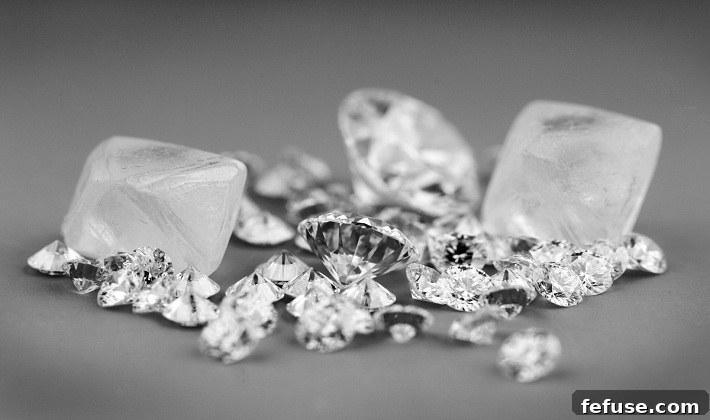
In a significant move to foster transparency and uphold consumer confidence within the global jewelry industry, the National Association of Jewellers (NAJ), in collaboration with eight leading diamond industry organizations, has unveiled a comprehensive Diamond Terminology Guideline. This crucial initiative, supported by powerhouses such as the Antwerp World Diamond Centre (AWDC), CIBJO (The World Jewellery Confederation), the Diamond Producers Association (DPA), the Gem & Jewellery Export Promotion Council (GJEPC), the Israel Diamond Institute (IDI), the International Diamond Manufacturers Association (IDMA), the World Diamond Council (WDC), and the World Federation of Diamond Bourses (WFDB), aims to establish a universally accepted framework for defining diamonds, synthetic diamonds, and their imitations.
The primary objective of this guideline is to ensure the full, fair, and effective use of clear, accessible definitions across all sector bodies, organizations, and traders. In an evolving market landscape where both natural and laboratory-created diamonds play significant roles, unambiguous terminology is not merely a preference but a necessity. It protects consumers, supports ethical trading practices, and safeguards the integrity of the diamond and jewelry trade as a whole.
Serving as an indispensable reference document, the ‘Diamond Terminology Guideline’ provides clarity for everyone involved in the diamond and jewelry trade, from miners and manufacturers to retailers and consumers. It specifically addresses how to accurately refer to natural diamonds and synthetic diamonds, thereby eliminating potential confusion and misrepresentation. This unified approach is critical for maintaining market stability and trust, especially as the distinction between naturally occurring and human-made diamonds becomes increasingly important for purchasing decisions.
Foundation of Unwavering Standards
The strength and authority of this guideline are rooted in its adherence to two internationally recognized and respected standards: the ISO 18323 Standard, officially titled “Jewellery – Consumer confidence in the diamond industry,” and the CIBJO Diamond Blue Book. By aligning with these established benchmarks, the guideline benefits from a global consensus on best practices and ethical conduct within the diamond sector. This ensures that the recommendations are not arbitrary but are instead built upon a robust foundation of scientific, technical, and commercial expertise.
The ISO 18323 standard, in particular, focuses on protecting consumer confidence by providing clear requirements for the identification, designation, and disclosure of diamonds, treated diamonds, and synthetic diamonds. Similarly, the CIBJO Diamond Blue Book outlines comprehensive standards and nomenclature for diamonds, gems, and pearls, serving as a vital resource for gemological laboratories and trade organizations worldwide. The integration of these two powerful standards imbues the new Diamond Terminology Guideline with unparalleled credibility and universal applicability, making it an essential tool for all stakeholders.
Essential Definitions for Clarity and Compliance
Understanding the fundamental definitions is paramount to complying with the guideline and fostering an environment of trust. The industry groups have meticulously outlined the following:
What is a Diamond?
A diamond is fundamentally a mineral created by nature. Originating deep within the Earth’s mantle over billions of years, under immense pressure and heat, natural diamonds possess a unique geological history that cannot be replicated. By definition, the term “diamond” exclusively refers to a natural diamond. This unequivocal stance establishes a clear baseline, affirming that the intrinsic value, rarity, and allure associated with diamonds stem from their natural formation process. When the word “diamond” is used without any qualifier, it should always be understood to signify a natural, earth-mined gemstone.
What is a Synthetic Diamond?
A synthetic diamond is an artificial product that has essentially the same physical characteristics, chemical composition, and crystal structure as a natural diamond. These are grown in controlled laboratory environments using advanced technological processes, primarily High-Pressure/High-Temperature (HPHT) or Chemical Vapor Deposition (CVD) methods. While they are chemically, physically, and optically identical to natural diamonds, their key distinguishing factor is their origin: they are human-made, not naturally formed in the Earth. Proper disclosure of a synthetic diamond’s origin is crucial for fair trade and consumer education.
What is an Imitation Diamond (Diamond Simulant)?
An imitation diamond, also known as a diamond simulant, is an artificial product that merely imitates the appearance of diamonds without sharing their chemical composition, physical properties, or crystal structure. Unlike synthetic diamonds, simulants are fundamentally different materials that simply *look* like diamonds. Common examples include Cubic Zirconia (CZ) and moissanite. These materials are generally less expensive and serve as alternatives for those seeking the sparkle of a diamond at a lower cost, but it is critical to distinguish them clearly from both natural and synthetic diamonds to prevent misrepresentation.
What is a Gemstone?
A gemstone is defined as a mineral of natural origin that is used in jewelry primarily for its combined beauty, rarity, and intrinsic value. This broad category includes a wide array of precious and semi-precious stones beyond diamonds, such as rubies, sapphires, emeralds, amethysts, and many others. Each gemstone possesses unique characteristics and origins, contributing to the diverse appeal of fine jewelry. While diamonds are indeed gemstones, this broader definition helps to contextualize the unique position of diamonds within the wider world of precious minerals.
Precise Terminology for Synthetic Diamonds
To ensure absolute clarity and avoid any ambiguity, the guideline provides strict directives on the terminology to be used when referring to synthetic diamonds. Adherence to these rules is non-negotiable for all industry participants:
Authorized Qualifiers for Synthetic Diamonds:
When discussing or describing synthetic diamonds, only the following authorized qualifiers are permissible: “synthetic,” “laboratory-grown,” or “laboratory-created.” These terms are specifically chosen for their precision and their ability to clearly communicate the human-made origin of the diamond, differentiating it from a natural diamond without diminishing its inherent qualities. The consistent application of these terms builds trust and ensures consumers are fully informed about their purchase.
Avoid Abbreviations:
The guideline expressly prohibits the use of abbreviated terms such as “lab-grown” and “lab-created.” While these might be common in informal conversation, their use in official documentation, marketing materials, and sales pitches can lead to casual misinterpretations. Using the full, formal qualifiers maintains the professional integrity and precision demanded by the industry standards, leaving no room for doubt regarding the diamond’s origin.
Do Not Use “Cultured” or “Cultivated”:
The terms “cultured diamonds” and “cultivated diamonds” are strictly forbidden. The words “cultured” and “cultivated” refer exclusively to organic or biogenic products, such as cultured pearls or cultivated plants. Applying these terms to diamonds, which are inorganic minerals (even when grown in a lab), creates a false association with biological processes and can mislead consumers about the scientific method of their creation. This clear distinction prevents confusion with other types of organic jewelry materials.
Exclusively for Natural:
Furthermore, the guideline states that the terms “real,” “genuine,” “precious,” “authentic,” and “natural” must not be used in reference to synthetic diamonds. These powerful descriptors are reserved exclusively for natural minerals and gemstones, reflecting their unique geological formation and intrinsic rarity. While a synthetic diamond is a “real” product in its existence, it is not “natural” in its origin. Using these terms for synthetic diamonds would dilute their meaning and potentially deceive consumers about the natural heritage and value proposition of earth-mined diamonds.
Recommendations for Natural Diamond Terminology
Just as important as the clear designation of synthetic diamonds is the consistent and accurate terminology for natural diamonds. The guideline offers specific recommendations to maintain clarity in this area:
“Diamond” Implies Natural:
A diamond is inherently natural by definition. Therefore, when referring to a natural diamond, the word “diamond” without any additional qualifier is the correct and preferred terminology. This reinforces the long-standing understanding that a “diamond” is a product of nature. This simple, unqualified term maintains the integrity of the natural diamond market and streamlines communication.
“Natural Diamonds” for Differentiation:
Should there be a context where differentiation from synthetic diamonds is specifically required or beneficial for clarity, the term “natural diamonds” should be used. This term serves as the equivalent meaning to the unqualified “diamond” but adds the necessary emphasis on its origin when juxtaposed with laboratory-grown alternatives. This ensures that while “diamond” alone is sufficient, specifying “natural” is available for situations demanding explicit distinction.
Avoid Confusing Expressions for Treated Diamonds:
The guideline strictly advises against the use of confusing expressions such as “natural treated diamonds” and “treated natural diamonds.” These phrases are redundant and can inadvertently create ambiguity, making it unclear whether the “natural” aspect is being modified or if the treatment is applied to something already identified as natural.
Use “Treated Diamonds” for Clarity:
Instead, when a natural diamond has undergone treatment to enhance its appearance (e.g., color enhancement, clarity enhancement), the simple and direct term “treated diamonds” should be used. This concise phrasing clearly indicates that the diamond has been altered from its original state, fulfilling the critical requirement for full disclosure without unnecessary or confusing modifiers. This applies to various treatments, such as HPHT (High-Pressure/High-Temperature) annealing for color improvement or fracture filling for clarity enhancement, ensuring consumers are well-informed about the item’s characteristics.
When and Where to Apply the Diamond Terminology Guideline
The leadership of all nine founding organizations – NAJ, AWDC, CIBJO, DPA, GJEPC, IDI, IDMA, WDC, and WFDB – strongly advocates for universal compliance with this guideline. Its application is not optional but is deemed essential for the health and integrity of the entire diamond and jewelry sector. The guideline must be meticulously applied across all forms of communication and documentation where diamonds, synthetic diamonds, gemstones, or related products are involved.
This includes, but is not limited to, all documents associated with trade, such as invoices, inventory lists, and certificates of origin. Crucially, it extends to all digital and physical marketing and sales materials, including company websites, e-commerce platforms, social media posts, advertising campaigns, brochures, point-of-sale displays, and press releases. Furthermore, gemological laboratory reports, which are critical for objective assessment and consumer trust, must strictly adhere to these terminologies. This comprehensive scope ensures that whether selling, buying, or promoting diamonds, synthetic diamonds, gemstones, diamond jewelry, or synthetic diamond jewelry, the language used is consistent, accurate, and unambiguous, thereby safeguarding consumer confidence and promoting fair trade practices globally.