
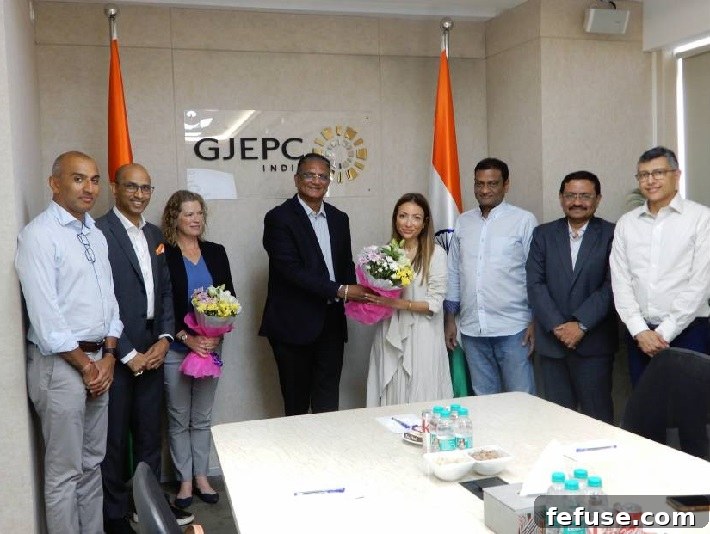
A landmark meeting took place on July 9th at the Gem & Jewellery Export Promotion Council (GJEPC) head office in Mumbai, bringing together key leaders from De Beers and GJEPC. This significant gathering underscores the deep-rooted partnership and shared vision between one of the world’s foremost diamond companies and India’s premier trade body for the gem and jewellery sector. The delegation from De Beers, a name synonymous with diamonds for over a century, was spearheaded by Ms. Feriel Zerouki, their esteemed Senior Vice President of Provenance, Ethics, and Industry Relations. Her presence highlighted De Beers’ unwavering commitment to responsible sourcing, ethical practices, and fostering robust relationships across the industry’s intricate value chain. This high-profile visit to the heart of India’s diamond trade signifies the mutual importance placed on addressing critical industry challenges and exploring collaborative pathways for sustainable growth.
Accompanying Ms. Zerouki were other influential figures from De Beers, further emphasizing the multifaceted nature of the discussions. Ms. Emma Wade Smith, the Global Head of Public Policy and Public Affairs, brought expertise in navigating the complex landscape of international regulations and stakeholder engagement. Her role is crucial in shaping public perception and advocating for policies that support a thriving and responsible diamond industry globally. Also part of the distinguished delegation was Mr. Amit Pratihari, the Managing Director of De Beers Forevermark. Mr. Pratihari’s involvement underscored the commercial aspects and brand strategies essential for driving consumer demand and maintaining the premium positioning of natural diamonds in an evolving market. The combined expertise of these leaders from De Beers offered a comprehensive perspective, covering ethical standards, public relations, and market development, all of which are vital for the long-term prosperity of the diamond sector.
Welcoming the Delegation: GJEPC Leadership at the Forefront
The De Beers delegation received a warm and official welcome from the top brass of the GJEPC, showcasing the council’s readiness to engage in substantive discussions vital for the Indian gem and jewellery industry. Leading the reception was Mr. Vipul Shah, the Chairman of GJEPC. As the head of the organization responsible for promoting and facilitating the export of gems and jewellery from India, Mr. Shah’s leadership is instrumental in steering the industry through global shifts and challenges. His insights into the domestic market and export dynamics are invaluable, providing a crucial Indian perspective to the global dialogue on diamonds. The GJEPC, established in 1966 by the Ministry of Commerce and Industry, Government of India, plays a pivotal role in promoting Indian jewellery products worldwide, contributing significantly to the nation’s economy and employment.
Further strengthening the GJEPC’s representation were key members from its Diamond Panel, reflecting the specific focus of the meeting on diamond-related matters. Mr. Ajesh Mehta, the Convener of the Diamond Panel, brought extensive experience and deep knowledge of the diamond trade, particularly from the perspective of Indian manufacturers and traders. His role involves addressing the operational and policy challenges faced by the diamond sector in India, ensuring that the industry remains competitive and compliant. Supporting Mr. Mehta was Mr. Saunak Parikh, the Co-Convener of the Diamond Panel, whose contributions help broaden the panel’s scope and effectiveness. Their combined efforts are crucial in formulating strategies that benefit the entire diamond value chain, from rough procurement to polished diamond sales. Additionally, Mr. Anil Virani, a respected Member of the Diamond Panel, contributed his expertise, ensuring that all facets of the diamond industry were adequately represented in the high-level discussions.
Providing essential administrative and strategic support was Mr. Sabyasachi Ray, the Executive Director of GJEPC. Mr. Ray oversees the day-to-day operations of the council and plays a crucial role in implementing its policies and initiatives. His involvement ensures that the outcomes of such high-level discussions are translated into actionable plans and executed efficiently. The collective presence of these GJEPC leaders underlined the importance India places on its relationship with global industry giants like De Beers, highlighting a shared commitment to addressing the evolving landscape of the diamond trade. This comprehensive representation from both sides created a robust platform for candid dialogue and strategic planning, aimed at fostering a more resilient and responsible future for the diamond industry.
Strategic Discussions: Charting the Future of the Diamond Industry
The agenda for the meeting was comprehensive, touching upon several critical areas that are currently shaping the global diamond industry. The discussions were geared towards fostering a deeper understanding of shared challenges and opportunities, ultimately aiming to fortify the integrity and sustainability of the diamond pipeline. One of the foremost topics was “compliances,” a multifaceted area encompassing ethical sourcing, anti-money laundering (AML) regulations, and adherence to international standards like the Kimberley Process Certification Scheme. Both De Beers and GJEPC recognize the paramount importance of maintaining a transparent and traceable supply chain to ensure consumer confidence and uphold the industry’s reputation. Discussions likely delved into best practices, the adoption of advanced tracking technologies, and collaborative efforts to combat illicit trade, ensuring that every diamond traded contributes positively to the communities involved in its journey from mine to market.
Another crucial subject was the “movement of rough diamonds.” This topic covers the entire journey of rough diamonds from mining sites to manufacturing hubs, with a significant portion destined for India’s world-renowned cutting and polishing centers. The conversation likely explored the intricacies of logistics, security, fair valuation, and the impact of various external factors on supply stability. Ensuring a steady and reliable supply of ethically sourced rough diamonds is vital for the Indian manufacturing sector, which processes approximately 90% of the world’s diamonds by value. Discussions would have focused on optimizing supply chain efficiency, mitigating risks associated with transportation, and fostering equitable distribution channels that support the growth of small and medium enterprises within the industry. Emphasis would also be placed on digital solutions for inventory management and transparent reporting, enhancing accountability at every stage.
The “current geopolitical scenario” formed a significant part of the dialogue, acknowledging its profound impact on global trade and economic stability. Recent international events, trade disputes, and sanctions have created ripples across various industries, and the diamond sector is no exception. The leaders likely discussed strategies to navigate these complexities, diversify supply routes, and build resilience against unforeseen disruptions. Understanding the implications of geopolitical shifts on consumer markets, investment flows, and regulatory frameworks is essential for proactive planning and maintaining market stability. Both De Beers and GJEPC share a common interest in advocating for policies that promote free and fair trade, while also ensuring compliance with international norms and sanctions, safeguarding the reputation and viability of the diamond industry in turbulent times.
“Regulatory challenges” were also a key discussion point. The diamond industry operates under a complex web of national and international regulations, including import/export duties, taxation policies, environmental standards, and labor laws. Navigating these diverse frameworks requires constant vigilance and adaptation. The meeting provided an opportunity for De Beers and GJEPC to exchange perspectives on emerging regulatory trends, share insights on compliance burdens, and explore potential avenues for harmonization or simplification where possible. This collaboration is crucial for creating a predictable and conducive business environment, encouraging investment, and fostering innovation within the sector. Addressing regulatory hurdles effectively can significantly reduce operational costs and enhance the global competitiveness of the Indian diamond industry.
Finally, “areas for collaboration” represented a forward-looking aspect of the discussions, aimed at identifying joint initiatives that could drive the industry forward. This broad topic encompasses a wide range of possibilities, from joint marketing campaigns to promote natural diamonds, to collaborative research and development in cutting-edge technologies for diamond processing and authentication. Both organizations share an interest in skill development and capacity building within the Indian diamond workforce, ensuring that the industry has access to highly trained professionals. Furthermore, discussions likely revolved around sustainability initiatives, including reducing the environmental footprint of mining and manufacturing, promoting fair labor practices, and contributing to community development. Combating the challenges posed by synthetic diamonds and reinforcing consumer trust in natural diamonds through shared messaging and educational campaigns would also have been paramount, solidifying the industry’s collective commitment to integrity and growth.
The Strategic Significance and Future Outlook
This pivotal meeting between De Beers and GJEPC carries immense strategic significance for the global diamond industry. For De Beers, it reinforces its commitment to India, which remains the world’s largest cutting and polishing hub and a vital market for finished diamonds. Engaging directly with GJEPC leadership allows De Beers to better understand the nuances of the Indian market, foster stronger relationships with key stakeholders, and ensure the smooth flow of rough diamonds to Indian manufacturers. It also demonstrates De Beers’ dedication to responsible business practices and its willingness to collaborate with industry bodies to uphold ethical standards across the supply chain, which is critical for maintaining consumer confidence in De Beers’ brands, including Forevermark.
For the GJEPC and the Indian diamond industry, this meeting represents a crucial opportunity to influence global policies and secure continued access to ethically sourced rough diamonds. Direct engagement with a major supplier like De Beers allows GJEPC to voice the concerns and needs of Indian manufacturers, advocating for favorable trade policies, consistent supply, and technological advancements. Such discussions are instrumental in strengthening India’s position as a global leader in diamond processing and exports. Furthermore, collaborative initiatives in marketing, skill development, and sustainability discussed in the meeting can significantly benefit Indian businesses, helping them to innovate, expand their global reach, and adapt to changing market demands, ultimately fostering long-term prosperity for the thousands of artisans and businesses dependent on this vibrant industry.
Looking ahead, the outcomes of these discussions are expected to shape future collaborations and strategic directions for both organizations. The emphasis on compliance, ethical sourcing, and navigating geopolitical challenges suggests a shared vision for a more resilient, transparent, and responsible diamond industry. Potential impacts could include joint industry initiatives to promote the integrity of natural diamonds, enhanced programs for workforce training, and collaborative efforts to streamline supply chain logistics. By fostering open dialogue and identifying common goals, De Beers and GJEPC are setting a precedent for industry-wide cooperation. This strategic partnership is vital not only for the economic well-being of the diamond sector but also for ensuring its social and environmental sustainability, paving the way for a future where natural diamonds continue to be cherished symbols of love and commitment, responsibly sourced and ethically traded.