
Union Budget 2018 Highlights: A Comprehensive Overview of India’s Economic Trajectory
The Union Budget 2018, presented by then Finance Minister Arun Jaitley, marked a pivotal moment for the Narendra Modi government. As the last full budget before the 2019 general elections, it was meticulously crafted to reflect the government’s economic philosophy and set the stage for future growth. Prime Minister Modi himself articulated the budget’s expansive scope, stating, “This budget has devoted attention to all sectors, ranging from agriculture to infrastructure,” underscoring its holistic approach to national development.
Setting the Stage: India’s Economic Vision and Pre-Budget Expectations
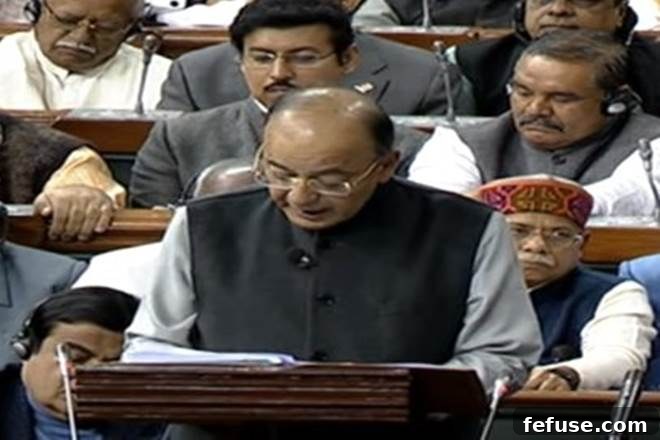
On February 1, 2018, Finance Minister Arun Jaitley met President Ram Nath Kovind at Rashtrapati Bhavan before proceeding to Parliament to unveil the Union Budget 2018-19. This presentation carried significant weight, being the final comprehensive financial plan of the incumbent administration. With general elections scheduled for the following year, the government would only present an interim budget in 2019, leaving the full budget exercise to the new government post-poll. Ahead of the presentation, both PM Modi and FM Jaitley had consistently indicated a focus on “hard economics” rather than political sops, managing public expectations and signaling a pragmatic fiscal approach.
Despite the emphasis on realism, market sentiment remained optimistic. The Sensex, India’s benchmark stock index, surged by over 150 points even before the minister began his address, breaching the crucial 36,000-mark with a 171-point jump in opening trade. This positive reaction from investors hinted at underlying confidence in the government’s economic stewardship. Following Cabinet approval, FM Jaitley commenced his address, highlighting India’s remarkable economic turnaround. He recalled that when the government took office in May 2014, India was often categorized among the “fragile five” economies. By 2018, this narrative had been entirely reversed, with India emerging as the world’s fastest-growing major economy. The nation had achieved a USD 2.5 trillion economy, moving from the seventh to an anticipated fifth-largest global economy soon. A robust 6.2% GDP growth underscored this strength. Jaitley affirmed the government’s commitment to achieving an 8% growth trajectory, emphasizing a renewed focus on “ease of living” for all citizens, particularly through strengthening the agricultural and rural economy.
Key Income Tax Reforms and Their Financial Impact
The Budget 2018 introduced several significant changes aimed at streamlining the tax regime, incentivizing certain investments, and promoting financial discipline. While there were no major overhauls in personal income tax rates for general individuals, the finance minister noted that the government had already made many positive adjustments in the preceding three years. However, specific provisions were introduced to benefit various segments of the population and economy:
- Support for Senior Citizens: A significant relief for senior citizens was the increase in exemption of interest income on bank and post office deposits from Rs 10,000 to Rs 50,000. Furthermore, the investment limit in interest-bearing LIC schemes for senior citizens was doubled from Rs 7.5 lakh to Rs 15 lakh, providing enhanced financial security.
- Relief for Salaried Employees: A standard deduction of Rs 40,000 was introduced for salaried taxpayers, replacing the previous exemptions for transport allowance and medical reimbursement. This move was estimated to result in a revenue loss of Rs 8,000 crore, indicating the government’s intent to provide tangible relief to the middle class.
- Real Estate Transactions: To reduce hardships in realty deals and foster transparency, no adjustment was mandated if the circle rate (government-assessed value) did not exceed 5% of the sale consideration.
- Curbing the Cash Economy: In a continued effort to transition towards a less-cash economy, cash payments exceeding Rs 10,000 by trusts and institutions were disallowed, promoting digital and banking transactions.
- Long-Term Capital Gains (LTCG) on Equities: One of the most significant tax announcements was the reintroduction of a 10% tax on long-term capital gains from equities exceeding Rs 1 lakh, without indexation benefit. This change, effective from April 1, 2018, aimed to ensure equity participants also contribute to nation-building, while Grandfathering Clause protected gains up to January 31, 2018.
- Education Cess Increase: To garner additional resources for educational infrastructure and programs, the education cess was increased from 3% to 4%, projected to collect an additional Rs 11,000 crore.
- Tax on Equity-Oriented Mutual Funds: A 10% tax was announced on the distributed income of equity-oriented mutual funds, aligning their taxation with equity gains.
- Electronic Assessment: A new scheme for providing electronic assessment was proposed, designed to eliminate person-to-person contact, enhance transparency, and reduce corruption in the tax assessment process.
- Customs Duty on Mobile Phones: To encourage domestic manufacturing under the “Make in India” initiative, customs duty on mobile phones was hiked to 20% from 15%.
Boosting Key Sectors: Agriculture, Rural Development, and Social Welfare
A cornerstone of Budget 2018 was its profound emphasis on strengthening India’s agricultural and rural economy, alongside significant investments in social welfare programs, reflecting the government’s commitment to inclusive growth:
- Agricultural Sector Support: The budget proposed to hike institutional credit for agriculture to a substantial Rs 11 lakh crore for 2018-19, aiming to provide farmers with easier access to finance. The Kisan Credit Card facility was extended to the fisheries and animal husbandry sectors, broadening its reach and benefits.
- Food Processing and Value Addition: Recognizing the food processing sector’s growth at 8%, its allocation was doubled to Rs 1,400 crore, intending to reduce post-harvest losses and boost farmer income.
- Rural Empowerment and Basic Amenities: The target for providing free LPG connections to poor women under the Ujjwala scheme was raised to 8 crore, demonstrating a commitment to improving household health and convenience. Under the Swachh Bharat Mission, the Centre planned to construct 2 crore more toilets, furthering the sanitation drive. Furthermore, 1 crore houses were targeted for construction under the Pradhan Mantri Awas Yojana in rural areas, addressing housing needs. A significant Rs 16,000 crore was allocated to provide electricity connections to 4 crore poor households under the Saubhagya scheme. The allocation under the National Livelihood Mission was substantially increased to Rs 5,750 crore in the next fiscal year, focusing on maximum livelihood projects in rural areas.
- Transforming Education: Addressing concerns about the quality of education, the budget proposed a holistic approach, treating education without segmentation from nursery to 12th grade. The government launched the ‘Revitalising Infrastructure and Systems in Education (RISE) by 2022’ initiative and committed to increasing digital intensity in education, moving infrastructure “from blackboard to digital board.” By 2022, every block with over 50% Scheduled Tribe (ST) population would feature Eklavya schools, on par with Navodaya Vidyalayas, ensuring equitable access to quality education. The ‘Prime Minister’s Research Fellow Scheme’ was introduced to identify 1,000 B.Tech students for Ph.D. programs at IITs, fostering research and innovation. Two new schools of planning and architecture were proposed, along with 18 more IITs and NIITs, to enhance technical education.
- Healthcare for All (Ayushman Bharat): A flagship ‘National Health Protection Scheme’ was announced, aiming to cover 10 crore poor and vulnerable families (approximately 50 crore people). Each family would receive an annual cover of Rs 5 lakh for treatment, marking a significant step towards universal health coverage. The government also pledged to set up 24 new medical colleges and hospitals by upgrading existing district-level ones, enhancing healthcare infrastructure and accessibility.
- Social Security and Aspirational Districts: The budget increased allocations for health, education, and social security to Rs 1.38 lakh crore for 2018-19. Specific allocations of Rs 56,619 crore for SC welfare and Rs 39,135 crore for ST welfare were announced. A major initiative focused on developing 115 “aspirational districts” into model districts by improving their quality of life across various development indices.
Infrastructure, Industrial Growth, and Digital India Initiatives
Infrastructure development and industrial growth remained central pillars of the budget, complemented by ambitious digital initiatives:
- Infrastructure Boost: A staggering Rs 50 lakh crore was deemed necessary for infrastructure building. The budget projected the completion of over 9,000 km of National Highways in 2018-19, significantly enhancing connectivity. Ninety-nine cities were selected for the Smart Cities project, with an outlay of Rs 2.04 lakh crore, aiming for urban modernization.
- Railway Modernization: The Indian Railways received a substantial allocation of over Rs 1.48 lakh crore for the next fiscal year. Targets included renewing 36,000 km of rail track and eliminating 4,267 unmanned railway crossings on broad gauge routes within two years to enhance safety. Wifi and CCTVs were to be progressively provided in all trains, and escalators at stations with over 25,000 footfalls.
- Aviation Sector Expansion: The government aimed to expand the capacity of airports by five times to cater to one billion trips annually, reflecting the burgeoning demand for air travel. The regional air connectivity scheme (UDAN) was to connect 56 unserved airports and 31 unserved helipads, boosting accessibility to remote areas.
- Financial Markets and Investment: SEBI was urged to consider mandating large corporates to use the bond market for financing one-fourth of their fund needs, deepening the corporate bond market. The government also planned to monetize select central public sector enterprises using Infrastructure Investment Trusts.
- Digital Connectivity: A robust plan to establish 5 lakh WiFi hotspots was announced, aiming to provide broadband access to 5 crore rural people, bridging the digital divide. The government also proposed a scheme to provide a unique ID to every enterprise, akin to Aadhaar, streamlining business operations.
- Stance on Cryptocurrency: The budget clarified that the government does not consider crypto-currency as legal tender and vowed to take all measures against its illegal use. However, it expressed encouragement for blockchain technology in payment systems, distinguishing between the technology and speculative digital assets.
- Disinvestment and Gold Policy: An ambitious disinvestment target of Rs 80,000 crore was set for 2018-19, building on an expected Rs 1 lakh crore receipt in the current year. The government had already initiated strategic disinvestment in 24 PSUs, including Air India. A comprehensive gold policy was proposed to develop gold as an asset class, with the gold monetization scheme being revamped to allow hassle-free gold deposit accounts.
Fiscal Management and Governance Reforms
The budget also addressed fiscal prudence, governance reforms, and adjustments to emoluments:
- Fiscal Deficit: The fiscal deficit for 2017-18 was revised upwards to 3.5% of GDP, against the previously estimated 3.2%, acknowledging economic realities. For FY19, it was pegged at 3.3%, slightly higher than the earlier 3% target, indicating a balanced approach between growth impetus and fiscal consolidation.
- Taxpayer Base Expansion: The finance minister highlighted a significant increase in the taxpayer base, rising from 6.47 crore in 2014-15 to 8.27 crore in 2016-17, attributing part of this growth to measures like demonetization, which was termed ‘Imaandari ka Utsav’ (Festival of Honesty).
- Corporate Tax Reduction: The reduced corporate tax rate of 25% was extended to companies with a turnover of up to Rs 250 crore, a move expected to benefit small, micro, and medium enterprises, with an estimated revenue forgone of Rs 7,000 crore.
- Defence and Food Subsidies: Defence outlay was raised to Rs 2.82 lakh crore for 2018-19 from Rs 2.67 lakh crore in the current year. Food subsidy was also projected to increase to Rs 1.69 lakh crore in 2018-19 from Rs 1.4 lakh crore.
- Financial Transactions & PAN: PAN was made mandatory for any entity entering into a financial transaction of Rs 2.5 lakh or more, and it would be used as a Unique Entity Number for non-individuals from April 1, enhancing financial oversight.
- Emoluments Revision: Emoluments of the President were revised to Rs 5 lakh per month, and for the Vice-president, to Rs 4 lakh per month. A significant proposal was also made to introduce a law for automatic revision of MPs’ emoluments every 5 years, indexed to inflation, aiming to depoliticize salary revisions.
- Ease of Doing Business: The government identified 372 specific business reform actions to further improve the ease of doing business, with performance evaluation based on user feedback.
- Women’s Employment: The Employees PF Act was proposed to be amended to reduce the contribution of women to 8% from 12%, with no change in the employer’s contribution, to encourage women’s participation in the workforce.
Reactions and Future Outlook
Following the budget presentation, Prime Minister Narendra Modi hailed it as “farmer friendly, common citizen friendly, business environment friendly and development friendly,” emphasizing its role in enhancing “Ease of Living.” He expressed confidence that the budget would bring new opportunities for rural India and particularly lauded the decision regarding Minimum Support Price (MSP), believing it would tremendously benefit farmers.
However, the opposition offered a contrasting view. Congress leader Manish Tewari criticized the budget as “a classical case of too less and completely at the inappropriate time,” suggesting it merely paid “lip service” to farmers and marginalized sections. Former Union Finance Minister P. Chidambaram also expressed disappointment, stating that FM Arun Jaitley “failed the fiscal consolidation test,” warning of serious consequences. These reactions underscored the political and economic debates that followed the budget’s unveiling, highlighting differing perspectives on its immediate impact and long-term implications.
For a more detailed understanding of its financial implications, individuals were encouraged to use an Income Tax Calculator updated for Budget 2018. This budget, rooted in the principles of “hard economics,” laid out a comprehensive roadmap for India’s growth, balancing fiscal realities with ambitious social and infrastructural development goals.
Source: FinancialExpress.com (Archival context from 2018)