
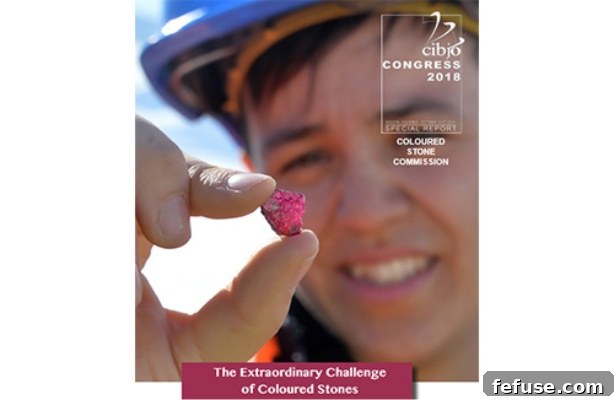
Pioneering Ethical Sourcing: CIBJO Drives Responsible Practices in the Coloured Gemstone Sector
The global coloured gemstone industry is embarking on a crucial journey towards enhanced responsibility and ethical conduct. Acknowledging the unique challenges and vast potential within this vibrant sector, the CIBJO Coloured Stone Commission is diligently working to establish a comprehensive framework. This pioneering initiative aims to define clear standards for responsible practices, guiding producers and manufacturers worldwide towards more sustainable and accountable operations. This significant development was highlighted in a recent report released in anticipation of the 2018 CIBJO Congress, which took place in Bogotá, Colombia.
The Unique Landscape of Coloured Gemstones: A Call for Tailored Responsibility
Unlike the more consolidated diamond or precious metals sectors, the coloured gemstone industry presents a distinct operational landscape. The CIBJO Coloured Stone Commission, under the leadership of Charles Abouchar, emphasizes that any effective framework for responsible sourcing must acknowledge and adapt to these inherent differences. A one-size-fits-all approach, often borrowed from other segments of the jewelry industry, simply won’t suffice for the intricate world of coloured gemstones.
A staggering statistic underscores this unique reality: over 80 percent of rough coloured gemstones entering the global supply chain originate from tens of thousands of artisanal and small-scale miners (ASM). These dedicated individuals operate across a multitude of small-scale mine sites scattered in remote regions worldwide. Their efforts, often carried out with rudimentary tools and limited resources, form the very bedrock of the coloured gemstone supply. Recognizing their pervasive role is not merely an observational point; it’s a foundational element for developing practical and equitable industry standards.
The economic impact of this decentralized mining model cannot be overstated. For millions of people across numerous communities, gemstone mining is not just an occupation; it is their primary means of livelihood, supporting families, funding education, and sustaining entire local economies. This deep integration means that policies crafted without careful consideration could have dire, unintended consequences. Implementing overly burdensome or restrictive responsible sourcing systems, while well-intentioned, could inadvertently disadvantage these artisanal miners, limiting their access to markets and pushing them further to the margins. Such a scenario risks destabilizing the very communities that depend on gemstone mining for survival, potentially leading to widespread economic hardship and social disruption.
Therefore, the CIBJO’s approach is not just about imposing rules, but about fostering an environment where responsible practices can flourish without inadvertently penalizing those at the base of the supply chain. It’s about empowering, educating, and integrating rather than excluding. This understanding is critical to ensuring that the pursuit of ethical standards genuinely uplifts the entire industry, from mine to market, rather than inadvertently creating new barriers for vulnerable populations.
Navigating the Complex Coloured Gemstone Supply Chain
Another significant challenge that sets the coloured gemstone industry apart is the absence of easily identifiable “choke points” within its supply chain. In sectors like diamonds, where goods often pass through a limited number of major sorting and trading hubs, monitoring and verification can be centralized and highly effective. This allows for more streamlined oversight and the implementation of robust traceability systems.
The coloured gemstone supply chain, by contrast, is far more diffuse and fragmented. Goods move through a myriad of small-scale brokers, traders, and cutters across numerous countries before reaching larger markets. This distributed nature means there are no single, dominant points through which most, if not all, supply passes, making comprehensive monitoring a complex and often elusive task. Without these natural ‘control points,’ establishing a robust system for tracking origin, ensuring ethical practices, and verifying compliance at every stage becomes significantly more difficult.
This challenge necessitates innovative solutions that go beyond traditional monitoring models. It requires a collaborative effort involving various stakeholders, from local communities and government agencies to international trade bodies and technology providers. The goal is to build a system of trust and accountability that can thrive even within a highly decentralized network. This might include developing accessible digital tracking tools, promoting direct sourcing relationships, or supporting local cooperatives that can help aggregate and verify goods from artisanal miners. The CIBJO commission’s work implicitly acknowledges that a successful framework for responsible sourcing in this context must be adaptable, flexible, and capable of functioning effectively across a vast and varied landscape.
Crafting and Enforcing Responsible Sourcing Guidelines
The development of meaningful Responsible Sourcing Guidelines has been a central topic of discussion at various key industry events, including the previous CIBJO Congress and the recent JCK Show. These discussions underscore a broad industry consensus on the necessity of these guidelines, yet also highlight the complexities involved in their practical application and enforcement. The challenge lies not just in drafting comprehensive standards, but in ensuring their adoption and adherence across a diverse global membership.
The CIBJO Coloured Stone Commission’s report clarifies the expected role of representative organizations endorsing these joint responsible practices. While these organizations would not necessarily be tasked with policing and enforcing compliance among their individual members, they bear a significant responsibility in upholding the integrity of the framework. In instances of demonstrable and gross violations of the document’s provisions by an individual or company, and following a proper judicial due process conducted by a recognized independent body, the relevant representative organization must be prepared to take decisive action. Such measures could include, but are not limited to, suspension and/or expulsion from its ranks. This commitment to accountability is vital for the credibility and effectiveness of the entire responsible sourcing initiative, ensuring that the guidelines are taken seriously and that transgressions have tangible consequences, thereby fostering a culture of adherence and ethical conduct within the industry.
Empowering Retailers and Consumers: Simplifying Gemstone Knowledge
In an increasingly complex market, knowledge is power, especially for retailers and consumers navigating the nuances of coloured gemstones. The CIBJO Coloured Stone Commission is spearheading a vital project to produce an abridged version of the authoritative Coloured Stone Blue Book. This initiative recognizes a growing need within the industry: while the original Blue Book serves as a definitive, highly detailed technical reference, its comprehensive nature has, over time, made it increasingly challenging for the layperson—including many retailers and their staff—to fully comprehend and utilize.
The complexity stems from the rapid advancements in gemstone treatments and the proliferation of sophisticated artificial products entering the market. What was once a relatively straightforward field now requires a deeper understanding of various enhancement processes, identification techniques for synthetic materials, and precise terminology. This evolution, while a testament to technological progress, also presents a barrier to entry and understanding for those not specialized in gemmology. An easier-to-understand, streamlined version of the Blue Book will act as an invaluable resource, demystifying complex information and presenting it in a digestible format. This accessibility will empower retailers to confidently educate their customers, enhancing trust and transparency in transactions. It will also equip consumers with the essential knowledge needed to make informed purchasing decisions, appreciating the inherent beauty and value of their chosen gemstones with a clearer understanding of their characteristics and provenance.
Enhancing Transparency in Gemmological Reporting
Transparency extends beyond sourcing to the very core of gemological analysis. In a significant joint initiative with CIBJO’s Gemmological Commission, efforts are underway to encourage gemmological laboratories worldwide to clearly separate scientific results from professional opinions in their reports. This distinction, while seemingly subtle, holds profound implications for consumer understanding and industry standardization.
Currently, many lab reports blend objective scientific data (such as measurements, chemical composition, or spectroscopic readings) with subjective professional opinions (like assessments of clarity enhancement levels, origin determination, or specific identification based on a constellation of features). While both are valuable, their amalgamation can sometimes lead to confusion. By explicitly delineating between ‘scientific results’ (facts derived from repeatable tests) and ‘professional opinions’ (interpretations based on experience, expertise, and available data), laboratories can enhance the clarity and utility of their reports. Charles Abouchar, head of the Coloured Stone Commission, notes, “We hope that once gemmological laboratories accept this practice, consumers will better understand that parts of a report reflect the opinion of the issuing laboratory, and that such opinions may differ from one laboratory to another.” This greater transparency will enable consumers to better interpret reports, recognize that different expert opinions can genuinely exist, and ultimately make more informed purchasing decisions. It fosters a higher degree of trust between labs, retailers, and end-consumers, contributing to the overall integrity of the coloured gemstone market.
Looking Ahead: A Sustainable Future for Coloured Gemstones
The initiatives undertaken by the CIBJO Coloured Stone Commission represent a proactive and forward-thinking approach to shaping the future of the coloured gemstone industry. By addressing the unique challenges posed by artisanal mining, the diffuse supply chain, and the complexities of gemmological reporting, CIBJO is laying down a robust foundation for a more ethical, transparent, and sustainable sector. These ongoing efforts are not just about compliance; they are about fostering a vibrant, responsible industry that benefits everyone, from the miners at the source to the consumers who cherish these natural treasures. The commitment to developing tailored solutions, empowering education, and promoting clarity signifies a new era of responsibility, ensuring that the allure of coloured gemstones is matched by the integrity of their journey to market.
Pic courtesy: CIBJO
News Source : gjepc.org