
Central African Republic Reinforces Diamond Sector Transparency with Strategic Peter Meeus Appointment
In a significant move to invigorate its vital diamond industry and enhance its global standing, the Government of the Central African Republic (CAR) has officially announced the appointment of Peter Meeus, a highly respected and seasoned international diamond consultant, as a Special Adviser. This pivotal decision was recently revealed in Brussels by Leopold Mboli-Fatr, the Minister of Mines and Geology, signaling CAR’s unwavering commitment to fostering transparency and competitiveness within its crucial diamond sector.
The timing of this high-profile appointment is particularly strategic, coming just days before the commencement of the crucial Kimberley Process (KP) Intersessional meeting, scheduled to begin in Antwerp on June 18. This proximity underscores the urgency and importance CAR places on addressing international concerns and actively participating in global efforts to ensure ethical diamond trade.
Peter Meeus: A Strategic Appointment for CAR’s Diamond Future
Peter Meeus brings an unparalleled depth of experience and expertise to his new role. The government has clearly outlined his multifaceted responsibilities: he will be tasked with advising and assisting in the robust implementation of the Kimberley Process framework within CAR, proposing innovative, performance-enhancing measures, and proactively promoting the country’s diamond sector on the global stage. The overarching goal is unequivocal – to transform CAR’s diamond production and marketing into a beacon of transparency and competitiveness, ensuring that the nation’s precious resources contribute directly to its sustainable development and stability.
Minister Mboli-Fatr expressed profound satisfaction with Meeus’s appointment, describing it as “an important step in the transformation of our diamond industry.” This sentiment highlights the government’s recognition of the challenges ahead and its determination to leverage top-tier international expertise to navigate them. Meeus’s role will be instrumental in re-establishing trust among international buyers and fostering an environment conducive to responsible investment and trade.
A Renowned Expert with Extensive Industry Credentials
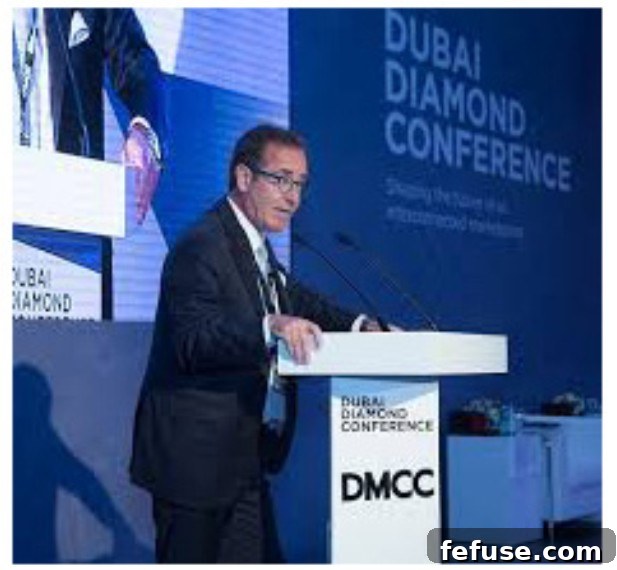
Peter Meeus’s distinguished career in the global diamond industry makes him exceptionally well-suited for this challenging advisory position. Prior to this new appointment, Meeus served with distinction as the president of the Dubai Diamond Exchange, a position he relinquished several months ago. His leadership there significantly contributed to Dubai’s emergence as a major global diamond trading hub. Before his tenure in Dubai, Meeus held the influential position of director general of the Antwerp World Diamond Centre (AWDC), the heart of the world’s diamond trade. His experience in these key roles provides him with invaluable insights into both producer and consumer market dynamics, as well as the intricate regulatory frameworks governing the industry.
Furthermore, Meeus is a founding member of the Kimberley Process Certification Scheme (KPCS), underscoring his deep-rooted understanding of its principles, operational mechanisms, and critical importance. His foundational involvement provides a unique perspective on the KP’s evolution and its application in complex environments. Significantly, Meeus has also previously headed the KP team specifically responsible for monitoring the Central African Republic’s diamond industry. This direct past involvement equips him with intimate knowledge of CAR’s specific challenges and progress, enabling him to hit the ground running with targeted and effective strategies.
Rebuilding Trust: The Central African Republic’s Journey with the Kimberley Process
The Central African Republic’s diamond sector has faced considerable hurdles in recent years, particularly concerning its adherence to Kimberley Process standards. From 2013 to 2016, CAR endured a painful suspension from the KP, which effectively barred the country from exporting rough diamonds onto the international market. This drastic measure was imposed due to concerns that diamonds from CAR were being used to fund armed conflict, thus violating the core principles of the Kimberley Process designed to prevent the trade of “conflict diamonds.”
The suspension had devastating consequences for CAR’s economy, heavily reliant on natural resources, and for the livelihoods of thousands of artisanal miners and their communities. It underscored the severe economic repercussions that arise when a nation struggles with governance issues and the illicit trade of its natural wealth. The ban created an environment ripe for black market activities, further complicating efforts to establish legitimate and transparent supply chains.
In 2016, following strenuous efforts by the CAR government and intensive monitoring by a dedicated KP team, a partial lifting of the ban was implemented. This allowed CAR to resume exports from specific regions identified as “green zones,” which were deemed to satisfy strict KP compliance needs. These zones were carefully monitored to ensure that diamonds originating from them were free from conflict financing. While a crucial step forward, this partial lifting highlighted the ongoing need for robust monitoring, verification, and continued reforms across the entire diamond-producing landscape of the country.
The Critical Role of the Kimberley Process in Global Diamond Trade
The Kimberley Process Certification Scheme (KPCS) is an international initiative launched in 2003, bringing together governments, industry, and civil society, with a singular mission: to prevent the flow of conflict diamonds. These are rough diamonds used by rebel movements to finance wars against legitimate governments. The KPCS establishes a stringent certification system for rough diamonds, requiring member states to implement national legislation and ensure that all diamond shipments are accompanied by a KP certificate guaranteeing their conflict-free origin.
For countries like the Central African Republic, adherence to KP standards is not merely a regulatory obligation; it is a gateway to international trade, economic legitimacy, and the potential for sustainable development. A country’s inability to meet these standards can lead to isolation from the global diamond market, significant economic losses, and a perpetuation of illicit activities that often fuel instability. The challenges faced by CAR underscore the complex interplay between resource management, governance, security, and international trade ethics.
While the KP has been instrumental in significantly reducing the trade in conflict diamonds, it has also faced criticisms regarding its scope and effectiveness in certain contexts. However, its fundamental importance as a framework for accountability and transparency remains undisputed. Peter Meeus’s deep historical involvement with the KP, combined with his specific experience monitoring CAR, positions him uniquely to address these nuances and guide CAR towards comprehensive, sustainable compliance that moves beyond mere technical adherence to foster genuine, sector-wide reform.
Paving the Way for Economic Recovery and Sustainable Development
The transparent and responsible management of its diamond sector is paramount for the Central African Republic’s long-term economic recovery and stability. Diamonds represent a significant natural resource with the potential to generate substantial revenue, create employment opportunities, and fund essential public services and infrastructure development. However, this potential can only be fully realized if the industry operates within a framework of robust governance, strict regulatory oversight, and complete transparency.
Peter Meeus’s appointment signifies CAR’s serious intent to unlock this potential. By implementing performance-enhancing measures and promoting the sector ethically, the government aims to attract legitimate foreign investment, strengthen local economies, and ensure that the benefits of diamond wealth reach the broader population, particularly the artisanal mining communities who are often at the forefront of the industry. A well-regulated and transparent diamond trade can help formalize the informal mining sector, improve working conditions, and reduce vulnerabilities to exploitation.
Beyond economics, a conflict-free and transparent diamond sector is a cornerstone for peacebuilding and social cohesion in a nation that has endured protracted periods of instability. By severing the links between natural resources and armed conflict, CAR can build a more stable foundation for its future. The ability to guarantee the ethical provenance of its diamonds will also bolster CAR’s international reputation, fostering greater trust and facilitating broader diplomatic and economic partnerships.
Navigating Future Challenges and Opportunities in the Diamond Sector
While Peter Meeus’s appointment is a hugely positive development, the path ahead for CAR’s diamond sector is not without its challenges. The ongoing need for enhanced security in mining regions, strengthening governmental oversight, and combating persistent illicit mining and smuggling activities will require sustained effort. Furthermore, changing international perceptions and educating the market about CAR’s progress will be crucial for regaining full access and maximizing export potential.
The immediate focus will undoubtedly be on the upcoming KP Intersessional meet in Antwerp, where CAR will have an opportunity to showcase its renewed commitment and progress. Long-term goals include expanding the “green zones,” strengthening the capacity of local institutions to monitor and verify diamond origins, and developing a comprehensive strategy for sustainable artisanal mining that prioritizes environmental protection and community development.
Meeus’s experience in both governance and market promotion will be vital in navigating these complexities. His role will extend beyond mere compliance, aiming to build a resilient, ethical, and commercially viable diamond industry that truly serves the people of the Central African Republic. This involves not only ensuring diamonds are conflict-free but also promoting best practices in mining, fair trade, and value addition within the country.
Conclusion: A New Chapter for CAR’s Diamonds
The appointment of Peter Meeus as Special Adviser marks a pivotal moment for the Central African Republic’s diamond industry. It represents a clear declaration of intent from the CAR government to embrace transparency, uphold international standards, and strategically position its diamond sector for sustainable growth and economic prosperity. With an expert of Meeus’s caliber at the helm of this advisory role, CAR is taking a decisive step towards rebuilding trust, attracting responsible investment, and ensuring that its valuable natural resources contribute meaningfully to the nation’s peace and development. This strategic move is poised to usher in a new, more transparent, and competitive era for Central African diamonds on the global stage, promising a brighter future for the country and its citizens.
News Source : gjepc.org