
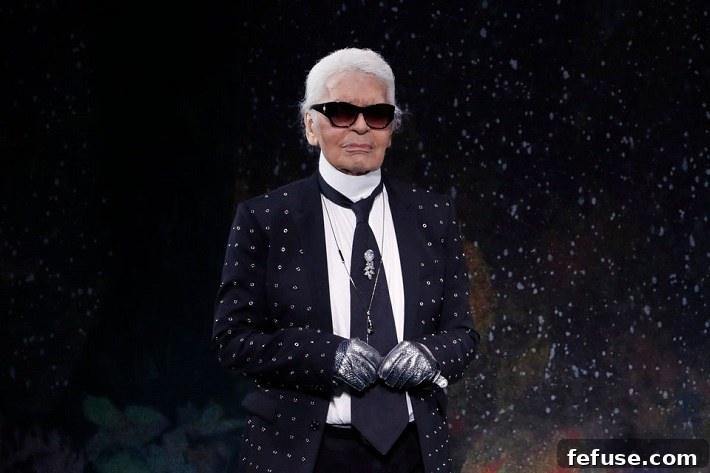
The fashion world collectively paused with the news of Karl Lagerfeld’s passing at the age of 85. A titan of style and an unparalleled creative force, Lagerfeld’s death in Paris marked the end of an extraordinary era that redefined luxury fashion across the globe. His departure left an immense void in the industry that is unlikely to be filled, prompting an immediate outpouring of heartfelt tributes from fashion luminaries, celebrities, and countless admirers worldwide, all acknowledging his immense talent, visionary leadership, and the profound legacy he leaves behind.
Born Karl Otto Lagerfeldt in Hamburg, Germany, in 1933, he would later drop the ‘t’ from his surname to make it sound more commercial and impactful. From a remarkably young age, Lagerfeld displayed an intense passion for drawing and a keen eye for fashion, an early indication of the prodigious talent that would shape an entire industry. His transformative journey into the high echelons of haute couture began when he moved to Paris as a teenager. His raw talent quickly became apparent, leading him to secure a coveted position as Pierre Balmain’s assistant in 1955, after winning a prestigious design competition. This initial foray into the structured yet dynamic world of Parisian fashion was just the beginning of a remarkable career that would span over six decades, distinguishing him as one of the most prolific, innovative, and influential designers in modern history.
Lagerfeld’s early career saw him contribute his creative genius to several major fashion houses, including Jean Patou and Chloé, where he gained invaluable experience and meticulously honed his unique aesthetic. However, it was his pivotal and long-standing roles as creative director for the venerable houses of Chanel and Fendi that truly cemented his status as a legendary figure. For decades, with an almost superhuman work ethic, he simultaneously juggled the creative directorships of these two iconic brands, alongside meticulously developing his own eponymous label. This extraordinary feat of sustained creativity, boundless energy, and sheer productivity remains virtually unmatched in the annals of fashion, showcasing his relentless dedication to his craft and an inexhaustible well of artistic inspiration.
The Chanel Renaissance: Revitalizing an Empire with Audacity
When Karl Lagerfeld took the helm as creative director of Chanel in 1983, the esteemed French fashion house was, by many accounts, struggling to maintain its contemporary relevance. Coco Chanel had passed away more than a decade prior, and while the brand remained undeniably iconic, it was perceived by some as somewhat staid and old-fashioned. Lagerfeld arrived with a clear, audacious vision: to not merely preserve but to resurrect Chanel’s core identity, infusing it with a modern, often provocative energy that would captivate and appeal to a brand new generation of fashion enthusiasts, while simultaneously respecting its rich heritage.
His arrival at Chanel heralded a dramatic and transformative era. Lagerfeld masterfully reinterpreted Chanel’s timeless codes – the classic tweed suits, the exquisite pearls, the delicate camellias, the iconic quilted bags, and the signature monochrome palette – giving them a fresh, contemporary edge. He fearlessly introduced daring silhouettes, experimented with innovative fabric combinations, and infused an overarching sense of theatricality and grandeur into his runway shows, which quickly became the most anticipated and talked-about events of Paris Fashion Week. Under his unparalleled guidance, Chanel was not just revived; it became synonymous with cutting-edge design, aspirational luxury, and profound cultural significance once more. He didn’t just design clothes; he crafted intricate narratives, creating entire worlds for each collection that captivated global audiences and consistently pushed the boundaries of fashion presentation. His prolific output, producing numerous haute couture and ready-to-wear collections annually, was a testament to his boundless energy and relentless creativity, firmly cementing Chanel’s position at the undisputed pinnacle of global luxury fashion.
Fendi: A Revolutionary Approach to Fur and Beyond
Lagerfeld’s transformative tenure at the Italian luxury house Fendi began much earlier, in 1965, and lasted an astonishing 54 years – an extraordinary and arguably unparalleled collaboration between a designer and a fashion house in history. At Fendi, he was initially tasked with modernizing their fur collection, a challenge he approached with characteristic ingenuity and a revolutionary mindset. Before Lagerfeld, fur was typically considered heavy, formal, and somewhat cumbersome. He completely revolutionized its perception and application, treating it like any other versatile fabric. He experimented boldly with dyeing, shearing, and intricate weaving techniques to create incredibly lightweight, playful, and undeniably chic garments that appealed to a younger, more fashion-forward clientele. He famously coined the brand’s iconic “double F” logo, which stands for “Fun Furs,” a playful yet sophisticated moniker that perfectly encapsulated his innovative vision for the brand and its core product.
Beyond his groundbreaking work with fur, Lagerfeld’s expansive influence at Fendi extended to its leather goods, accessories, and ready-to-wear lines, helping to transform it into a formidable global luxury powerhouse. His distinct work for Fendi showcased a different yet equally brilliant facet of his design genius, characterized by bold experimentation, a luxurious sensibility that embraced daring textures and vibrant colours, and an unwavering commitment to exquisite Italian craftsmanship. The remarkable ability to maintain distinct, powerful creative directions for both Chanel and Fendi simultaneously, all while upholding their individual brand identities, unequivocally underscores his remarkable versatility, unparalleled creative range, and legendary work ethic.
The Karl Lagerfeld Brand: Accessible Luxury and Personal Style Embodied
Alongside his high-profile and demanding roles at Chanel and Fendi, Karl Lagerfeld meticulously cultivated and expanded his eponymous label, a brand that served as a direct reflection of his personal aesthetic: a sophisticated blend of rock-chic edge, Parisian elegance, and modern accessibility. The Karl Lagerfeld brand was conceived with the aim to democratize luxury, offering stylish apparel, cutting-edge accessories, and chic footwear that embodied his signature look and distinctive design philosophy at a more attainable price point. It represented a direct and personal extension of his instantly recognizable persona, making his unique vision and sartorial flair accessible to a much wider global audience.
The brand’s offerings consistently featured clean lines, sharp tailoring, and a predominantly monochromatic palette, often playfully punctuated with unexpected details and whimsical motifs inspired by his own life, passions, and iconic interests, including his beloved cat, Choupette. This personal label served as a vital creative outlet for Lagerfeld to explore contemporary trends, infuse them with his inimitable flair, and experiment freely, ensuring his pervasive influence permeated various segments of the fashion market, from high fashion runways to everyday stylish wardrobes.
An Icon Defined: The Unmistakable Lagerfeld Persona
Beyond his groundbreaking designs and profound contributions to fashion, Karl Lagerfeld was, unequivocally, a brand in himself. His instantly recognizable public image – the distinctive powdered white ponytail, the impenetrable dark sunglasses, the high-collared starched shirts, and often the signature fingerless gloves – became as iconic and celebrated as the magnificent creations he sent down the runway. This meticulously cultivated persona exuded an aura of mystery, sharp intellect, uncompromising individuality, and an almost regal detachment. He was renowned for his piercing wit, incisive commentary, and sometimes controversial yet always memorable pronouncements on fashion, culture, and society, making him a perpetual subject of media fascination and public discourse.
Lagerfeld possessed an innate understanding of the power of image and leveraged it masterfully throughout his career. His distinctive look wasn’t merely a stylistic choice; it was an integral and inseparable part of his creative identity, a carefully constructed uniform that allowed him to project an unyielding and consistent vision of modern elegance and an almost futuristic classicism. This powerful and unforgettable personal branding played an immeasurable role in elevating his status from a mere designer to a truly global cultural phenomenon, an enigmatic figure who transcended the confines of fashion.
Diversifying Influence: Jewellery Collaborations and Beyond
Mr. Lagerfeld’s boundless creative touch wasn’t confined solely to apparel and traditional accessories; his profound influence gracefully extended into the intricate jewellery sector, among numerous other successful ventures. A particularly significant partnership that highlighted this expansion and his commercial savvy was the multi-year jewellery licensing deal signed with the esteemed Swarovski Group two years prior to his passing. This collaboration was a natural and strategic progression, as he was famously quoted by Pier Paolo Righi, chief executive of the Karl Lagerfeld namesake brand, saying, “Karl is the man of accessorisation and jewellery, it was, therefore, the next natural step for us to expand our product range with a fashion jewellery collection. Swarovski with their significant expertise makes the perfect partner for us.” This statement perfectly encapsulated Lagerfeld’s holistic view of fashion, where every detail, especially jewellery, played a crucial role in completing a look.
This strategic alliance saw the launch of a captivating and expansive collection of specially-designed necklaces, bracelets, rings, and earrings that seamlessly blended Swarovski’s unparalleled crystal artistry with Lagerfeld’s signature aesthetic. The pieces often featured his iconic motifs, such as edgy studs, delicate pearls, and a sleek, modern design language, effectively making high-quality, fashion-forward jewellery accessible to a broader and younger audience. This venture profoundly underscored Lagerfeld’s unwavering belief in the transformative power of accessories to complete, define, and personalize a look, making aspirational personal style attainable for everyone. Beyond jewellery, his prolific and diverse collaborations included groundbreaking ventures with H&M for accessible capsule collections, distinctive designs for Diet Coke limited-edition bottle series, and innovative makeup lines for Shu Uemura, unequivocally demonstrating his incredible versatility, commercial acumen, and unwavering willingness to democratize his unparalleled design genius across a multitude of varied consumer segments and product categories.
A Legacy Etched in Fabric and Time: An Enduring Vision
Karl Lagerfeld’s monumental impact on the fashion industry is truly immeasurable. He was not merely a designer; he was an architect of modern fashion, a shrewd cultural commentator, a visionary trendsetter, and a relentless innovator who constantly pushed boundaries. His enduring legacy is etched not only in the exquisite garments he meticulously created but also in the way he fundamentally transformed brands, powerfully shaped global trends, and inspired countless individuals both within and far beyond the confines of the fashion world. His tireless work ethic, famously reported by the BBC as “simultaneously churning out collections for LVMH’s Fendi and his own label, up until his death,” epitomized his unwavering commitment to creativity, artistry, and an almost superhuman dedication to his craft.
He taught an entire generation that fashion should be about constant evolution, fearless reinvention, and a continuous, dynamic dialogue between the revered past and the exciting present. Lagerfeld’s visionary aesthetic and design philosophy continue to profoundly influence contemporary designers, stylists, and fashion enthusiasts across the globe. His unparalleled ability to consistently push creative boundaries while simultaneously respecting and reinvigorating the rich heritage of the illustrious houses he led, created an enduring blueprint for modern luxury branding and creative leadership. The world may have lost a true genius, but the indomitable spirit of Karl Lagerfeld – bold, visionary, uncompromisingly chic, and eternally inspiring – will forever remain a cornerstone of fashion history, inspiring future generations to dare greatly, to create fearlessly, and to never, ever settle for anything less than truly extraordinary.