
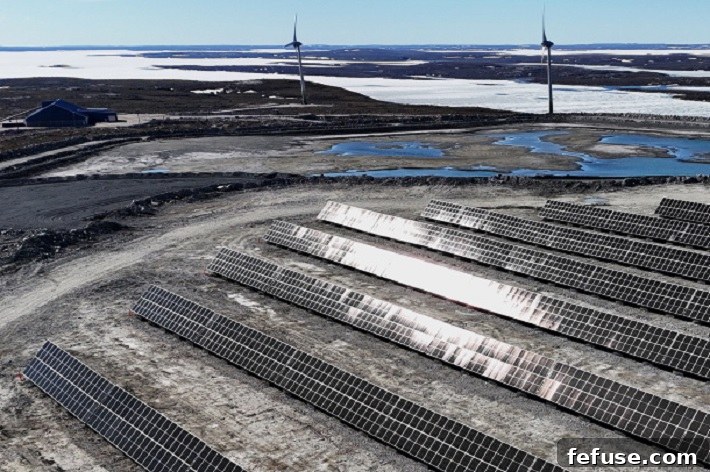
Rio Tinto has made a significant stride in sustainable mining practices by inaugurating Canada’s largest off-grid solar power plant at its Diavik diamond mine. This groundbreaking installation, nestled on the very edge of the Arctic Circle in the remote Northwest Territories, represents a monumental leap forward in powering industrial operations in extreme, isolated environments. The project underscores a strong commitment to decarbonization and positions Diavik as a global leader in integrating renewable energy into complex mining operations.
The Diavik mine, renowned for producing some of the world’s most exquisite diamonds, has always been at the forefront of innovation, not just in extraction but also in operational efficiency and environmental stewardship. Its remote location, approximately 300 kilometers northeast of Yellowknife, presents unique logistical and energy challenges. Historically, such isolated sites have relied heavily on diesel generators, necessitating constant fuel transport – a costly, logistically complex, and carbon-intensive undertaking. The introduction of this large-scale solar facility directly addresses these challenges, significantly reducing the mine’s carbon footprint and dependence on fossil fuels.
This cutting-edge solar installation is engineered to supply a substantial portion of the Diavik mine’s electricity needs. Specifically, it will provide up to a quarter of the power required for ongoing production until the mine reaches its planned end-of-life in 2026. Furthermore, its benefits will extend through the subsequent three-year closure period, ensuring that even the decommissioning phase is powered by cleaner, more sustainable energy. This long-term integration highlights the strategic importance of renewable energy not just for active operations but also for the responsible environmental legacy of a mining site.
The Australian mining giant, Rio Tinto, has invested in state-of-the-art technology to overcome the unique climatic hurdles of the Arctic. The solar plant comprises an impressive array of over 6,600 specialized bifacial solar panels. These innovative two-sided panels are meticulously designed to capture not only direct sunlight but also the reflected solar radiation bouncing off the expansive snow and ice cover characteristic of the Arctic landscape. This dual-capture capability is crucial for maximizing energy generation in an environment where conventional solar panels might underperform due to varying light conditions and the high reflectivity (albedo) of snow.
The engineering behind these bifacial panels, coupled with their strategic placement, is expected to yield remarkable results. The plant is projected to generate an impressive 4.2 million kilowatt-hours (kWh) of solar energy annually. This significant energy output translates directly into a substantial reduction in diesel fuel consumption, which in turn leads to a dramatic decrease in greenhouse gas emissions. The environmental impact of this reduction is equivalent to removing 630 passenger cars from the road each year, marking a profound contribution to climate change mitigation efforts and underscoring Rio Tinto’s commitment to cleaner energy solutions in its global operations.
The Diavik mine is not new to pioneering renewable energy solutions in challenging climates. Since its inception in 2012, the mine has also been home to one of Canada’s largest wind power installations, a testament to its long-standing commitment to sustainable practices. The integration of both wind and now solar power creates a robust hybrid energy system. This combination is particularly effective in off-grid locations like Diavik, where variability in weather patterns means that when solar output might dip (e.g., during prolonged darkness in winter or cloudy days), wind power can compensate, and vice-versa, ensuring a more consistent and reliable power supply. This forward-thinking approach showcases Diavik as a beacon for hybrid renewable energy solutions in the industrial sector.
Matthew Breen, Diavik’s Chief Operating Officer, articulated the company’s pride in this achievement, stating, “We are proud to lead the way for large-scale renewable energy projects in Canada’s North.” His statement highlights not just the technical accomplishment but also the leadership role Diavik is playing in demonstrating the viability and efficacy of such projects in remote, harsh environments. This initiative serves as a powerful proof-of-concept for other industrial operations and northern communities grappling with similar energy challenges and striving for greater energy independence and sustainability.
The project has also garnered significant praise from governmental bodies. Caroline Wawzonek, the Northwest Territories’ Minister of Infrastructure, commented, “The project demonstrates Rio Tinto’s leadership when it comes to reducing emissions, and signals potential for leadership in the renewable energy sector in and by the North.” Her remarks emphasize the broader regional implications of the Diavik solar plant. It not only showcases Rio Tinto’s corporate responsibility but also illuminates the vast potential for the Northwest Territories to become a hub for renewable energy innovation, fostering local expertise, creating economic opportunities, and contributing to the global energy transition from the unique vantage point of the Arctic.
The successful deployment of Canada’s largest off-grid solar facility at the Diavik diamond mine sets a new precedent for sustainable mining and industrial operations in extreme environments. It demonstrates that with innovative engineering and strategic investment, even the most remote and challenging sites can significantly reduce their reliance on fossil fuels and contribute meaningfully to global decarbonization goals. This pioneering project by Rio Tinto not only fortifies Diavik’s operational efficiency and environmental credentials but also provides an invaluable blueprint for future resource development projects worldwide, proving that economic prosperity and environmental stewardship can indeed go hand-in-hand, even on the very edge of the Arctic Circle.