
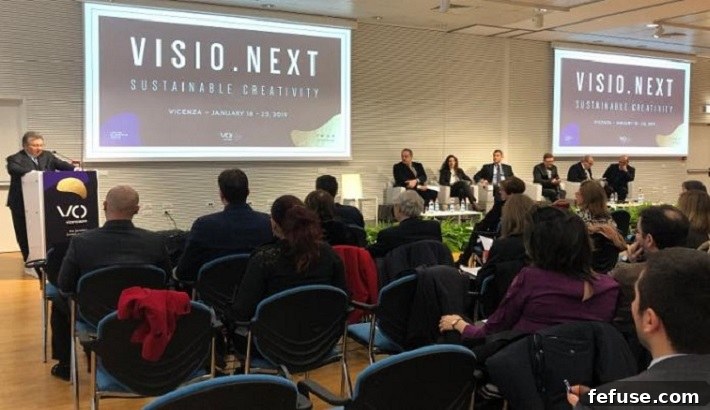
The prestigious Vicenzaoro January jewelry trade show, held in Vicenza, Italy, on January 19, became the focal point for a crucial discussion on the future of the jewelry industry. A highlight of the event was a deeply insightful and well-attended seminar, which prominently featured CIBJO’s groundbreaking new Responsible Sourcing Blue Book. This pivotal document was unveiled amidst significant industry interest, with the precious coral sector serving as a compelling case study to underscore the broader themes of sustainability and ethical practices within the global jewelry supply chain. The seminar marked a significant step forward in reinforcing the industry’s commitment to responsible practices, drawing attention to both the challenges and innovative solutions available.
Vicenzaoro Hosts Key Seminar on Responsible Sourcing and Sustainability
This seminal event also inaugurated the 21st Symposium of the Federation for European Education in Gemmology (FEEG), an institution committed to advancing gemmological knowledge and standards across Europe. Hosted with distinction by the Italian Gemological Institute, the symposium provided an ideal platform for high-level discussions. FEEG President Guy Lalous extended a warm welcome to the diverse delegation of industry leaders, gemmologists, and educators. His sentiments were echoed by Marco Carniello, Director of the Jewellery & Fashion Division of the Italian Exhibition Group (IEG), the esteemed organizer behind the renowned Vicenzaoro shows. Their joint welcome underscored the collective importance placed on responsible sourcing and the collaborative spirit driving progress within the jewelry sector.
The Evolving Landscape of Consumer Confidence: Beyond Product Integrity
CIBJO President Gaetano Cavalieri, who skillfully moderated the opening seminar, delivered a profound introduction, emphasizing that consumer confidence is the very bedrock upon which the entire jewelry business is built. Without it, he asserted, the industry’s premise would be rendered meaningless. However, Cavalieri stressed that maintaining this confidence today demands far more than merely ensuring the integrity and quality of the product itself. In an increasingly interconnected and conscious world, consumers are looking deeper into the origins and ethical journey of their purchases.
“For the past two decades, and perhaps even longer, it has become undeniably clear that the way we, as members of the jewelry industry, conduct ourselves – our actions and their profound impact on society and the environment – are now fundamental determinants of consumer confidence,” Cavalieri articulated. He firmly rejected the notion of operating in a moral vacuum, where the inherent value of precious products could be disconnected from the ethical practices of the businesses handling them. “That might have been a viable approach in the distant past, but it holds no truth in our contemporary era,” he continued, highlighting the transformative power of the internet and social media. In this digital age, a single photograph, video, or tweet possesses the viral potential to disseminate information globally within hours, making transparency and ethical behavior paramount. This shift signifies a maturation of the market, where social and environmental responsibility are no longer optional but essential components of brand reputation and consumer trust.
Introducing CIBJO’s Responsible Sourcing Blue Book: A Framework for Progress
Philip Olden, President of CIBJO’s Responsible Sourcing Commission, provided a comprehensive overview of the newly published Responsible Sourcing Blue Book. This pivotal document, which had received unanimous approval from the CIBJO Board of Directors earlier in the month, represents a significant stride towards standardizing ethical practices across the industry. Accessible for free download from the CIBJO website, it aims to empower businesses of all sizes to integrate responsible sourcing into their core operations.
Olden meticulously clarified the Blue Book’s purpose: it is not intended to function as a prescriptive code of practice for which compliance can be certified, nor does it establish a strict chain of custody protocol. Instead, its primary objective is to serve as a comprehensive guide and provide a flexible framework. Within this framework, every member of the jewelry industry – from artisanal workshops to large-scale corporations – can effectively perform responsible-sourcing due diligence, irrespective of their operational scale or specific business model. “We firmly believe in the principle of continuous improvement,” Olden stated, underscoring the iterative nature of ethical progress. “Responsible sourcing is a journey, a process that can effectively commence by taking just a few basic, yet impactful, steps.” This philosophy encourages incremental progress, making responsible practices attainable for all stakeholders within the complex jewelry ecosystem.
Blockchain Technology: Revolutionizing CSR and Supply Chain Transparency
Francesca Marino, CIBJO’s senior advisor on Corporate Social Responsibility (CSR), delved into the transformative potential of Blockchain technology in revolutionizing the implementation and assessment of social responsibility practices. She highlighted how this innovative technology could usher in an unprecedented era of transparency and objectivity in supply chains. “Compared to previously utilized systems, Blockchain intrinsically makes the process of ethically evaluating a company’s behavior far more objective,” Marino explained, emphasizing its ability to eliminate the inherent arbitrariness and subjective biases that often plague other traditional verification methods. By creating an immutable and distributed ledger of transactions and data, Blockchain offers a robust, verifiable record of ethical compliance from source to consumer. This technological advancement promises to significantly enhance trust, not just among industry participants but also with the end consumer, by providing undeniable proof of responsible practices.
Precious Coral: A Sustainability Case Study in Depth
The second segment of the CIBJO seminar focused a critical spotlight on precious coral, a material that has garnered considerable media attention in recent years. This heightened scrutiny largely stems from growing global concern over the detrimental effects of global warming on fragile ocean ecosystems and marine life. Rui Galopim de Carvalho, Vice President of CIBJO’s Coral Commission, provided an invaluable gemmological and historical overview of precious coral, clarifying crucial distinctions often misunderstood by the public.
He emphasized the critical importance of differentiating the eight specific species of coral that are legitimately considered precious from the thousands of other common coral species. This distinction is not merely academic; it is fundamental to effective conservation and responsible sourcing. De Carvalho explained that precious coral species typically thrive in deep-sea environments, often found at depths of 50 meters or more below the ocean’s surface. In these profound depths, factors such as ocean warming and acidification – which pose significant threats to shallower marine life – are not considered to be substantial threats. Conversely, many common corals, including all vital reef corals, are predominantly found in shallow, sunlit waters. These shallow habitats are acutely vulnerable to rising ocean temperatures and coral bleaching events, which can, and often do, have devastating and widespread ecological consequences. Understanding these environmental nuances is paramount for informed discussions on coral sustainability and responsible trade.
Conservation Efforts and the Future of Coral
Vincenzo Liverino, President of the CIBJO Coral Commission, shared encouraging news regarding ongoing research aimed at protecting and restoring coral populations. He detailed how scientific institutes worldwide, with crucial backing from the CIBJO Coral Commission, are conducting groundbreaking research that is yielding promising results. These initiatives could potentially lead to the successful regrowth and repopulation of common corals that have been adversely affected by global warming and other environmental stressors. Cavalieri lauded Liverino as an individual who has almost singlehandedly dedicated himself to restoring the market position and reputation of precious coral over the past three years. Beyond his direct efforts with precious coral, Liverino has strategically leveraged the high profile of this material to raise broader awareness about the overall health of the oceans. His impassioned advocacy encourages proactive measures and concerted action to protect the sustainability of this essential source of life and sustenance for the entire planet. His work exemplifies how responsible industry leadership can translate into wider environmental stewardship.
Liverino further stressed that coral education forms an absolutely critical part of this overarching process. Recognizing the need for accessible and accurate information, the CIBJO Coral Commission is poised to launch an innovative online course dedicated to both precious and common coral. This educational resource will aim to demystify coral biology, ecology, and responsible sourcing practices for a wider audience. Furthermore, the Commission is actively providing assistance to various gemology educational institutes, supporting their efforts to seamlessly integrate comprehensive coral units into their regular academic programs. This ensures that future generations of gemmologists and jewelry professionals are equipped with the knowledge necessary to champion sustainable practices and make informed decisions regarding coral.
Blockchain’s Role in Fortifying the Coral Supply Chain
Concluding the insightful seminar was Professor Roberto Vona, Dean of the Business Management Department at the University of Naples Federico II. Professor Vona, whose extensive research spans the dynamic intersection of business management, entrepreneurship, technology, and ethics, provided a fascinating perspective on the practical application of Blockchain technology. He specifically explored how Blockchain could be strategically implemented to enhance the management of the coral supply chain, thereby presenting unparalleled opportunities to significantly improve both the quality and sustainability of the product as it moves through various stages.
“You operate within a field where transactions are traditionally concluded on a fundamental assumption of trust,” Professor Vona observed, acknowledging the inherent reliance on integrity within the jewelry sector. “However, there are undeniable instances where that trust can be, and sometimes is, betrayed.” He then elaborated on Blockchain’s revolutionary potential: it could provide an objective, immutable, and fully auditable record of all known information about a product as it traverses the entire chain of distribution. This robust digital ledger would offer irrefutable evidence that sustainable practices have been meticulously complied with throughout every stage – from the initial harvesting process to subsequent processing and finally, to the point of sale. This level of verifiable transparency would not only bolster consumer confidence but also significantly mitigate risks associated with unethical sourcing, paving the way for a truly responsible and trustworthy coral market.
Embracing a Sustainable Future for the Jewelry Industry
The seminar at Vicenzaoro served as a powerful testament to the jewelry industry’s evolving commitment to responsible sourcing and sustainability. From the foundational principles outlined in CIBJO’s Responsible Sourcing Blue Book to the specific case study of precious coral, and the innovative integration of Blockchain technology, the path forward is clear. The industry is moving towards greater transparency, accountability, and ethical engagement. By prioritizing consumer confidence through robust ethical practices, fostering continuous improvement, and embracing cutting-edge technologies, the jewelry sector can ensure its enduring allure and contribute positively to both society and the environment. Education, collaboration, and a steadfast dedication to responsible practices will undoubtedly pave the way for a more sustainable and trustworthy future for all stakeholders.
NewsSource: idexonline