
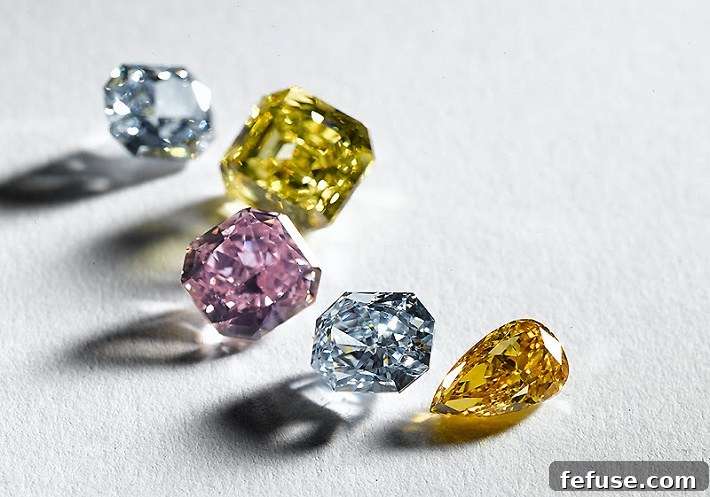
The Enduring Appeal of Fancy Color Diamonds: A Comprehensive Investment Guide
The onset of the COVID-19 pandemic unleashed an unprecedented wave of global uncertainty and financial instability. Witnessing civil unrest and a palpable lack of coherent governmental policies, many high-net-worth individuals found themselves grappling with a profound sense of insecurity. This tumultuous period spurred a growing desire among discerning investors to explore tangible, portable forms of wealth that could offer stability and preserve value amidst chaos. It was against this backdrop of upheaval that the Fancy Color Diamond Index garnered significant attention from the international financial community. In response to widespread interest and numerous inquiries from our members, we have compiled this comprehensive report to provide a foundational understanding of Fancy Color Diamonds as an asset class, addressing critical questions regarding their investment potential and market dynamics.
Investors frequently pose questions such as: “What distinct advantages do Fancy Color Diamonds offer compared to other luxurious collectibles?” “Is there a viable platform for short-term trading of these exquisite natural diamonds?” “How resilient is this alternative investment category during economic crises?” “What are the inherent pros and cons when juxtaposed with traditional investment avenues?” and crucially, “What constitutes the most pragmatic investment approach, ensuring realistic expectations without overpromising results?” Over the past year, we have meticulously gathered our insights and conducted up-to-date market analyses, synthesizing this valuable information into an accessible report specifically tailored for our esteemed members within the financial sector.
Navigating the Investment Landscape: Dispelling Myths and Clarifying Realities
The phrase “Fancy Color Diamonds as an investment” is a common parlance outside the traditional wholesale market, frequently touting these gems as a compelling “alternative investment vehicle.” However, it is essential to acknowledge that the Fancy Color Diamond market lacks a standardized, transparent investment practice. Without clear guidelines regarding margins, inventory turnover cycles, or universally accepted pricing benchmarks, a proliferation of “investment agents” has emerged. These entities often employ complex, sometimes misleading, or even unrealistic investment terminology, which can confuse and misdirect potential investors.
One significant and persistent misconception that requires immediate refutation is the notion that Fancy Color Diamond auction results can serve as a reliable, generic pricing database. This belief is fundamentally flawed. In the vast majority of cases, Fancy Color Diamonds offered at public auctions are stones that have been previously deemed undesirable by professional dealers due to specific quality flaws or characteristics that render them “a hard sell” in the primary market. Consequently, diamonds presented at auction represent a very small, often inconsistent, and generally unrepresentative sample of the higher-quality stones available across the broader market. In fact, the overwhelming majority of Fancy Color Diamonds transacted outside the auction circuit boast superior quality and are typically sold by reputable retailers at significantly higher price points. Following the unprecedented events of the COVID-19 pandemic and the renewed impetus for various investment agents to explore Fancy Color Diamond investments, we recognized the critical need to revisit fundamental industry principles. Our aim is to delineate the distinctions among various investment options and help calibrate investor expectations more accurately.
A Historical Perspective: From Adornment to Asset
The allure of Fancy Color Diamonds is not a recent phenomenon. During the 1960s and 1970s, individuals possessing extensive jewelry collections, who sought truly unique and unattainable gems, naturally gravitated towards Fancy Color Diamonds. At that time, their acquisition was primarily driven by aesthetic appreciation and a desire for exclusivity, rather than an explicit investment strategy. These rare colored diamonds quickly became a potent symbol of exotic yet refined taste, embodying a sophisticated lifestyle. Today’s collectors continue this tradition, often adorning themselves with multimillion-dollar Fancy Color diamond jewelry, using these magnificent pieces as a silent, yet powerful, declaration of their identity and discernment.
While investing in Fancy Color Diamonds can indeed be a highly profitable endeavor, it is by no means a trivial undertaking. Prospective investors must temper their expectations regarding the maturity timeline of such an investment, the potential margins, and crucially, the specific platform through which they would eventually liquidate these diamonds, should the need arise. A clear understanding of these parameters is paramount for a successful investment journey.
The concept of Fancy Color Diamonds as a personal investment truly began to gain traction in the 1990s. This era witnessed astute buyers recognizing and responding to sharp and consistent price increases within the Fancy Color market. Two decades later, as the global economy demonstrated resilience following the subprime mortgage meltdown, and as Fancy Color Diamond prices consistently outperformed many alternative asset classes, the broader investment community began to take serious notice. This growing interest spurred the formation of several local and international investment initiatives dedicated to these extraordinary gems.
The Undeniable Value Proposition: Stability and Appreciation
Over the last several decades, the category of rare Fancy Color Diamonds has demonstrated a remarkable and consistent upward trajectory in value. The natural colored diamond segment stands out as one of the least volatile among both traditional and alternative asset classes, showcasing an impressive resilience even during periods of economic turbulence. For instance, data indicates that Blue Fancy Color Diamonds have appreciated by an astonishing 241% since 2005, while Pink Fancy Color Diamonds have seen an even more significant increase of 366% over the same period. Crucially, neither of these categories experienced any substantial decreases in value throughout this prolonged timeframe, underscoring their stability as a wealth-preservation asset.
Unlike conventional investments that primarily yield income but can be subject to significant market fluctuations, Fancy Color Diamonds are first and foremost objects of unparalleled beauty and profound passion. Their desirability stems from the realization that Fancy Color Diamonds are an inherently limited resource, formed over billions of years deep within the Earth’s mantle under unique geological conditions. As the global supply of these natural marvels continually diminishes due to exhaustive mining and the extreme rarity of new discoveries, the global community of discerning collectors continues to expand. This dynamic interplay of dwindling supply and escalating demand ensures that this exclusive niche market remains exceptionally stable and robust over the long term. Much like a masterpiece painting by Gerhard Richter, a vintage 1963 GTO Ferrari, or a flawless 3-carat Fancy Vivid Pink diamond, these assets, when privately owned, may not generate a conventional Internal Rate of Return (IRR) in the short term. However, they consistently appreciate in value or steadfastly maintain their price, acting as powerful stores of wealth. Among all alternative investments, a Fancy Color Diamond possesses unique benefits that cater to a long-term, often intimate, family need – a profound aspect we will explore in greater detail later, encompassing legacy building and intergenerational wealth transfer.
Behind the Scenes: The Unique Wholesale Ecosystem
The diamond business culture has evolved around a foundational principle: a diamond possesses an extraordinary size-to-value ratio, making it an incredibly concentrated form of wealth. For centuries, this unique characteristic meant it seemed unnecessary to develop intricate, documented business protocols for an object that could literally be passed from hand to hand, often concealed within a handshake. As diamond trading gradually transformed into a sophisticated global industry, today’s markets remarkably retained much of their deeply rooted “family business” culture. This created a highly exclusive, legitimate “ecosystem” founded on pillars of unwavering morality, absolute mutual trust, and remarkably minimal bureaucracy.
The ongoing confidence displayed by governments worldwide, allowing these precious stones to be transported door-to-door to major diamond centers with minimal import taxes and simplified bureaucratic processes, is a testament to the integrity and reliability of this unique system. To the astonishment of many outsiders, transactions often equivalent in value to substantial residential properties are still frequently sealed with a single, potent Hebrew word — “Mazal” — which simply signifies “luck” or “good fortune.” This tradition underscores the profound level of trust that underpins the industry. The primary tiers of this intricate business structure typically include mining companies at the source, followed by diamond manufacturers responsible for cutting and polishing, then wholesale traders who distribute the finished goods, and finally, retailers who connect with the end consumer. For those who successfully integrate into this established system, the benefits include relatively swift movement of goods and the generation of moderate, consistent profits within this highly specialized niche.
Understanding Industry Selling Cycles: Implications for Investors
To truly place the investment potential of Fancy Color Diamonds in proper perspective and to align expectations with various investment approaches, it is crucial to become intimately acquainted with the industry’s distinct sales cycles. This understanding is particularly vital given that many nascent investment platforms often claim to possess the expertise of seasoned industry traders. Through an extensive survey conducted among the leading Fancy Color Diamond dealers globally, we have been able to identify and categorize several distinct inventory cycles. The insights derived from these cycles shed considerable light on critical investment factors that every prospective investor must carefully consider.
Within the dynamic wholesale market for Fancy Color Diamonds, we observed three primary time cycles for sales, each with its own characteristics and implications: Fast-moving, Moderate, and Slow-moving categories.
Fast-moving Fancy Color Diamonds: These exceptional stones are typically sold at wholesale within a remarkably short timeframe, usually ranging from three to nine months from the moment a gemological report (such as a GIA certificate) is officially issued for the stone. These are often highly sought-after, popular color and size combinations with strong market demand.
Moderate Sales Cycle Fancy Color Diamonds: Diamonds in this category generally require a longer, yet still reasonable, period to transact. A moderate sales cycle typically takes anywhere from one to three years for the diamond to be sold. These might include slightly less common color intensities or sizes, or stones that require a more specific buyer.
Slow-moving Fancy Color Diamonds: This category encompasses stones that may take significantly longer to sell, often extending beyond three years, and sometimes even five years or more. These can include highly unique, exceedingly rare, or exceptionally large diamonds that appeal to a very specific, limited pool of ultra-high-net-worth collectors or institutions. Investing in slow-moving assets requires considerable patience and a very long-term perspective.
Understanding these cycles is vital. Investors seeking quicker liquidity might focus on the fast-moving category, albeit potentially with narrower margins. Those with a longer-term horizon might explore moderate or slow-moving diamonds, which, while requiring patience, often yield more substantial returns due to their rarity and the specific demand they eventually attract. Aligning your investment strategy with these intrinsic market cycles is crucial for managing expectations and optimizing potential outcomes in the Fancy Color Diamond market.