
The Enchanting World of Amethyst: A GIA Examination Reveals a Masterpiece of Nature
In the vast and captivating realm of gemstones, some specimens stand out not just for their inherent beauty but for the unique narratives etched within their very core. The Gemological Institute of America (GIA), a global authority in gemology, regularly encounters such treasures. Recently, GIA’s Carlsbad laboratory had the privilege of examining an extraordinary amethyst that perfectly encapsulates the artistry of nature. This particular gemstone, far exceeding the typical, presented a confluence of classic gemological properties and a singularly striking internal feature, offering a profound glimpse into its natural genesis and an interactive beauty rarely seen.
This detailed exploration delves into the scientific examination of this remarkable amethyst, highlighting its standard gemological characteristics, its distinct origin, and the captivating inclusion that elevates it from a beautiful stone to a true collector’s marvel. Join us as we uncover the story of this unique purple gem, a testament to the Earth’s enduring capacity to produce wonders.
A Remarkable Specimen: The 15.54 Carat Moroccan Amethyst
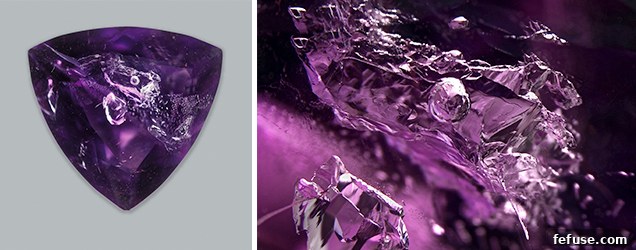
The journey of this exceptional gemstone began when L. Allen Brown of All That Glitters, a distinguished purveyor based in Methuen, Massachusetts, submitted it to the GIA for comprehensive scientific examination. What arrived at the laboratory was a substantial 15.54 carat stone, exquisitely fashioned into a triangular modified brilliant cut. It was presented as a Moroccan amethyst, a origin known for producing vibrant and high-quality specimens. The sheer size of this amethyst immediately set it apart, making it a significant piece even before any detailed analysis commenced. Its impressive weight and precise cut hinted at the potential for a gemstone of considerable aesthetic and scientific interest, ready to unveil its secrets under the scrutinizing gaze of GIA’s expert gemologists.
The stone’s deep, alluring purple hue, characteristic of fine amethyst, promised a visual treat. However, it was the subsequent gemological testing that would confirm its identity and, more importantly, reveal the extraordinary feature that makes this particular amethyst truly unforgettable. This specimen not only represents the inherent appeal of amethyst but also serves as a prime example of how nature imbues each gemstone with its own unique identity, often in the most surprising and beautiful ways.
Unveiling Identity: The Rigor of Gemological Testing
At the core of gem identification lies a meticulous process of standard gemological testing, a protocol rigorously followed by institutions like the GIA. These tests are essential for accurately identifying a gemstone, distinguishing natural from synthetic, and often determining treatment history. For the 15.54 carat triangular modified brilliant, a series of standard tests were conducted, yielding results that were consistently aligned with the known properties of natural amethyst. Each test contributes a crucial piece to the overall puzzle, affirming the gemstone’s authenticity and classification.
Key Gemological Properties and Their Significance
The following properties were established during the examination:
- Refractive Index (RI): The measured Refractive Index ranged from 1.544 to 1.553. The RI is a fundamental optical property that measures how much light bends when it passes through a gemstone. This measurement is crucial for identifying transparent and translucent stones, as each gem type possesses a characteristic RI range. For amethyst, a variety of quartz, this range is perfectly consistent, providing a strong initial indicator of its identity.
- Birefringence: A birefringence value of 0.009 was recorded. Birefringence refers to the difference between a gemstone’s two extreme refractive indices, indicating how much light splits into two polarized rays as it passes through the stone. This property is particularly diagnostic for doubly refractive gems like quartz and helps confirm its crystalline structure. The 0.009 birefringence is typical for amethyst, further solidifying its identification.
- Optic Sign: The stone exhibited a uniaxial positive optic sign. This property describes how light behaves when passing through a crystal and is determined using a polariscope. Uniaxial positive is characteristic of quartz and its varieties, including amethyst, reinforcing the gem’s classification within the quartz family.
- Pleochroism: Moderate purplish blue to purple pleochroism was observed. Pleochroism is the phenomenon where a gemstone appears to be different colors when viewed from different crystallographic directions. This amethyst displayed a distinct shift in color saturation and hue, from a purplish blue to a more intense purple, depending on the viewing angle. This moderate pleochroism is a common and diagnostic feature for many amethysts, adding to their visual complexity and appeal.
- Specific Gravity (SG): The Specific Gravity was measured at 2.65. Specific gravity is a ratio that compares the density of a gemstone to the density of an equal volume of water. It is a critical identification parameter, particularly useful for distinguishing between gems of similar appearance. An SG of 2.65 falls squarely within the expected range for natural quartz varieties, once again confirming the stone’s identity as amethyst.
- Fluorescence Reaction: The stone was inert to both long-wave and short-wave UV radiation. Fluorescence refers to a gemstone’s emission of visible light when exposed to ultraviolet light. While some gemstones exhibit strong fluorescence, many, like amethyst, show little to no reaction. An inert response to UV light is a typical characteristic of natural amethyst, providing another consistent data point in its identification profile.
Collectively, these meticulously documented properties provided an unambiguous confirmation: the 15.54 carat stone was indeed a natural amethyst. While these tests confirmed its fundamental identity, it was another feature, a captivating internal secret, that truly set this particular specimen apart and elevated it to a status of unique distinction.
The Heart of the Matter: A Striking Fluid Inclusion
Beyond the standard gemological properties that confirmed its identity, what truly rendered this 15.54 carat amethyst exceptional was a strikingly large primary fluid inclusion. Located prominently under the table facet, this natural marvel was easily discernible with the unaided eye, immediately drawing attention and sparking curiosity. Inclusions are often viewed as imperfections, but in cases like this, they transform into compelling features that tell a stone’s story and even enhance its desirability.
The Wonder of a Primary Fluid Inclusion
Fluid inclusions are microscopic pockets within a crystal that contain fluid (liquid, gas, or both) trapped during the crystal’s growth. They are essentially tiny time capsules, preserving a sample of the environment in which the crystal formed millions of years ago. A “primary” fluid inclusion, like the one in this amethyst, means it was trapped during the initial growth of the crystal. This is distinct from “secondary” inclusions, which form later, often along fractures. The presence of such an inclusion provides invaluable insights into the geological conditions and processes that shaped the gemstone.
The inclusion in this particular amethyst was not merely large; it was dynamic. Contained within this primary fluid inclusion was a gas bubble that moved freely and visibly when the stone was gently turned. This interactive quality is highly unusual and adds an unparalleled dimension to the gemstone’s appeal. Unlike typical inclusions that require magnification to appreciate, the beauty of this interactive feature could be effortlessly enjoyed by simply rocking and tilting the stone. This kinetic element transforms the amethyst from a static object of beauty into a miniature, self-contained world, inviting observation and delight.
Confirming Natural Origin and Enhancing Beauty
The presence of such a distinct primary fluid inclusion, especially one with a freely moving gas bubble, serves as irrefutable evidence of the stone’s natural origin. Inclusions are often referred to as nature’s fingerprints; they are unique signatures that are incredibly difficult, if not impossible, to replicate in synthetic or laboratory-grown gemstones. While advanced techniques can mimic some natural characteristics, the complexity and authenticity of such an organic inclusion are almost always indicative of a naturally formed crystal. This feature, therefore, provides definitive confirmation that this magnificent amethyst is a product of geological processes, not human intervention.
Moreover, far from being a detraction, this inclusion significantly enhances the aesthetic value and intrinsic fascination of the amethyst. In the world of fine gemstones, certain inclusions, particularly those that are unique, aesthetically pleasing, or highly diagnostic of origin, can elevate a stone’s desirability and even its monetary value. This interactive fluid inclusion transforms the amethyst into a conversation piece, a gem with a personality and a story to tell. It embodies a rare convergence of scientific interest and captivating visual appeal, making it a prized specimen for collectors and gem enthusiasts alike.
The Allure of Amethyst: Beyond the Inclusion
While the extraordinary fluid inclusion makes this particular stone unique, it is important to remember the inherent allure of amethyst itself. Amethyst, a beloved variety of quartz, has captivated humanity for millennia with its enchanting purple hues, ranging from delicate lilac to deep, royal violet. Its name, derived from the Greek “amethystos,” meaning “not intoxicated,” reflects an ancient belief in its power to ward off drunkenness and foster a clear mind. Throughout history, amethyst has been cherished by royalty, religious figures, and common folk alike, gracing crowns, ecclesiastical rings, and personal adornments.
Geologically, amethyst is formed in hydrothermal veins within igneous rocks, often in geodes or crystal-lined cavities. The vibrant purple color is attributed to irradiation, iron impurities, and the presence of trace elements within the crystal structure. While Brazil and Uruguay are perhaps the most famous sources for large amethyst geodes and fine crystals, other notable localities include Zambia, South Korea, and, as in the case of this magnificent specimen, Morocco. Moroccan amethysts are particularly noted for their attractive coloration and clarity, often exhibiting beautiful hexagonal crystal formations.
The value of amethyst is determined by several factors, including its color saturation, clarity, cut, and size. Stones with a rich, uniform purple color with minimal color zoning, excellent clarity (eye-clean), and a well-executed cut are highly prized. While large amethysts are not as rare as some other gemstones, a specimen of 15.54 carats with such remarkable clarity and a unique internal feature truly stands out, making it an exceptional example of what nature can create within this popular gem species. Its triangular modified brilliant cut maximizes its brilliance and fire, further enhancing its visual appeal.
GIA’s Enduring Legacy in Gemological Science
The examination of this unique amethyst underscores the critical role played by institutions like the Gemological Institute of America (GIA). As a non-profit organization dedicated to research and education in gemology, GIA is a global leader in establishing and maintaining standards for evaluating gemstones. Its meticulous scientific approach provides unbiased and accurate identification and grading, serving as a cornerstone for consumer confidence and industry integrity. By documenting and analyzing such exceptional specimens, GIA not only contributes to the collective body of gemological knowledge but also offers fascinating insights into the natural world.
For a gemstone of this caliber, with its substantial size and extraordinary inclusion, a GIA examination report is invaluable. It provides authoritative confirmation of the gem’s identity, its natural origin, and a detailed record of its properties. Such reports instill confidence in buyers and collectors, verifying the authenticity and unique characteristics of high-value and scientifically interesting pieces. The GIA’s unwavering commitment to scientific rigor ensures that every stone, whether a common variety or a rare marvel like this amethyst, receives the same meticulous attention, thereby preserving the trust and transparency essential to the global gem and jewelry trade.
A Testament to Nature’s Artistry
The 15.54 carat triangular modified brilliant amethyst, submitted by L. Allen Brown and examined by GIA, stands as a remarkable testament to the intricate and often surprising artistry of nature. While its gemological properties consistently confirmed its identity as a natural amethyst, it was the stunning, eye-visible primary fluid inclusion with its freely moving gas bubble that truly captured the imagination. This interactive phenomenon not only provides incontrovertible proof of the stone’s natural origin but also bestows upon it a unique charm and character, transforming it into a living, breathing piece of geological history.
In a world increasingly focused on perfection and flawless beauty, this amethyst reminds us that true magnificence often lies in the distinctive marks and stories of nature’s creation. It is a rare gem that invites prolonged admiration, not just for its color and sparkle, but for the captivating dance within its heart. This extraordinary amethyst, therefore, is more than just a gemstone; it is a profound natural wonder, meticulously documented by GIA, that continues to inspire awe and curiosity among gemologists and enthusiasts alike, solidifying its place as a truly unforgettable treasure from the Earth.
News Source : gia.edu