
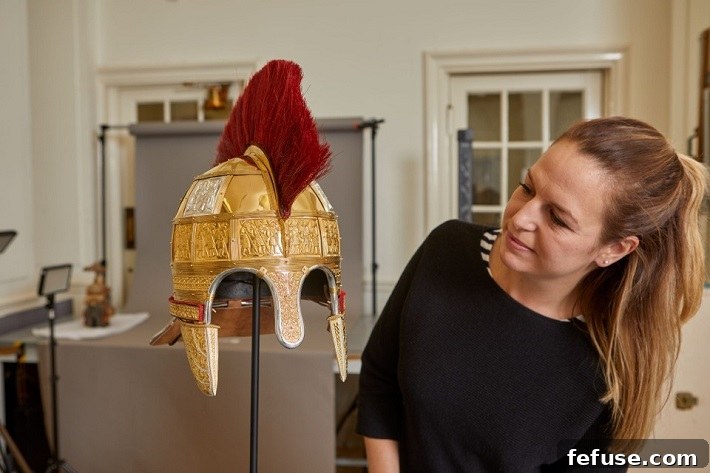
Unveiling History: The Remarkable Reconstruction of the Staffordshire Hoard Helmet
In a triumph of historical research and modern craftsmanship, two stunning reconstructions of a high-status helmet from the enigmatic Staffordshire Hoard have been brought to life. Nearly a decade after its initial discovery, this significant achievement, spearheaded by the Birmingham City University’s School of Jewellery in collaboration with a team of expert conservators and makers, offers an unprecedented glimpse into the martial culture of Anglo-Saxon England. These meticulously crafted replicas are now on public display at the Birmingham Museum & Art Gallery and The Potteries Museum & Art Gallery, inviting audiences to connect with a pivotal piece of early medieval history.
The Staffordshire Hoard: A Glimpse into Anglo-Saxon Riches
The story of the Staffordshire Hoard begins in 2009, when it was unearthed in a field near the village of Hammerwich, Lichfield. This extraordinary find represents the largest collection of Anglo-Saxon gold and silver ever discovered, comprising over 4,000 precious fragments. Its discovery sent ripples through the archaeological world, fundamentally altering our understanding of early medieval craftsmanship, wealth, and warfare in Britain. The hoard’s sheer volume of opulent metalwork – including intricate sword fittings, ecclesiastical objects, and numerous decorative elements – painted a vivid picture of a society rich in artistic skill and material culture, likely dating back to the 7th century AD.
However, the hoard presented a profound challenge: it was heavily damaged before burial, fragmented into thousands of pieces. Among these myriad fragments, experts soon realized, lay the scattered remains of something truly exceptional: a single, incredibly high-status helmet. This realization sparked a dedicated research project to identify, understand, and ultimately reconstruct this unparalleled artifact, providing crucial insights into Anglo-Saxon elite identity and military prowess.
Piecing Together the Past: The Helmet’s Enigmatic Fragments
From 2014 to 2017, the helmet became the focal point of a major research initiative, generously funded by Historic England and the museums responsible for safeguarding the Staffordshire Hoard collection. During this intensive period, scholars and conservators meticulously studied thousands of the more than 1,300-year-old fragments. Their goal was to painstakingly identify which pieces belonged to the helmet, believed to have been crafted between AD 600-650. This phase required an almost forensic level of detail, comparing decorative motifs, metal composition, and structural elements to gradually build a comprehensive picture of the original object.
Helmets from this specific Anglo-Saxon period are extraordinarily rare; historical records and archaeological finds account for only five other known examples. The Staffordshire Hoard Helmet, with its intricate details and bold, crested design, immediately stood out as an artifact of immense importance. Such elaborate headgear would not have been worn by an ordinary warrior; its very existence signals an owner of considerable wealth, power, and prestige – likely a king, a prince, or a paramount military leader. The journey from scattered fragments to a coherent understanding of such an object was a testament to enduring scholarly dedication.
A Fusion of Ancient Craft and Modern Technology: The Reconstruction Process
Once the research had provided a clear understanding of the helmet’s likely appearance, the monumental task of reconstruction began. This ambitious phase spanned 18 months and involved a remarkable collaboration, merging cutting-edge digital technology with time-honored ancient craft techniques. The project brought together a diverse team of specialist makers, each contributing unique expertise to breathe new life into the ancient artifact.
Birmingham City University’s Pivotal Role
At the forefront of crafting the helmet’s intricate precious metal elements was the School of Jewellery at Birmingham City University. This institution, renowned for its heritage and innovation in jewellery manufacturing, played a central role in fabricating the thousands of components that would form the helmet’s gilded surface. Their approach involved a meticulous blend of digital precision and traditional artistry. Laser scanning of the original, surviving fragments was employed to generate highly accurate digital models, ensuring that every recreated piece was as faithful as possible to the ancient prototypes. This digital foundation allowed for unparalleled precision in the reconstruction process.
Frank Cooper, Senior Lecturer in Jewellery Manufacturing Technologies at Birmingham City University, vividly described the undertaking: “This is one of the most diverse, interesting and certainly challenging projects we have ever taken on in the almost 130-year history of the School of Jewellery.” He emphasized the critical contribution of his team at the School’s Centre for Digital Design and Manufacturing. “Without their diverse talents, technical skills and jewellery expertise coupled with boundless enthusiasm and sheer hard work, this project could have remained but a fanciful dream.”
Cooper elaborated on the complex methodology: “A major challenge was digitally correcting the damaged and missing elements of the helmet’s many components. To achieve this we turned to our laser scanning and CAD skills to create digital files which were then used to drive our CNC milling and 3D printing technologies.” This initial digital phase was crucial for generating precise forms from fragmented and distorted originals. Following this, the team seamlessly transitioned back to their core jewellery craft skills: “From this point forward we reverted back to our jewellery craft skills to cast, stamp and polish and even rivet the collection of components to produce the magnificent helmet you can now see.” This fusion of high-tech digital fabrication and traditional goldsmithing was instrumental in achieving the astonishing level of accuracy and authenticity seen in the final reconstructions.
Collaborative Expertise: Beyond the Precious Metals
The reconstruction was not solely a metalworking feat. Other distinguished specialists contributed their unique skills, working under the expert guidance of archaeologists to ensure historical accuracy. Royal Oak Armoury lent its expertise in the construction of historically accurate armor, while Gallybagger Leather provided the intricate leather components that would have formed the internal lining and strapping. Drakon Heritage and Conservation ensured the structural integrity and long-term stability of the reconstructions, and metalsmith Samantha Chilton contributed to various metalworking aspects. This multidisciplinary approach underscored the complexity of early medieval craftsmanship and the dedication required to faithfully recreate such an artifact.
The Significance of the Staffordshire Hoard Helmet
Despite the intensive research project, the Staffordshire Hoard Helmet continues to hold many secrets. Questions persist about its precise owner and the circumstances of its burial. However, what is unequivocally clear is its profound historical significance. The rarity of Anglo-Saxon helmets – with only a handful known to exist – elevates the Staffordshire Hoard example to an unparalleled status. Its intricate design, lavish use of gold and garnet, and the bold crested form are hallmarks of royal or princely regalia, indicating it belonged to an individual of the highest echelon of Anglo-Saxon society.
The helmet finds a compelling parallel in the famous Sutton Hoo Helmet from Suffolk, of which a celebrated reconstruction is proudly displayed at the British Museum. That helmet is widely believed to have belonged to Rædwald, King of the East Angles, or another member of his royal household. The Staffordshire Hoard Helmet, with its comparable opulence and craftsmanship, strongly suggests a similar princely or kingly ownership, offering tantalizing clues about the powerful figures who shaped 7th-century Britain.
Dr. Ellen McAdam, Director of Birmingham Museums Trust, eloquently summarized the enduring allure of the hoard: “After nearly 10 years the Staffordshire Hoard is still giving up its secrets. Research has now shown us that the Hoard contains fragments of a helmet. Only Anglo-Saxon Kings wore helmets, and this is one of a very small number ever to be found.” She emphasized the impact of the reconstructions: “It has been carefully reconstructed by scholars and craftspeople to give us an insight into the way Anglo-Saxon warriors lived and fought. The displays in Birmingham and Stoke-on-Trent will share the results of research with the public to help them understand how the Hoard came into being.”
Public Engagement and Lasting Legacy
The successful reconstruction project was made possible through dedicated fundraising efforts by Birmingham Museums Trust and The Potteries Museum & Art Gallery, Stoke-on-Trent, building upon the foundational research funded by Historic England and the participating museums. These displays represent a culmination of years of diligent work, offering the public an extraordinary opportunity to witness history brought to life.
The unveiling of these helmets is more than just an exhibition; it is an educational endeavor aimed at deepening public understanding of Anglo-Saxon England, its rich material culture, and the sophisticated skills of its artisans. Further scholarly insights will be made available when the comprehensive research findings are published in 2019 by the Society of Antiquaries of London and the Archaeology Data Service. This ongoing commitment to research and public dissemination ensures that the Staffordshire Hoard will continue to inspire and inform for generations to come.
The Staffordshire Hoard Helmet reconstructions stand as powerful symbols of human ingenuity – bridging millennia through a combination of meticulous scholarship, pioneering technology, and timeless craftsmanship. They illuminate a pivotal period in British history and underscore the enduring power of archaeological discoveries to captivate and educate, reminding us of the rich tapestry of our past.