
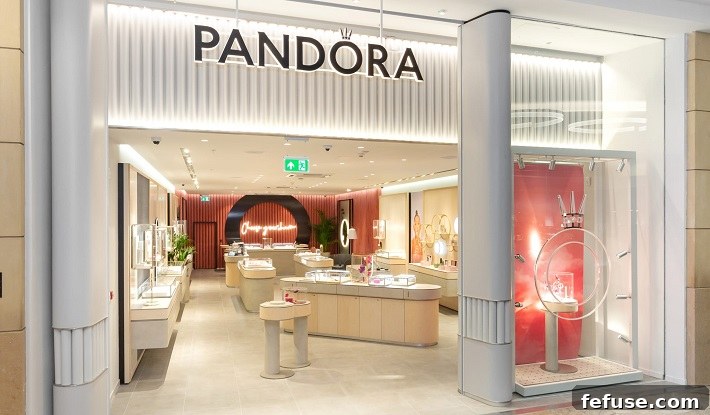
Pandora Navigates Unprecedented Challenges: Withdrawing Financial Guidance Amidst Global COVID-19 Impact
The global landscape of commerce and consumer behavior has been profoundly reshaped by the unprecedented challenges brought forth by the COVID-19 pandemic. In an stark reflection of these turbulent times, Pandora, one of the world’s leading jewelry brands, has officially announced the withdrawal of its financial guidance for the current fiscal year. The company stated unequivocally that its previously issued outlook is “no longer meaningful” given the widespread and evolving impact the coronavirus outbreak is having on business operations worldwide. This significant decision underscores the deep uncertainty facing even established global enterprises as they contend with a rapidly shifting economic environment.
The recent and swift escalation of the COVID-19 crisis has sent ripples across virtually every sector of the global economy, leaving few industries untouched. The luxury retail and jewelry sectors, heavily reliant on discretionary spending, tourism, and physical store interactions, have been particularly vulnerable. Pandora, with its extensive global footprint, stands as one of many prominent jewelry firms directly and indirectly affected by the pervasive outbreak. The sheer scale and speed of the pandemic’s spread necessitated immediate and drastic measures from governments and businesses alike, disrupting established patterns of trade and consumer engagement.
Initial Strength Derailed: A Rapid Shift in Market Dynamics
Prior to the widespread escalation of the pandemic, Pandora had demonstrated robust financial performance throughout January and February of the current year. The initial months saw particularly encouraging development within the company’s online channels, signaling a healthy digital transformation and strong consumer engagement. Furthermore, total like-for-like sales, excluding the specific challenges already emerging in China, were even exceeding the company’s full-year financial guidance. This early momentum painted a picture of a brand on a positive trajectory, building on previous strategic initiatives. However, this promising start was abruptly curtailed as the coronavirus crisis intensified, leading to a material and rapid weakening of sales across virtually all global markets. The abruptness of this downturn highlights the fragility of global supply chains and consumer confidence in the face of such a monumental public health crisis.
The impact of COVID-19 was first keenly felt in the crucial Chinese market. Since late January, Pandora has observed a dramatic decline in like-for-like sales within China, plummeting to between -70% and -80%. While there have been nascent signs of revenue beginning to slightly improve as containment measures eased in some regions, the path to normalized demand is expected to be protracted and complex. The pace of this recovery remains largely outside Pandora’s direct control, tied instead to broader macroeconomic trends, consumer sentiment, and ongoing public health developments. This experience in China served as an early indicator of the challenges that would soon cascade across other regions.
By late February, the ripple effects of the pandemic had visibly reached European markets, with Italy experiencing a particularly severe impact. Italy, a significant market for luxury goods, had initially generated solid positive like-for-like sales in January and February. However, the month of March witnessed a dramatic shift, with trading almost coming to a complete halt as stringent lockdown measures were implemented nationwide. This rapid deceleration in a key European market underscored the speed with which the crisis was spreading and its immediate, devastating effects on retail operations.
Beyond Europe, the contagion of economic slowdown spread globally. Australia, for instance, has been significantly affected by a sharp decline in international tourism, a vital component of its retail economy. More broadly, most other markets are now experiencing indirect impacts through a general dampening of consumer sentiment and spending, exacerbated by widespread anxiety and economic uncertainty. In regions subjected to mandated lockdowns, store closures, and other governmental restrictions designed to curb the spread of the virus, revenue streams are anticipated to become negligible for the duration of these extraordinary circumstances. The precise timing and eventual pattern of a return to normalized business operations remain shrouded in deep uncertainty, making long-term forecasting exceedingly difficult for businesses like Pandora.
Strategic Adaptations: Navigating the Downturn with Resilience
In response to these unprecedented headwinds, Pandora has swiftly implemented a comprehensive strategy focused on proactive cost management to safeguard its financial stability and preserve its core business capabilities. The company is actively scrutinizing and adjusting various expenditure categories, including significant investments in media and marketing, rental obligations for its extensive network of physical stores, and other operational store costs. The overarching objective is to strike a delicate and appropriate balance: protecting profitability in the immediate term while simultaneously continuing to drive revenue through its increasingly vital online store and building upon the underlying brand momentum established prior to the crisis. This dual focus on cost control and strategic investment in digital channels is critical for long-term resilience.
Despite the formidable challenges posed by COVID-19, Pandora anticipates that its profitability will remain strong during the first quarter of 2020. This expectation is rooted in Pandora’s inherently profitable and cash-generative business model, which provides a crucial buffer during periods of economic contraction. The company’s robust operational efficiency and strong cash flows mean that Pandora is strategically positioned to absorb several months of suppressed consumer traffic and reduced sales volumes and still project overall profitability and cash generation for the full fiscal year. This financial robustness is further bolstered by a consistently conservative capital structure policy, characterized by light funding covenants and healthy funding availability. These pillars collectively equip Pandora with a strong financial position, providing the necessary liquidity and flexibility to effectively manage and navigate through this prolonged downturn period with confidence.
Protecting the Balance Sheet: A Prudent Pause on Share Repurchases
In a testament to its unwavering commitment to preserving a robust balance sheet under these extraordinary and volatile circumstances, Pandora’s board of directors has made a decisive move. As of today, the company has announced the suspension of any further treasury share buybacks under the authorization granted at its 2020 Annual General Meeting. Share buyback programs are typically initiated to return value to shareholders and boost earnings per share, often signaling a company’s confidence in its future outlook. However, in times of extreme uncertainty, pausing such programs is a prudent measure to conserve cash and enhance liquidity, thereby fortifying the company’s financial position against potential prolonged economic disruption.
Pandora has clearly articulated its intention to reinitiate a share buyback program once the global situation demonstrably improves and economic stability is restored. This resumption will, however, be subject to the company’s stringent capital structure policy, which mandates maintaining a specific ratio of net interest-bearing debt (including committed leases) of 0.5 to 1.5 times EBITDA, excluding restructuring costs. This financial discipline ensures that any future capital allocation decisions are made responsibly, aligning with the company’s long-term financial health and strategic objectives. The temporary suspension reflects a cautious but necessary step to navigate immediate challenges while keeping an eye on long-term value creation.
Withdrawal of Guidance: A Reflection of Global Uncertainty
It is important to recall that Pandora’s financial guidance, which was initially announced on February 4, 2020, explicitly excluded any potential impact from the then-emerging COVID-19 situation. At that time, the full scope and severity of the global pandemic were not yet fully understood or quantifiable. As a direct and unavoidable consequence of the rapid, worldwide escalation of the situation, the original financial guidance for 2020 has rendered itself completely obsolete and has now been formally withdrawn. This withdrawal is not merely a procedural step; it is a candid acknowledgement of the profound and unpredictable shifts in market conditions, consumer behavior, and operational capabilities that have unfolded globally.
In the face of this fluid crisis, Pandora remains steadfast in its commitment to vigilant monitoring of the ongoing development of the COVID-19 pandemic. The company’s paramount focus continues to be the well-being and safety of its dedicated employees across all its operations, alongside ensuring safe and hygienic environments for its valued customers. This people-first approach is central to its operational philosophy during a public health crisis.
To uphold the highest standards of safety and responsibility, Pandora is rigorously adhering to all guidelines and mandates set forth by local authorities in every region where it operates. This commitment includes the temporary closure of stores and offices as advised by governmental and health organizations. Such closures, while impacting revenue, are deemed essential to protect public health and mitigate the spread of the virus, demonstrating Pandora’s corporate social responsibility.
A critical factor underpinning Pandora’s resilience during this period is the continued operational stability of its manufacturing facilities in Thailand. These facilities continue to run without significant disruption, maintaining stable supplies of materials and finished products. Crucially, there has been no notable impact from the global situation on these vital production hubs. This unwavering manufacturing capacity ensures that Pandora can maintain its supply chain integrity, a significant advantage when many industries are grappling with severe production and logistics bottlenecks. The consistent output from its Thai facilities positions Pandora favorably for a potential swift recovery when market conditions improve and demand begins to normalize.
The actions taken by Pandora, from strategic cost adjustments and bolstering its balance sheet to prioritizing employee and customer safety and maintaining robust manufacturing capabilities, collectively illustrate a proactive and resilient approach to navigating an unprecedented global crisis. While the short-term outlook remains uncertain, these measures underscore Pandora’s commitment to long-term sustainability and its ability to adapt in a rapidly changing world.