
ALROSA Mir Diamond Mine Disaster: Official Report Pinpoints Multi-Faceted Causes
The catastrophic accident at ALROSA’s Mir Diamond Mine, which tragically resulted in the deaths of eight individuals in August, has been thoroughly investigated by the Russian government. According to a statement released by ALROSA, the official inquiry has concluded that a “combination of hydrogeological, technical, and organizational factors” was responsible for the sudden and devastating flooding. This comprehensive report offers crucial insights into the profound complexities and inherent dangers associated with deep-earth mining operations, compelling a rigorous re-evaluation of safety protocols and operational paradigms across the global industry.
The Legacy of Mir: A World-Renowned Diamond Powerhouse
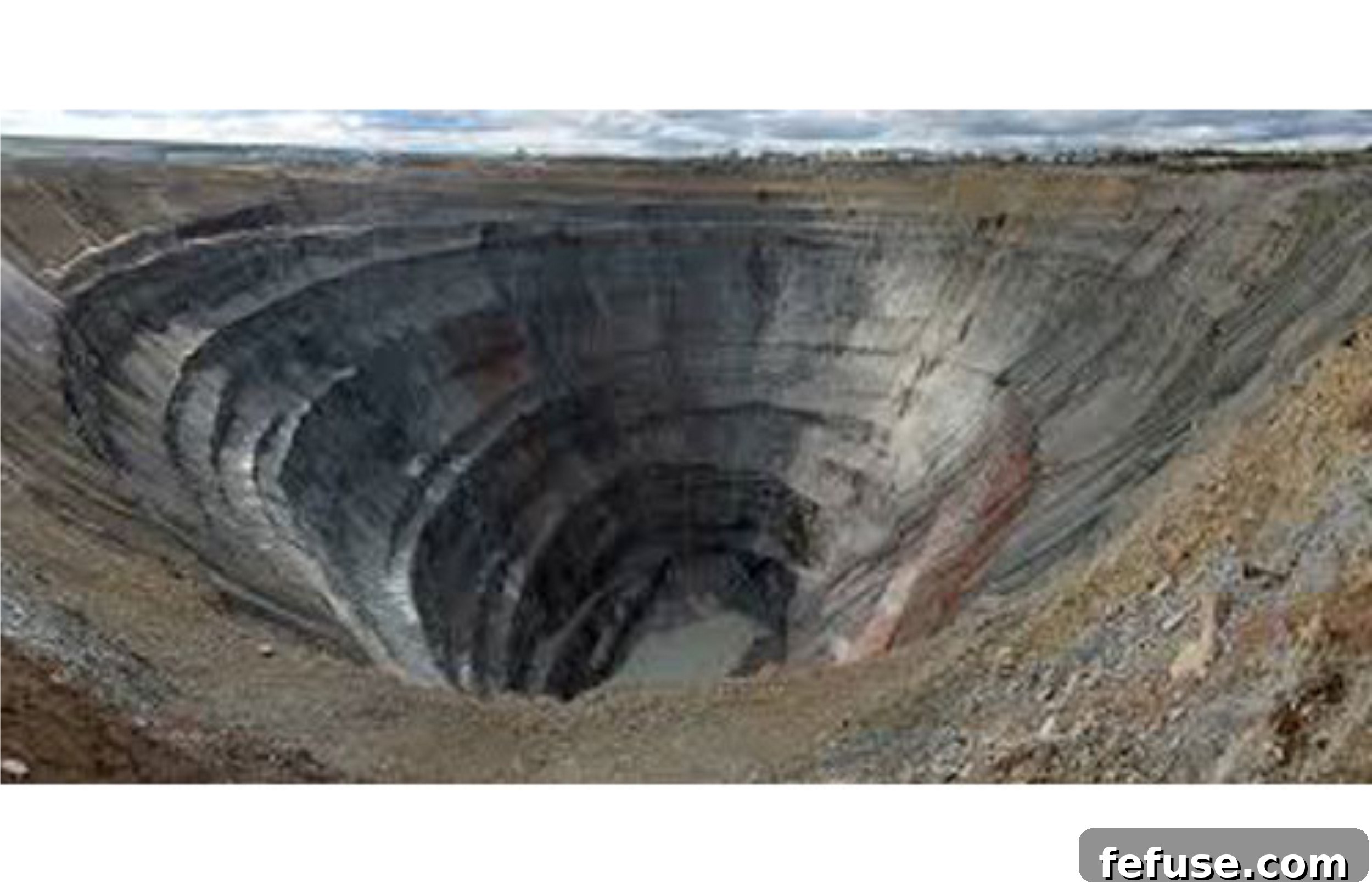
The Mir Mine, often hailed as the “Diamond Capital of Russia,” stands as one of the planet’s largest and most historically significant diamond mines. Located in Mirny, within the Sakha Republic, it has served as a cornerstone of ALROSA’s operations and a vital contributor to the global diamond supply for many decades. Initiated as a vast open-pit operation in 1957, the mine transitioned to underground extraction in the early 2000s as the open pit reached its economic and operational limits. This significant shift necessitated intricate engineering solutions, including the ambitious ‘dry conservation’ project designed to manage water levels within the colossal open-pit crater. The mine’s deep underground workings, extending hundreds of meters beneath the surface, inherently presented constant geological and hydrogeological challenges, making its structural integrity and operational safety paramount considerations.
The August Tragedy: A Mine Overwhelmed by Water
The accident itself unfolded with terrifying rapidity in August, when a sudden and overwhelming influx of water breached the mine’s defenses, trapping workers deep within its complex subterranean network. Despite immediate and extensive rescue operations, which saw dedicated teams working tirelessly against formidable odds and treacherous conditions, eight miners ultimately succumbed to the disaster. This profound loss of life sent shockwaves throughout Russia and the international mining community, instantly triggering an urgent and comprehensive investigation. The primary objective was to meticulously uncover the precise chain of events and identify the underlying systemic issues that contributed to such a devastating and, arguably, preventable tragedy. The immense human cost served as the driving impetus for a relentless pursuit of truth and ultimate accountability.
The Investigation Unfolds: Rostechnadzor Leads the Charge
The formidable task of uncovering the truth behind the Mir Mine disaster was entrusted to the Federal Environmental, Industrial and Nuclear Supervision Service of Russia (Rostechnadzor), the nation’s principal regulatory authority for industrial safety. The meticulously prepared report by Rostechnadzor was formally deliberated during a critical meeting between ALROSA President Sergey Ivanov and the Head of Rostechnadzor, Alexey Aleshin, underscoring the official weight and gravity attributed to its findings. To ensure an exhaustive and unbiased inquiry, a specialized technical investigation commission was established under the direct supervision of Rostechnadzor. This commission benefited immensely from the diverse expertise of four distinct groups, comprising leading Russian specialists and scientists from an array of pertinent disciplines, including geology, hydrology, mining engineering, and safety management. This multi-faceted approach was designed to leave no aspect unexamined in understanding the intricate interplay of factors that culminated in the disaster.
Deep-Seated Hydrogeological Vulnerabilities: A Foundational Flaw
One of the most critical conclusions articulated by the commission underscored the “anomalous hydrogeological complexity” of the Mir deposit. This wasn’t merely a minor geological anomaly but a fundamental vulnerability stemming from a pervasive system of “unfavorably underlying cracks” situated within a significant structural fault. The report elaborated that these inherent geological imperfections created natural pathways for water ingress, a risk further exacerbated by inadequate monitoring practices. Specifically, hydrogeological observations were regrettably confined solely to the immediate ore body, critically neglecting the essential monitoring of brine inflows originating from surrounding geological structures. This significant oversight led to an “unreliable assessment of the changed hydrogeological situation” within the open-pit mine, implying that crucial early warning signs of escalating water pressure and infiltration were either missed or severely underestimated. Consequently, the conditions conducive to the accident did not emerge abruptly but rather developed insidiously over a prolonged period of several years, a silent and growing threat accumulating deep beneath the surface.
Technical Design Deficiencies: A Cascade of Compounding Errors
Beyond the inherent geological complexities, the investigation meticulously identified several “adopted design decisions” that significantly contributed to the catastrophic accident. A central focus of the commission’s critique was the project of ‘dry conservation’ of the open-pit mine, which was implemented in the early 2000s. This ambitious undertaking aimed to effectively manage water levels within the colossal open pit after its transition to underground mining. However, the commission uncovered serious shortcomings in its original design and subsequent execution:
- Underestimation of Washout Risks: The project fundamentally failed to adequately account for the distinct possibility of ore and surrounding rocks washing out. Such occurrences could severely compromise structural integrity and create new, unmanaged pathways for water infiltration into the mine workings.
- Inadequate Pumping System Longevity: The original design did not provide for the long-term, sustained performance and resilience of the crucial pumps installed at the bottom of the open pit. These pumps were vital for continuously expelling incoming water, and their premature failure or insufficient capacity inevitably led to dangerous water accumulation.
- Absence of Backfilling Technology: The technological regulations and development projects were found to contain no specific technology, methodology, or explicit provision for the backfilling of washouts or voids within the mine workings. This critical absence meant that any existing or developing cavities could not be properly reinforced or sealed, thereby increasing the risk of structural collapse or further water ingress.
- Detrimental Impact of Salt Storage: Crucially, the practice of storing salt on the open-pit edge was identified as a significant contributing factor. This practice accelerated the early degradation and failure of water-circulation galleries, which were an integral component of the ‘dry conservation’ system, further compromising the mine’s overall capacity to effectively manage water.
These collective technical oversights and design deficiencies cumulatively created an increasingly hazardous operational environment, gradually eroding the mine’s inherent resilience against the relentless natural forces of water and geology.
Organizational Failures and the Imperative for Accountability
The comprehensive report also brought to light significant organizational lapses. It explicitly stated that “neither ALROSA experts nor the monitoring system noted any signs of impending emergency,” despite clear evidence that the hazardous conditions had been developing over an extended period of several years. This critical finding points directly to a profound failure in internal oversight, risk assessment methodologies, and the accurate interpretation of readily available geological and hydrological data. The investigation further highlighted a broader technological challenge, noting that “today, there are no reliable control systems in Russia and abroad that can make it possible to identify the development of cavity formations in rocks.” While this acknowledges a global technological limitation, it implicitly suggests that even with current constraints, a more diligent interpretation of existing data and a more cautious, proactive operational approach might have potentially averted the disaster.
In direct response to these damning findings, the commission meticulously developed a comprehensive set of organizational and technical measures specifically aimed at localizing and definitively eliminating the root causes of the accident. Even more significantly, it formally identified 16 officials deemed directly responsible for the violations and shortcomings that directly contributed to the catastrophic flooding. ALROSA’s management has now been formally tasked with the crucial responsibility of compiling a complete list of these individuals and detailing their specific personal responsibility for the incident. This emphatic focus on individual accountability underscores the severity of the systemic lapses and signals a firm commitment to ensuring justice and preventing any future recurrences.
Economic Repercussions and the Uncertain Future of Mir Mine
The financial ramifications of the disaster are undeniably substantial. The commission estimated the total economic damage at a staggering RUB 10.216 billion (approximately USD 170 million at the time of the incident). This formidable figure encompasses not only immediate operational losses but also the substantial long-term impact on operations, potential rehabilitation efforts, and environmental remediation costs. Unsurprisingly, all operations at the Mir Mine have been completely halted since the accident occurred. The long-term future of this iconic mine, once a symbol of Russian diamond production, remains deeply uncertain. While the immediate focus is unequivocally on ensuring safety and meticulously implementing the commission’s extensive recommendations, the sheer scale of the hydrogeological and structural challenges, coupled with the immense financial outlay required for comprehensive remediation, raises serious questions about the long-term viability of resuming any form of underground operations at Mir. Any future decision will undoubtedly hinge on a detailed and rigorous analysis of inherent risks versus potential rewards, with human safety and environmental protection prioritized above all other considerations.
This tragic incident serves as a stark and sobering reminder for the global mining industry about the critical and non-negotiable importance of integrating robust hydrogeological assessments, implementing innovative and resilient engineering designs, and maintaining vigilant, proactive organizational oversight. It profoundly underscores the continuous imperative for significant investment in advanced monitoring technologies and the cultivation of a deeply ingrained, proactive safety culture that prioritizes early detection and comprehensive mitigation over reactive responses. The hard-won lessons learned from the Mir Mine tragedy must unequivocally inform all future mining practices, ensuring that the pursuit of valuable resources never again comes at the unacceptable cost of human lives or environmental integrity.
Image Caption:
A striking aerial view of the Mir Mine, a site of immense geological beauty and profound industrial tragedy.