
Navigating the Nuanced Dance: Gold, the US Dollar, and Future Market Directions
The relationship between gold and the US dollar has long been a cornerstone of macroeconomic analysis. Traditionally, these two powerful assets are perceived to move in an inverse correlation: as one strengthens, the other weakens. This conventional wisdom stems from gold being priced in US dollars globally; consequently, a stronger dollar makes gold more expensive for holders of other currencies, dampening demand, while a weaker dollar has the opposite effect. Furthermore, both assets often serve as safe havens during times of global economic uncertainty, but for different reasons. The dollar benefits from its status as the world’s primary reserve currency, drawing capital in turbulent times, while gold has an intrinsic value and a historical reputation as a store of wealth that transcends national currencies. Over extended periods, their long-term trends can sometimes align, but the magnitude and timing of their movements frequently diverge, creating complexities for investors.
However, recent market dynamics have challenged this conventional inverse relationship, presenting a more intricate picture for investors and analysts alike. The straightforward, predictable inverse correlation has proven less than perfect in recent months and years, prompting a deeper examination of the underlying forces at play that shape the destinies of both gold and the US dollar.
Unpacking Recent Divergences: When Traditional Rules Bend
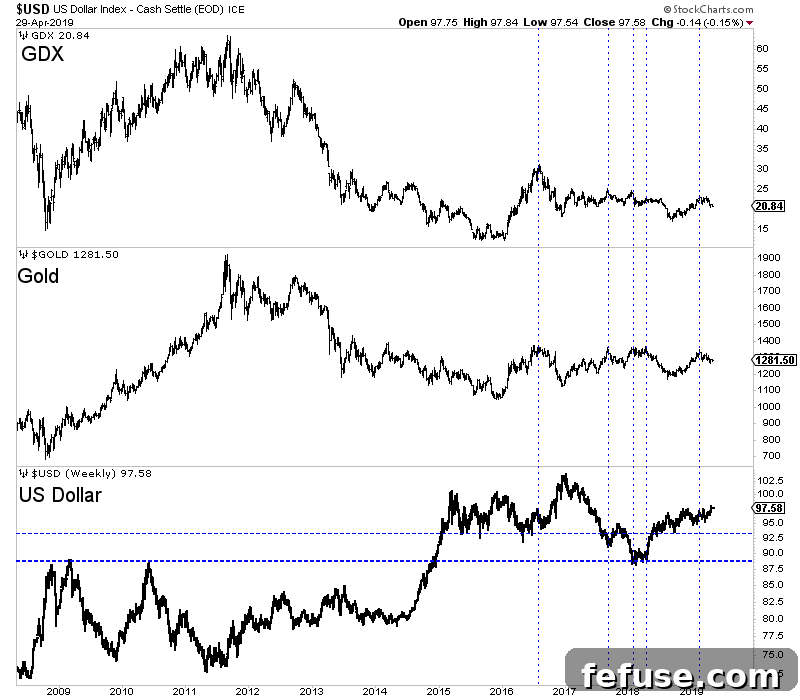
To truly understand the evolving dynamics between gold, gold stocks, and the US dollar, it’s essential to analyze historical instances where their paths diverged from the expected. Our observations, as illustrated in accompanying market charts (which visually highlight critical resistance levels for gold with vertical lines), reveal that the relationship with the dollar hasn’t always been uniform or straightforward, particularly in recent economic cycles.
The 2017 Anomaly: A Deeper Look into Gold’s Underperformance
A prime example of this divergence occurred in 2017. During this period, the US dollar experienced a significant decline, even penetrating its 2016 low to the downside. According to traditional wisdom, such a substantial weakening of the dollar should have acted as a strong catalyst for gold prices, potentially pushing them to new highs. Yet, gold conspicuously failed to achieve a new high, and gold mining stocks, often considered a leveraged play on gold prices, performed even worse, not even coming close to their 2016 peaks. This scenario clearly challenged the simplistic inverse correlation narrative, raising questions about what other macroeconomic factors were influencing gold’s trajectory.
The primary reason for gold’s muted performance in 2017, despite dollar weakness, can be largely attributed to the behavior of real interest rates. Throughout 2017, real interest rates, which account for inflation, were on the rise. Gold, as a non-yielding asset, becomes less attractive when real interest rates increase, as the opportunity cost of holding gold (i.e., the return one could earn elsewhere) becomes higher. Therefore, while dollar weakness prevented gold and gold stocks from potentially faring even worse, it was insufficient to overcome the bearish influence of rising real interest rates. This period served as a powerful reminder that while the US dollar is a significant factor, it is not the sole determinant of gold’s price action; other fundamental drivers play an equally, if not more, critical role.
Current Market Dynamics: A Shifting Landscape
Fast forward to more recent times, and we’ve observed a fascinating reversal of this dynamic. The US dollar has shown considerable strength, in some instances breaking out to new highs. Conventionally, this would imply significant pressure on gold prices, potentially driving them towards their 52-week lows. However, against expectations, gold has demonstrated remarkable resilience, remaining much closer to its 52-week high than its 52-week low. This recent divergence presents another puzzling scenario for gold investors. It suggests that despite a strong dollar, other factors might be providing underlying support for gold, or perhaps the market is pricing in future scenarios that could be beneficial for the yellow metal.
Beyond the Dollar: Key Drivers for Gold’s Performance
The recent anomalies underscore the necessity of looking beyond the simple dollar-gold relationship to fully comprehend gold’s price movements. Several other critical economic indicators and policy decisions exert profound influence.
The Crucial Role of Real Interest Rates
As highlighted by the 2017 experience, real interest rates are arguably the most significant fundamental driver for gold. Real interest rates represent the true return investors receive after accounting for inflation. When real interest rates are low or negative, the appeal of holding non-yielding assets like gold increases, as the opportunity cost is minimal, or investors are effectively losing purchasing power by holding cash. Conversely, high or rising real interest rates make gold less attractive compared to interest-bearing assets suchating bonds, as investors can earn a positive real return elsewhere without the volatility of commodity markets. Understanding the trajectory of real interest rates – driven by both nominal interest rates set by central banks and inflation expectations – is paramount for forecasting gold’s direction.
Global Economic Health and Investor Sentiment
Gold’s role as a safe-haven asset means its demand often surges during periods of economic and geopolitical uncertainty. When global economic growth falters, geopolitical risks escalate, or market volatility spikes, investors tend to flock to gold to preserve capital. Conversely, a strong global economic recovery, characterized by robust growth and low perceived risks, can diminish gold’s appeal as a safe haven. In such environments, capital typically flows into riskier assets like equities and higher-yielding investments, reducing demand for gold. The performance of global stock markets, therefore, often provides an indirect gauge of investor risk appetite, which can significantly impact gold prices. If strength in US stocks and global stocks continues, it implies a ‘risk-on’ environment, which might limit gold’s upside regardless of dollar movements.
The Federal Reserve’s Guiding Hand
Monetary policy decisions by the US Federal Reserve have a cascading effect on both the dollar and real interest rates, thereby indirectly influencing gold. Decisions regarding interest rate hikes or cuts, as well as quantitative easing or tightening programs, directly impact nominal interest rates and market liquidity. These actions shape inflation expectations and the overall economic outlook, consequently affecting real interest rates. A hawkish Fed policy (raising rates, tightening liquidity) generally strengthens the dollar and pushes real rates higher, which is typically bearish for gold. Conversely, a dovish stance (cutting rates, easing liquidity) tends to weaken the dollar and lower real rates, creating a more bullish environment for gold. The market’s anticipation of future Fed moves is therefore a crucial factor for gold investors to monitor.
Forecasting Gold’s Future: Scenarios and Outlooks
Understanding these complex interplays allows us to project potential scenarios for gold’s performance, moving beyond the simple inverse dollar correlation.
Scenario 1: A Repeat of Dollar Weakness (without Gold Breakout)
Some gold bulls might hope that the current dollar breakout will reverse course, leading to a significant decline, which they anticipate would naturally propel gold to a massive breakout. However, drawing parallels from 2017, this outcome is not guaranteed. If the dollar were to decline again, and for similar reasons as in 2017 – primarily driven by a robust global economic recovery and the successful aversion of global risks – then we should temper expectations for a significant gold breakout. In such an environment, investor confidence would likely remain high, leading to continued strength in US and global equities. Furthermore, if this recovery were accompanied by rising real interest rates (perhaps due to controlled inflation and central bank normalization), gold’s appeal as a non-yielding asset would diminish, making a substantial breakout unlikely, regardless of the dollar’s depreciation. Dollar weakness would merely prevent gold from falling further, rather than initiating a major rally.
Scenario 2: Sustained Dollar Strength and its Ripple Effects
Conversely, consider a scenario where the US dollar continues its ascent, potentially strengthening throughout the remainder of the year and into the future. While this might initially seem bearish for gold, sustained dollar appreciation often carries with it a myriad of economic challenges. A persistently strong dollar can weigh heavily on US multinational corporations by making their exports more expensive and reducing the value of their overseas earnings when repatriated. It can also exacerbate debt burdens for emerging market economies that have borrowed in dollar-denominated terms. These economic pressures could eventually lead to a softening of monetary policy by the Federal Reserve, potentially manifesting as a pause in rate hikes or even future rate cuts. In such a sequence of events, gold may not experience an immediate breakout while the dollar remains strong. However, as the negative economic consequences of a strong dollar become evident and force the Fed’s hand towards more accommodative policies, the subsequent decrease in real interest rates and erosion of confidence could eventually provide a powerful catalyst for gold, leading to a delayed but significant breakout.
Scenario 3: The ‘Gold Standard’ for Bullish Action
The most bullish scenario for gold would be a confluence of favorable factors: a decline in the US dollar coupled with a significant decrease in real interest rates. This ideal environment for gold could be triggered by two primary mechanisms. Firstly, aggressive interest rate cuts by the Federal Reserve would directly lower nominal rates, and assuming inflation remains stable or even rises, this would lead to a sharp drop in real interest rates. Secondly, a sustained and consistent rise in inflation, while the Fed stands pat or is slow to react, would also lead to falling real interest rates. Both pathways would make gold’s non-yielding nature far less of a disadvantage, enhancing its appeal as a hedge against inflation and a store of value. When this decrease in real rates is combined with a weakening dollar – perhaps due to decreased global safe-haven demand for the dollar or shifting international trade dynamics – the dual tailwinds would create a powerful impetus for gold prices, likely leading to a robust and sustained breakout.
The Path Forward: Monitoring the Dollar and Broader Economic Signals
In conclusion, while the traditional inverse relationship between gold and the US dollar remains a foundational concept, recent market behavior unequivocally demonstrates its limitations. Investors and analysts must adopt a more holistic approach, integrating the complex interplay of real interest rates, global economic health, investor sentiment, and central bank monetary policy decisions into their outlook. The US dollar undeniably holds significant sway over gold’s immediate trajectory, but its influence is often mediated and sometimes overshadowed by these other crucial factors.
Therefore, it remains imperative to keep a very close eye on the US Dollar’s performance over the coming weeks and months. Its trajectory could provide invaluable insights into the broader economic landscape and give us a clearer sense of where things are heading for the balance of the year and beyond. By carefully assessing the dollar’s fate in conjunction with changes in real interest rates and the overall global economic climate, we can better anticipate how gold may react and position investments accordingly. A nuanced understanding, rather than a simplistic adherence to old rules, will be key to successfully navigating the dynamic gold market.