
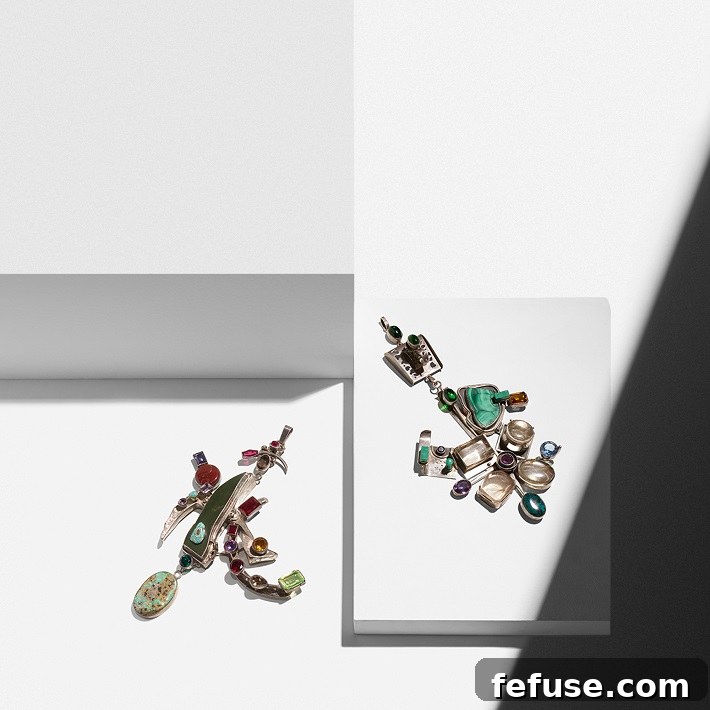
Welcome to an unparalleled exploration into the revolutionary world of studio jewelry, where artistry transcends conventional boundaries and adornment becomes a profound statement. Rago/Wright is proud to announce a landmark auction event, “Structure and Ornament: Studio Jewelry from 1900 to the Present,” a direct and momentous successor to the iconic 1984 exhibition at New York’s Fifty/50 Gallery. Curated once again by the visionary Mark McDonald, who organized the original groundbreaking show, this auction represents a pivotal moment in the appreciation and collection of American modernist studio jewelry, celebrating over a century of innovation, rebellion, and artistic genius.
Redefining Adornment: The Evolution of Studio Jewelry
The 20th century witnessed a seismic shift in the perception and creation of jewelry. Traditionally, jewelry was synonymous with precious metals and rare gemstones, serving primarily as a symbol of status, wealth, and beautification. However, as the century unfolded, a new movement emerged – studio jewelry. This movement dared to challenge established norms, pushing jewelry beyond its decorative function and into the realm of conceptual art. Artists began to experiment with an audacious array of materials, techniques, and philosophies, reflecting and engaging with the rapid cultural, artistic, technological, and societal transformations of the era. This auction precisely captures this exhilarating evolution, presenting works that embody a journey from mere adornment to a vibrant, experimental, and deeply conceptual medium.
The “Structure and Ornament” sale is unprecedented in the United States, marking the first auction dedicated exclusively to studio jewelry. This singular focus underscores the growing recognition of this art form and provides a unique platform for both seasoned collectors and new enthusiasts to engage with its rich history. Mark McDonald, the esteemed owner of the renowned Fifty/50 Gallery, has been intimately involved with these pioneering works since the early 1980s. His deep connections and personal relationships with many of the featured artists and collectors have imbued this curation with an unparalleled sense of authenticity and historical depth. McDonald’s diverse and often provocative curatorial approach aims to highlight “the continuum – the interconnected ideas, techniques, and materials” that link contemporary jewelry designers with their predecessors from a century ago, revealing a fascinating narrative of continuous innovation and shared artistic spirit.
A Century of Innovation: From Wiener Werkstätte to Avant-Garde
The auction’s comprehensive scope spans over a hundred years, showcasing the remarkable breadth and evolution of studio jewelry. Among the earliest and most exquisite pieces is a unique hair comb from 1909, crafted by the illustrious Josef Hoffmann and the Wiener Werkstätte. This piece exemplifies an early radical approach, combining precious gilt silver with the delicate luminescence of mother-of-pearl. A century later, this spirit of unconventional material pairing finds a contemporary echo in an alluring double ring by Cécile Zu Hohenlohe, which boldly unites 22-karat gold with the unexpected brilliance of pyrite. Such juxtapositions are central to the studio jewelry narrative, illustrating a consistent drive to explore new aesthetic territories.
Mastery of Traditional and Experimental Techniques
The collection celebrates both a reverence for ancient craftsmanship and a fearless embrace of modern experimentation. Works by artists such as John Paul Miller, Lisa Gralnick, and Giampaolo Babetto – a prominent figure of the famed Padua School – demonstrate a meticulous revival and reimagination of ancient goldsmithing and intricate enamel techniques. Their creations are testaments to the enduring beauty and complexity achievable through time-honored methods.
Juxtaposed with these traditional masterpieces are groundbreaking experimentations in plastics and other nontraditional materials. Pioneers like Peter Chang, known for his vibrant, sculptural forms; Terhi Tolvanen, with her organic and narrative-driven pieces; and Petra Zimmerman, who masterfully integrates found objects and industrial materials, exemplify the movement’s avant-garde spirit. These artists transformed humble or unconventional materials into objects of profound artistic merit, challenging the very definition of “precious.”
Further pushing the boundaries are artists like Karl Fritsch and Gijs Bakker, whose works deliberately transgress conventional notions of aesthetics, function, and historicism. Fritsch’s often brutalist and unapologetically raw rings, for instance, question traditional beauty standards, while Bakker’s conceptual pieces invite a deeper intellectual engagement, forcing observers to reconsider the relationship between object and wearer, and between jewelry and fine art.
Cross-Pollination with Fine Arts: A Shared Canvas
A significant thread woven throughout the studio jewelry movement, and robustly represented in this sale, is its profound connection and crossover with the fine arts. The auction features stunning examples of jewelry crafted by renowned painters and sculptors, demonstrating that the human form served as yet another canvas for their artistic expression. Luminaries such as Arnaldo Pomodoro, known for his monumental bronzes, bring a sculptural sensibility to wearable art. Beatrice Wood, the “Mama of Dada,” infuses her ceramic jewelry with the same whimsical and rebellious spirit that characterized her larger works. Rolph Scarlett, an abstract painter, translates his dynamic forms into miniature wearable sculptures. Alexandre Noll, celebrated for his carved wood sculptures, applies a similar organic elegance to his jewelry. Claire Falkenstein, known for her intricate metal sculptures, creates jewelry that captures movement and light. And Albert Paley, a master of architectural ironwork, brings his powerful, industrial aesthetic to smaller, intimate forms.
Beyond direct crossovers, the sale also highlights venerated designers whose work was deeply informed by major art movements. Margaret De Patta, for instance, operated within the rigorous and innovative traditions of the Bauhaus, translating its principles of form and function into sophisticated, geometric jewelry. Sam Kramer, conversely, drew inspiration from the subversive and fantastical realms of Dada and Surrealism, creating whimsical, often unsettling, yet undeniably captivating pieces that challenged perception and delighted the imagination. These artists collectively illustrate how studio jewelry became a vital extension of the broader artistic currents of the 20th century, absorbing and reflecting the aesthetic and philosophical shifts of the era.
“Structure and Ornament”: A Landmark Opportunity for Collectors
“Structure and Ornament: Studio Jewelry from 1900 to the Present” offers a truly rare and exceptional opportunity to acquire masterpiece works in a medium that has undergone a remarkable transformation. Over the course of a century, studio jewelry was elevated from the realm of craft to the esteemed status of fine art. It became a potent embodiment of the many incorrigible and enthralling movements that defined the 20th century – from Art Nouveau and Art Deco to Modernism, Abstract Expressionism, and Conceptual Art. Each piece in this collection tells a story, not just of its creator’s vision but of the cultural zeitgeist it emerged from, making it far more than just an accessory; it is a tangible piece of art history.
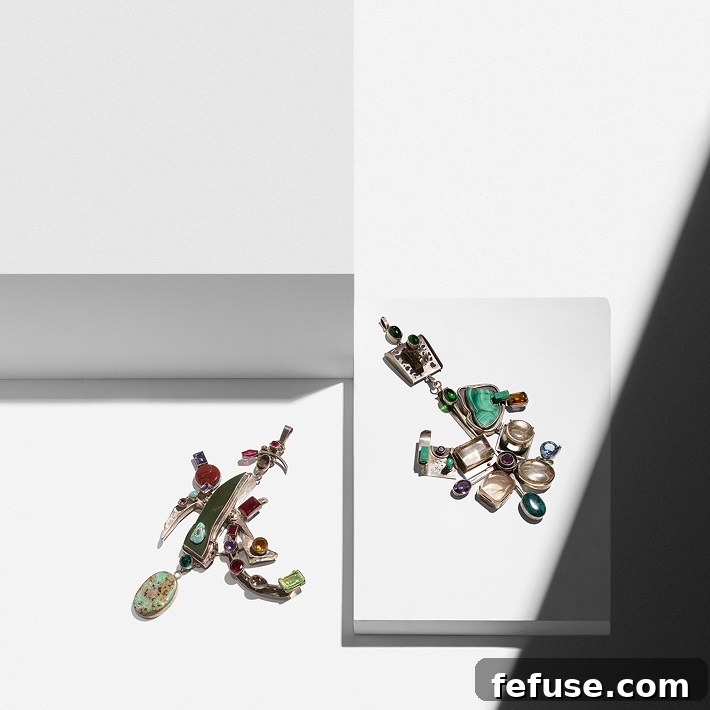
Exhibition and Auction Details
Prospective buyers and enthusiasts are invited to experience these extraordinary works firsthand. An exclusive exhibition will be held at 507 West 27th Street, New York, running from January 31st to February 6th. Viewing hours are Monday through Saturday, from 12 PM to 5 PM, with Sunday appointments available upon request. Following its New York presentation, the full collection will be on public view at Rago in Lambertville, New Jersey, from February 8th to February 12th.
To accompany this monumental sale, a meticulously curated, full-color catalog has been produced. This invaluable resource illustrates each of the featured works in exquisite detail and includes a compelling introduction by Mark McDonald, offering insights into his curatorial vision, alongside an illuminating essay by renowned scholar Toni Greenbaum, providing critical context and historical analysis of the studio jewelry movement. This catalog is an essential companion for collectors and an important scholarly document in its own right.
The highly anticipated auction itself will take place in Lambertville, New Jersey, on February 12th, commencing promptly at 11 AM EST. This event is not merely a sale; it is a celebration of artistic ingenuity, a testament to the enduring power of jewelry as an art form, and an unparalleled opportunity to acquire pieces that have shaped the very landscape of modernist and contemporary design.
A Legacy Forged in Ornament and Innovation
The “Structure and Ornament” auction by Rago/Wright is more than just a collection of beautiful objects; it is a meticulously assembled narrative of artistic evolution, daring experimentation, and profound cultural reflection. Under the expert guidance of Mark McDonald, this sale not only pays homage to the original 1984 exhibition but significantly expands its legacy, solidifying studio jewelry’s rightful place within the pantheon of fine art. By bringing together works that span the entire trajectory of this dynamic movement, from early avant-garde pieces to contemporary masterpieces, the auction offers an invaluable opportunity to understand, appreciate, and invest in a field that continues to captivate and inspire. Whether you are a long-time admirer or new to the world of studio jewelry, this event promises a deep dive into the creativity and innovation that has made this art form so compelling throughout the modern era.