
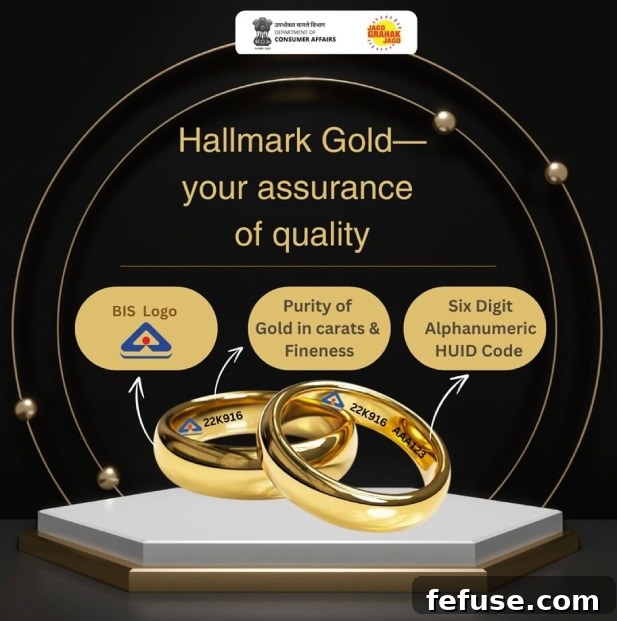
As the auspicious occasion of Dhanteras approaches, signalling the onset of festive gold and silver purchases, the Ministry of Consumer Affairs, Food & Public Distribution has issued a crucial advisory to consumers. This proactive measure aims to safeguard consumer interests, urging individuals to exercise heightened caution and diligently verify the purity of gold and silver jewellery before making any purchases. At the heart of this initiative lies the robust and mandatory hallmarking scheme, meticulously implemented by the Bureau of Indian Standards (BIS), serving as an indispensable guardian of quality and authenticity in the precious metals market.
The Ministry’s unequivocal statement underscores the paramount importance of investing solely in BIS-hallmarked jewellery. This certification is not merely a stamp; it is an ironclad guarantee that the precious metal indeed possesses the declared purity, offering peace of mind to every buyer. To further empower consumers, the Ministry highlighted an accessible and user-friendly tool: the BIS Care App. This innovative application allows consumers to effortlessly verify the authenticity of the hallmark, transforming a complex verification process into a simple tap on their smartphones. This comprehensive scheme is a testament to the government’s commitment to consumer protection, ensuring that every purchase aligns with the declared purity standards and instilling confidence in the Indian jewellery market.
The advisory further extends to practical guidance, recommending that consumers patronise only reputable and established jewellers. It also stresses the critical importance of meticulously examining the hallmark markings on every piece of jewellery. By adhering to these straightforward yet vital guidelines, consumers can make informed decisions, protect their valuable investments, and truly celebrate the spirit of Dhanteras with genuine, certified precious metals. This detailed guide delves deeper into the nuances of BIS hallmarking, smart buying practices, and the comprehensive support available to consumers.
Empowering Your Purchase: A Comprehensive Guide to BIS Hallmarking for Gold & Silver Jewellery
The tradition of buying gold and silver holds profound cultural and economic significance in India, particularly during festive seasons like Dhanteras and Diwali. These precious metals are not just ornaments; they are symbols of prosperity, heirlooms passed down through generations, and tangible investments. However, with the sentimental and financial value attached to these purchases, ensuring their authenticity and purity becomes paramount. This is precisely where the Bureau of Indian Standards (BIS) hallmarking scheme steps in, offering a standardised, reliable mechanism to protect consumers from deceptive practices and ensure they receive exactly what they pay for.
The Cultural & Economic Significance of Precious Metals in India
For centuries, gold and silver have been intertwined with India’s cultural fabric. They adorn deities, mark rites of passage, symbolise wealth at weddings, and are considered auspicious during festivals. Dhanteras, in particular, is synonymous with buying gold and silver, believed to usher in good fortune and prosperity. Beyond cultural practices, these metals represent a significant portion of household savings and investments. Indian families often prefer to invest in physical gold and silver as a hedge against inflation and a secure asset. Given this deep-rooted cultural importance and substantial financial investment, the purity and authenticity of these metals cannot be left to chance.
Why Purity Verification is Non-Negotiable: Understanding the Risks
The market for precious metals, while vibrant, is not without its challenges. The primary concern for consumers is the potential for misrepresentation of purity. Unscrupulous sellers might try to pass off lower purity gold or silver as higher purity, or even mix base metals, thereby defrauding consumers both financially and emotionally. Such practices erode trust in the market and can lead to significant financial losses for buyers. Without a standardised system, verifying the exact composition of an alloy becomes incredibly difficult for an average consumer. This lack of transparency undermines the investment value and the emotional significance attached to the jewellery, highlighting the critical need for a robust regulatory framework.
BIS Hallmarking: Your Unwavering Assurance of Quality and Trust
Recognising the need for consumer protection and market standardisation, the Bureau of Indian Standards (BIS) introduced the hallmarking scheme for gold jewellery in April 2000, and later for silver jewellery. Hallmarking is a quality assurance process where precious metal articles are assayed and certified for their purity and fineness. This scheme provides an independent, third-party guarantee of the purity of gold and silver articles, establishing a uniform standard across the country. The Ministry of Consumer Affairs has been instrumental in making this scheme mandatory in phases, reinforcing its commitment to ensuring fair trade practices and consumer confidence in the jewellery sector.
Decoding the BIS Hallmark: What Each Mark Signifies
A BIS hallmark is not a single stamp but a combination of several marks, each providing crucial information about the jewellery piece. Understanding these components is essential for consumers to confidently identify genuine hallmarked items. Prior to July 1, 2021, the hallmark consisted of four marks. Post this date, a new system was implemented, primarily featuring three marks, with the inclusion of the Hallmark Unique Identification (HUID) number. Let’s break down the current components:
- BIS Logo: This is a triangular mark, the national standard mark, signifying that the jewellery has been certified by the Bureau of Indian Standards. It is the fundamental symbol of authenticity and adherence to national standards.
- Purity Grade/Fineness: This mark indicates the purity of the precious metal in carats (for gold) or fineness (for gold and silver). For gold, common purities are 22K916 (meaning 91.6% pure gold or 22 carat), 18K750 (75% pure gold or 18 carat), and 14K585 (58.5% pure gold or 14 carat). For silver, the purity is often denoted as 999 (99.9% pure) or 925 (92.5% pure, also known as sterling silver). This number directly reflects the quantity of pure precious metal in the alloy.
- Hallmark Unique Identification (HUID) Number: This is a six-digit alphanumeric code unique to each piece of hallmarked jewellery. Introduced to enhance transparency and traceability, the HUID number allows every article to be tracked back to the assaying and hallmarking centre and the jeweller. It’s a game-changer for digital verification and provides an unparalleled level of accountability in the hallmarking process.
Navigating the Mandatory Hallmarking Scheme: A Progressive Implementation
The journey towards mandatory hallmarking has been a progressive one, reflecting the government’s adaptive approach to market dynamics and consumer needs. Initially voluntary, the scheme transitioned to mandatory hallmarking for gold jewellery in identified districts from June 16, 2021, covering specific purities like 14K, 18K, 20K, 22K, 23K, and 24K. Later, in September 2023, the scope was further expanded to cover an additional 56 districts, bringing the total number of mandatory hallmarking districts to 343 across India. This phased implementation ensures that the infrastructure for assaying and hallmarking keeps pace with the demands, progressively bringing more jewellers and regions under the purview of this essential consumer protection measure. For silver jewellery, hallmarking remains voluntary for now, but the BIS continues to encourage its adoption, indicating a future where similar mandatory regulations might apply.
Empowering Consumers: The Indispensable BIS Care App
In line with its mission to empower consumers, the Ministry of Consumer Affairs and BIS have developed innovative tools to simplify the verification process. The flagship of these tools is the ‘BIS Care App’, a mobile application designed to provide instant access to crucial information about hallmarked jewellery. This app is a powerful ally for consumers, enabling them to verify the authenticity of hallmarked gold and silver articles with ease and confidence. By simply entering the HUID number found on the jewellery, users can retrieve detailed information, including the purity of the article, the name of the jeweller who got the article hallmarked, and the assaying and hallmarking centre where it was certified. The app also allows consumers to register grievances, providing a direct channel for feedback and redressal.
Beyond Verification: Additional Features of the BIS Care App
- Verify HUID: This is the primary function, allowing instant authentication of jewellery details.
- Licence Details: Consumers can check the validity and scope of a jeweller’s BIS licence.
- Product Certification: The app also provides information on other BIS-certified products, broadening its utility beyond jewellery.
- Grievance Redressal: A crucial feature allowing consumers to lodge complaints regarding misleading hallmarks or other quality issues, ensuring accountability.
- Know Your Standards: Access to various Indian standards, promoting awareness and understanding.
Essential Tips for Making Smart & Verified Jewellery Purchases
While the BIS hallmarking scheme provides a robust framework, consumers can further protect their interests by adopting smart buying practices. Especially during high-volume purchasing periods like Dhanteras, vigilance is key. Here are some actionable tips to ensure your gold and silver purchases are genuine and provide lasting value:
- Choose Reputable and Licensed Jewellers: Always purchase from well-established jewellers who are BIS-licensed for selling hallmarked articles. Reputable jewellers are more likely to adhere to ethical practices and offer transparent pricing and policies. You can verify a jeweller’s BIS licence on the BIS website or through the BIS Care App.
- Always Insist on a Detailed Invoice/Bill: A proper invoice is your most important document for any gold or silver purchase. It should clearly state the net weight of the gold/silver, the purity (e.g., 22K916), the HUID number, the value of the precious metal, making charges, and applicable taxes. This invoice serves as proof of purchase and is essential for future exchange, resale, or in case of any dispute.
- Visually Inspect the Hallmark Markings: Before completing your purchase, take a moment to carefully examine the hallmark on the jewellery. While the marks can be tiny, they should be clear and legible. Ensure all components of the current BIS hallmark (BIS logo, purity grade, and HUID number) are present and clearly etched.
- Understand the HUID Number: Familiarise yourself with the concept of the HUID number. It’s unique to each piece. If you are buying multiple pieces, each should have its own distinct HUID. Use the BIS Care App to cross-verify the HUID number against the details provided by the jeweller, ensuring consistency and authenticity.
- Ask About Buy-Back Policies: Inquire about the jeweller’s buy-back or exchange policy. Reputable jewellers usually have transparent policies based on the prevailing market rate and the certified purity of the metal. This is an important consideration for the long-term value of your investment.
- Be Aware of Making Charges: Making charges (or craftsmanship charges) are a significant component of the final price. These can vary widely based on the intricacy of the design. Understand how these are calculated (per gram or as a percentage) and compare them across different jewellers.
Beyond Purity: Maximising Your Gold & Silver Investment
While purity is paramount, a smart consumer also considers other aspects to maximise their investment. Market rates for gold and silver fluctuate daily; staying informed about these trends can help in timing your purchase. Discussing the weight of the precious metal separately from stones (if any) is also crucial. Ensure that the bill clearly itemises the weight and value of the metal versus any precious or semi-precious stones embedded in the jewellery. This clarity prevents overpaying for non-metal components and ensures the true value of your gold or silver is reflected.
Consumer Protection and Grievance Redressal: Your Rights
The mandatory hallmarking scheme is backed by robust legal provisions. If a consumer discovers that their hallmarked jewellery is of a lower purity than declared, they have legal recourse. The BIS (Hallmarking) Regulations provide for assaying and hallmarking centres to certify the purity. If a complaint arises, the article can be re-tested at any BIS-recognised Assaying & Hallmarking Centre. If the purity is found to be deficient, the jeweller is liable to compensate the consumer for the shortfall in purity, along with any testing charges. This mechanism ensures accountability and instils trust in the hallmarking system, offering a clear path for redressal.
Conclusion: Invest Wisely, Celebrate Safely This Festive Season
Dhanteras and other festive occasions are times of joy and celebration, often marked by the cherished tradition of buying gold and silver. By heeding the Ministry of Consumer Affairs’ advisory and embracing the power of BIS hallmarking, consumers can transform these significant purchases into confident and secure investments. The mandatory hallmarking scheme, supported by tools like the BIS Care App and clear guidelines, is a beacon of transparency in the precious metals market. Make it a practice to insist on BIS-hallmarked jewellery, verify its authenticity, and obtain a detailed invoice. By doing so, you not only protect your financial interests but also uphold the sanctity of these treasured traditions, ensuring your celebrations are adorned with genuine brilliance and enduring value. Invest wisely, celebrate safely, and cherish the true purity of your precious metal purchases.