
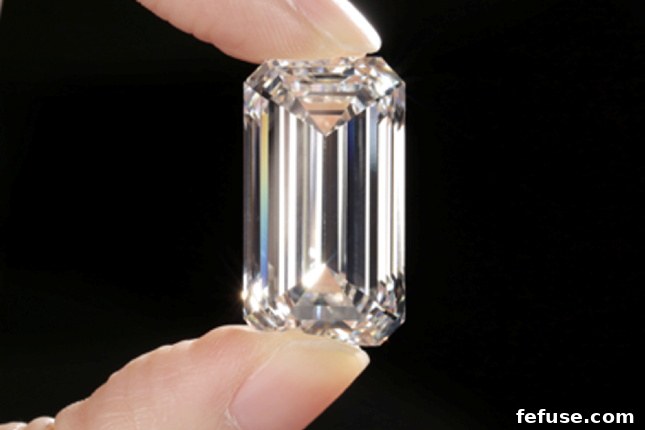
The world of diamonds is witnessing an extraordinary evolution, with lab-grown diamonds increasingly challenging conventional perceptions of size, quality, and origin. A groundbreaking development has recently been announced by the Gemological Institute of America (GIA), which has graded its largest ever lab-grown polished diamond. This monumental stone is an astonishing 34.59-carat emerald-cut diamond, boasting impressive G color and VS2 clarity. This record-shattering achievement not only highlights the remarkable advancements in diamond synthesis technology but also underscores the growing prominence of lab-grown diamonds in the global market.
Produced by Ethereal Green Diamond, an innovator in India’s burgeoning lab-grown diamond industry, this magnificent gem represents a significant leap forward. Its sheer size is particularly notable, as it is more than double the weight of the previous record holder – a 16.41-carat princess-cut diamond that was graded by GIA in January 2022, originating from Shanghai Zhengshi Technology in China. This rapid escalation in size within a relatively short period speaks volumes about the accelerated pace of technological innovation in this specialized field.
The dimensions of this colossal 34.59-carat stone are equally impressive, measuring 24.94mm x 13.95mm x 9.39mm. Its grading took place at GIA’s state-of-the-art laboratory in Hong Kong, a testament to GIA’s global reach and its expertise in evaluating both natural and laboratory-grown diamonds with the highest standards of precision and impartiality. The meticulous examination by GIA ensures that consumers and industry professionals alike can trust the authenticity and characteristics of these remarkable stones.
At the heart of these advancements lies Chemical Vapor Deposition (CVD) technology. The GIA, a universally recognized authority in gemology, has explicitly stated that there have been significant and continuous improvements in CVD synthesis methods. CVD is a sophisticated process where diamonds are grown in a vacuum chamber, starting from a tiny diamond seed. Carbon-rich gases are introduced into the chamber, and under precise conditions of temperature and pressure, carbon atoms detach from the gas and deposit onto the seed, atom by atom, gradually forming a larger diamond crystal. This method allows for greater control over the diamond’s growth environment, leading to larger and purer crystals over time.
Tom Moses, GIA’s executive vice president and chief laboratory and research officer, encapsulated the industry’s sentiment regarding this breakthrough. He remarked, “This more than two-fold increase in size within one year is an impressive technical achievement in CVD diamond growth.” His statement not only acknowledges the scientific prowess behind such an accomplishment but also highlights the incredibly fast progression of this technology. Such rapid evolution signals a new era for the diamond industry, where the boundaries of what is possible in diamond creation are continually being redefined.
Moses further emphasized a critical aspect of this expanding market: “With such production improvements, correct identification and disclosure are critical to maintaining consumer trust.” This sentiment underscores GIA’s unwavering commitment to transparency and ethical practices within the diamond trade. As lab-grown diamonds become increasingly sophisticated and indistinguishable from natural diamonds to the untrained eye, the role of independent grading laboratories like GIA becomes paramount. They provide the necessary verification and detailed reporting to ensure consumers are fully informed about their purchases, differentiating between earth-mined and laboratory-created gems.
The GIA’s comprehensive analysis of the 34.59-carat diamond extended beyond its basic characteristics, delving into its unique identifying features. Researchers meticulously examined the stone, and their findings were documented in a research note published in GIA’s prestigious Gems & Gemology journal. Among the observations were small black graphite inclusions. These inclusions were noted to appear both along the inside of the diamond’s body and, in other instances, formed clusters of clouds between its growth layers. These subtle internal characteristics are invaluable for gemologists in distinguishing the origin and growth process of diamonds.
Further microscopic observation revealed another intriguing characteristic: a weak “oily” or wavy graining when viewed through the table facet of the diamond. This particular feature, while not exclusive, is sometimes observed in CVD laboratory-grown diamonds. Such graining can be a tell-tale sign of the specific growth conditions and stresses experienced during the diamond’s formation in a controlled environment. Understanding these distinctive features is vital for gemologists and ensures that the diamond’s identity as lab-grown is accurately established and disclosed.
The emergence of such a large and high-quality lab-grown diamond signifies a pivotal moment for the industry. It demonstrates that producers are not only capable of creating significant carat weights but are also achieving exceptional standards of color and clarity that rival those found in nature. This advancement expands the possibilities for jewelry designers and consumers alike, offering a wider array of choices for engagement rings, statement pieces, and investment-grade gems.
Ethereal Green Diamond’s achievement also places India firmly at the forefront of lab-grown diamond production. While traditionally known for its diamond cutting and polishing industry for natural stones, India is rapidly diversifying its expertise into the synthesis of these technologically advanced gems. This shift not only creates new economic opportunities but also positions India as a key player in shaping the future trajectory of the global diamond market. The ability to produce such large, high-quality diamonds locally enhances the country’s manufacturing capabilities and technological prowess.
The growth of the lab-grown diamond market is propelled by several factors, including increasing consumer demand for ethically sourced and environmentally responsible alternatives. Many consumers are drawn to lab-grown diamonds because they offer the same physical, chemical, and optical properties as natural diamonds, yet often come with a more attractive price point and a clear origin story. The narrative of sustainability and reduced environmental impact associated with lab-grown diamonds resonates strongly with a modern, conscious consumer base.
However, with great progress comes increased responsibility. The importance of robust grading systems and transparent disclosure, as highlighted by GIA’s Tom Moses, cannot be overstated. Maintaining clear distinctions and providing comprehensive information about the origin of each diamond is essential for preserving the integrity of both the natural and lab-grown diamond markets. Consumers need to be confident that they are purchasing exactly what they intend, whether it is a stone formed over billions of years deep within the Earth or one meticulously cultivated in a technologically advanced laboratory.
Looking ahead, this record-breaking 34.59-carat diamond is likely just a precursor to even larger and more flawless lab-grown gems. The continuous refinement of CVD technology, coupled with ongoing research and development, suggests that the ceiling for lab-grown diamond size and quality is still far from being reached. This ongoing innovation promises to make high-carat diamonds more accessible to a broader audience, potentially democratizing luxury and shifting long-held perceptions about rarity and value within the diamond world.
In conclusion, the GIA’s grading of the 34.59-carat emerald-cut lab-grown diamond marks an indelible milestone in the history of gemology. It stands as a powerful testament to human ingenuity and the rapid pace of technological innovation, particularly in CVD diamond synthesis. This achievement not only redefines the possibilities for large, high-quality lab-grown diamonds but also reinforces the critical role of organizations like GIA in ensuring accuracy, transparency, and consumer trust in an ever-evolving market. As lab-grown diamonds continue to grow in size and sophistication, their presence will undoubtedly shape the future landscape of the global jewelry industry, offering exciting new avenues for both producers and consumers alike.